
Blade Application Guides / Application Guide / Electronics recycling
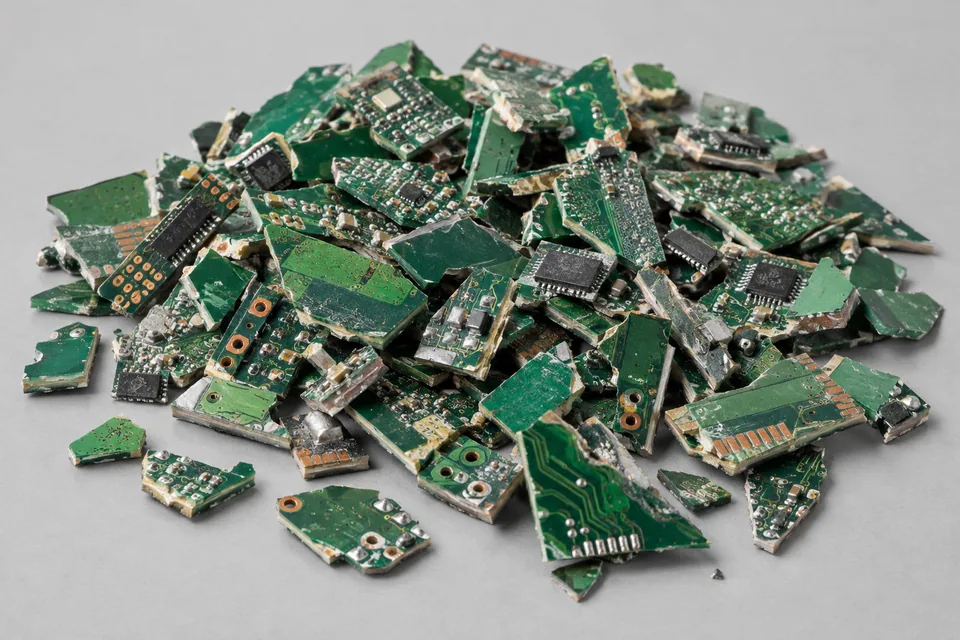
Printed Circuit Board Scrap Secondary Shredder Knives
Secondary shredding accepts board pieces that have already been opened or cut to a manageable size. The aim is to reduce oversized fragments and long tails before a sizing or separation stage, while controlling repeated passes, wrapping and heat. It should not be described as primary feeding of whole assemblies, nor as the final liberation step. Supply an actual sample of upstream product and a target size distribution for the next stage before evaluating rotor knives, counterknife fit or any screen.
Updated
Where This Cutting Application Appears
Defined upstream feed
Sample the primary shredder output by size, board composition and attached flexible pieces. Oversized items that bypassed the first stage may need removal or controlled recirculation rather than a tighter secondary cutter gap.
Reducing tails and mixed fragments
Check the length and proportion of uncut tails as well as a simple top-size limit. Compare incoming and discharged distributions at a steady feed rate, and identify whether long pieces repeatedly escape the cut zone.
Knife interface and residence
Review rotor knife condition, overlap with the stationary edge or mating shaft, and any screen that retains material. Excessive residence or a blocked discharge can raise temperature and make the sample unrepresentative.
Transfer to the next process
Inspect discharge uniformity and whether tangled wires or fibers agglomerate after cutting. The next granulator or separator should receive material within its stated feed envelope, without hidden large fragments.
Define the Required Cut Result
- Reduce primary fragments to the agreed medium-size distribution.
- Control uncut tails and wrapped material.
- Maintain stable discharge at the trial feed rate.
- Keep product temperature and dust within the site’s process controls.
Problems to Diagnose Before Changing the Knife
Long tails remain in the secondary product
- Trace them to upstream feed and material type.
- Inspect knife overlap, worn edges and counterknife location.
- Check whether tails bypass the active cut or screen.
Material wraps or stalls after a stable start
- Look for cables and flexible laminates in the feed sample.
- Inspect shaft ends and discharge restriction.
- Compare feed rate before and after the event.
Product temperature rises during repeated passes
- Measure residence and recirculation rate.
- Check screen blockage and discharge airflow.
- Review cutter condition and load trend with site operators.
Knife Forms That May Be Considered
| Possible knife form | When it may be considered | What must be confirmed |
|---|---|---|
| Rotor knife and counterknife set | For secondary cutting on a compatible single-rotor machine. | Confirm mounting, measured interface, wear state and output sample. |
| Intermeshing secondary cutter set | For an existing multi-shaft line requiring a smaller fragment target. | Confirm shaft geometry, cutter spacing, screen/discharge and wrapping behavior. |
Information to Send for Technical Review
You do not need to know the exact blade name. Send the available workpiece, machine, current-knife and cut-result information so the application can be reviewed against a drawing or sample.
- Representative primary-stage product and size distribution
- Board and attachment composition
- Required secondary top size and tail allowance
- Rotor, shaft and counterknife drawings
- Actual knife overlap and wear condition
- Screen or classifier opening where used
- Feed rate, recirculation and discharge route
- Temperature, dust and wrapping observations
- Next-stage acceptance limits
Questions About This Cutting Application
Why sample the upstream product?
Secondary cutter performance depends on the fragments it receives, including long tails, wires and mixed laminate pieces.
Does smaller output always improve recycling?
No. Further reduction adds energy use and fines. Match size to the next separation or granulation requirement.
Is a screen always part of secondary shredding?
Machine arrangements vary. Confirm the actual line drawing and inspect any screen or classifier that controls residence.
What makes this stage different from primary shredding?
It starts with already opened fragments and targets a controlled smaller distribution, rather than accepting whole incoming boards.
Public references and scope
These public sources provide material, cutting-method or safety context for this guide. Supplier pages describe their own materials or equipment; they do not establish a MEIRENTE blade specification or performance claim. Confirm the actual grade, machine setup and required cut with a drawing or sample.
Related product and service information
- Electronics Foam Gasket Cutting - electronics foam gasket stock · kiss cutting and profiling
- Printed Circuit Board Scrap Primary Shredder Knives - printed circuit board scrap · primary shredding
- Multilayer Pouch Production Waste Secondary Shredder Knives - multilayer pouch production waste · secondary shredding
Request a Custom Cutting-Knife Review
Send the workpiece details, machine or holder information, current knife photos or sample, required quantity and examples of the present cut problem. Final dimensions, material, edge geometry and tolerances are confirmed from the approved requirements.