
Blade Application Guides / Application Guide / Electronics recycling
Printed Circuit Board Scrap Primary Shredder Knives
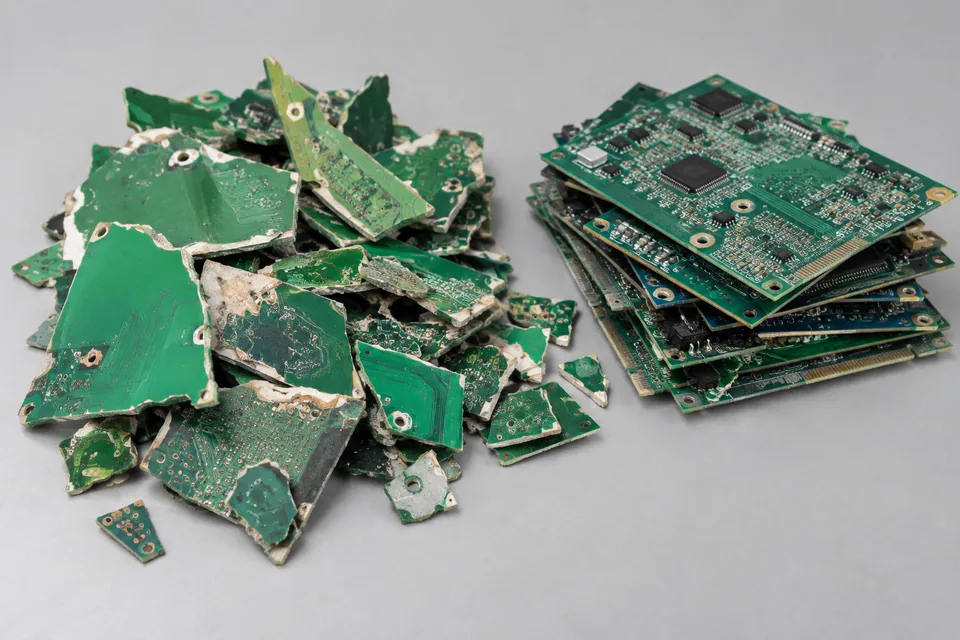
Primary shredding is the first mechanical opening of incoming printed circuit board scrap. Its job is to make feedable coarse fragments for the next operation, not to produce a clean final metal fraction. Bare boards, populated assemblies, attached cables and batteries present different feed questions, so the buyer must identify and sort the actual incoming stream before a cutter arrangement is discussed. A trial should track feed behavior, large-fragment distribution, bridging, wrapping, heat and dust at both the cutting chamber and discharge.
Updated
Where This Cutting Application Appears
Accepting the incoming board stream
Describe the largest board dimensions, thickness, component population and attached materials. Agree which items are removed before feeding and what constitutes an unacceptable foreign object. A cutter drawing cannot compensate for an undefined input mix.
Coarse opening at the first stage
Observe how rotary cutters engage whole boards or pre-cut panels against the counterknife or mating cutters. Record the first-pass fragment-size distribution and the portion that needs recirculation; the target must fit the next machine’s feed opening.
Bridging and wrapping control
Check whether broad panels bridge above the cutters and whether wires or flexible layers wrap around shafts. Compare the feed rate and orientation that triggered the event with stable conditions before changing cutter shape.
Containment and discharge
Capture representative coarse product and generated dust. Inspect the discharge path for retained pieces and elevated temperature. Site controls for mixed-material dust and any hazardous components belong to the whole recycling line, not to a knife specification alone.
Define the Required Cut Result
- Open the defined incoming board stream without chronic feed bridges.
- Produce coarse fragments accepted by the next reduction stage.
- Limit wrapping and uncut large pieces under the agreed trial conditions.
- Keep generated dust and suspect components within the site’s handling controls.
Problems to Diagnose Before Changing the Knife
Whole boards bridge above the cutting zone
- Compare board dimensions and feed orientation with chamber opening.
- Check hopper geometry and feed-assist settings.
- Measure how often a stoppage occurs per representative input lot.
Wires or laminates wrap on a shaft
- Identify the incoming attachment that started wrapping.
- Inspect cutter-to-counterknife interaction and accessible clearance.
- Check the pre-sort plan and safe clearing procedure.
Unexpected fine dust appears in coarse output
- Compare dust by board construction and component population.
- Inspect cutter wear and repeated recirculation.
- Review enclosure and extraction at feed and discharge.
Knife Forms That May Be Considered
| Possible knife form | When it may be considered | What must be confirmed |
|---|---|---|
| Intermeshing rotary shredder cutters | For coarse opening where the actual machine uses paired shafts. | Confirm shaft layout, cutter pitch, counter-elements and feed trial on representative boards. |
| Single-rotor cutter with counterknife | For coarse reduction on a compatible single-shaft machine. | Confirm rotor, counterknife, screen or discharge arrangement and accepted coarse output. |
Information to Send for Technical Review
You do not need to know the exact blade name. Send the available workpiece, machine, current-knife and cut-result information so the application can be reviewed against a drawing or sample.
- Board type, construction and component population
- Maximum incoming board size and thickness
- Attached cables, connectors or other materials and pre-sort rules
- Feed rate and machine chamber/shaft drawings
- Coarse fragment target and next-stage feed limit
- Existing cutter and counterknife arrangement
- Observed bridging, wrapping and wear records
- Dust, temperature and discharge controls
- Representative samples and trial inspection plan
Questions About This Cutting Application
Will primary shredding liberate every metal from the board?
No. This stage opens and reduces whole boards to a feedable coarse product. Liberation and separation must be judged across the later line stages.
Can cutters be selected from the board outline alone?
No. Board construction, attachments, thickness, feed rate, machine layout and downstream target all affect the trial.
What is the first acceptance check?
Confirm the incoming stream is compatible with the machine and pre-sort rules, then measure feed stability and coarse product distribution.
Why record dust at a coarse stage?
Even early mechanical opening of mixed board materials can release fines; the site must assess capture and handling alongside the cutter trial.
Public references and scope
These public sources provide material, cutting-method or safety context for this guide. Supplier pages describe their own materials or equipment; they do not establish a MEIRENTE blade specification or performance claim. Confirm the actual grade, machine setup and required cut with a drawing or sample.
Related product and service information
- Printed Circuit Board Scrap Secondary Shredder Knives - printed circuit board scrap · secondary shredding
- Multilayer Pouch Production Waste Primary Shredder Knives - multilayer pouch production waste · primary shredding
- Flexible Printed Circuit Scrap Fine-Crusher Knives - flexible printed circuit scrap · fine crushing
Request a Custom Cutting-Knife Review
Send the workpiece details, machine or holder information, current knife photos or sample, required quantity and examples of the present cut problem. Final dimensions, material, edge geometry and tolerances are confirmed from the approved requirements.