
Blade Application Guides / Application Guide / Plastic recycling
Multilayer Pouch Production Waste Secondary Shredder Knives
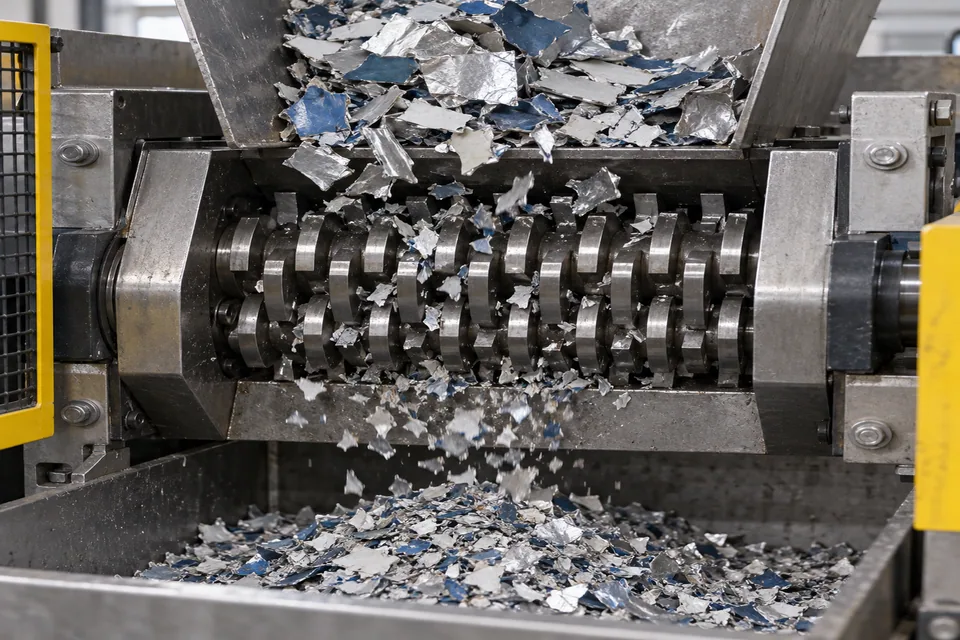
Secondary shredding is a conditional second size-reduction pass, not a mandatory machine for every multilayer pouch waste line. EREMA documents recycling of multilayer production films; ZERMA shows shredders and granulators can be combined in different arrangements, while Vecoplan describes re-shredders for controlled output size. The feed here is pre-sorted, coarsely shredded flexible laminate—not whole filled pouches. The objective is to remove long tails and oversized folded pieces so the next granulator can be fed evenly. A second shred cannot separate PET from PE or make the material chemically compatible. It can also make unnecessary fines or heat if the first output already meets granulator acceptance. Require a route drawing and a trial with the actual laminated waste before specifying knives or screen openings.
Updated
Where This Cutting Application Appears
Verify that a second pass is needed
Sample the primary discharge for longest strips, clumps, folded layers and bulk density. Compare it with the granulator or wash-line inlet. Use a defined oversize limit rather than adding a stage merely because the process list contains one.
Meter coarse feed into the rotor
Prevent a sudden carpet of film from smothering the shredder. Record inlet size, rotor and counterknife arrangement, screen choice, return path and conveyor rate. Review whether prior print ink or hot-melt sealing edges smear at the contact surfaces.
Grade the second-stage pieces
Measure distribution and count ribbons that could wrap the next auger or cutter. Inspect heat-softened clumps, delaminated fringes, dust and particles from tool wear. Compare output with the same material before this stage so the benefit of the second cut is visible.
Match granulator response
Feed a short qualified batch to the downstream knife granulator. If it accepts the primary output without starvation or plugging, document that finding. If the second pass improves feed stability, preserve the knife and screen setup with lot traceability.
Define the Required Cut Result
- Reduce oversize tails only to the downstream feed target.
- Avoid heat-smearing and excess fines from repeated cutting.
- Maintain known pouch-laminate stream identity.
- Deliver stable granulator or washing-line feed.
Problems to Diagnose Before Changing the Knife
Oversize ribbons persist
- Inspect screen condition and bypass.
- Review rotor/counterknife wear.
- Check whether input arrives folded or rolled.
Pieces fuse into warm clumps
- Measure temperature through the second pass.
- Review residence time and blade friction.
- Compare first and second stage feed rates.
Dust rises with no feed benefit
- Check screen size against downstream requirement.
- Review number of recirculation passes.
- Consider bypassing the second stage in a buyer trial.
Knife Forms That May Be Considered
| Possible knife form | When it may be considered | What must be confirmed |
|---|---|---|
| Re-shredder rotor and counterknife set | When primary pieces exceed the downstream acceptance size. | Confirm mounted geometry, screen choice and tail reduction on actual waste. |
| Low-speed multi-shaft cutter set | Where a staged plant uses shear-cut shafts to shorten coarse ribbons. | Confirm anti-wrap discharge and that added fines stay within buyer criteria. |
Information to Send for Technical Review
You do not need to know the exact blade name. Send the available workpiece, machine, current-knife and cut-result information so the application can be reviewed against a drawing or sample.
- Primary shred size distribution and oversize definition
- Actual pouch laminate and lot segregation plan
- Second-stage machine and rotor/counterknife drawings
- Screen/opening and recirculation route
- Granulator or washer inlet acceptance
- Allowed dust, heat and metal-wear particles
- Conveyor metering and surge limits
- Before/after trial sampling method
Questions About This Cutting Application
Does every pouch waste line need secondary shredding?
No. Use it only when coarse pieces do not meet the next machine’s feed requirement.
Can this step delaminate polymers?
No. It mainly shortens composite film pieces; separation needs a distinct process.
What is a useful acceptance test?
Compare long-tail count and downstream feed stability before and after the second pass.
Why monitor heat?
Repeated cuts may soften sealant or polymer layers and make clumps or buildup.
Does a smaller piece ensure recyclable resin?
No. Compatibility and final material quality depend on the whole recycling line.
Public references and scope
These public sources provide material, cutting-method or safety context for this guide. Supplier pages describe their own materials or equipment; they do not establish a MEIRENTE blade specification or performance claim. Confirm the actual grade, machine setup and required cut with a drawing or sample.
Related product and service information
- ABS Sheet Cut To Size Blades - ABS sheet · cut to size
- Multilayer Pouch Production Waste Primary Shredder Knives - multilayer pouch production waste · primary shredding
- Printed Circuit Board Scrap Secondary Shredder Knives - printed circuit board scrap · secondary shredding
Request a Custom Cutting-Knife Review
Send the workpiece details, machine or holder information, current knife photos or sample, required quantity and examples of the present cut problem. Final dimensions, material, edge geometry and tolerances are confirmed from the approved requirements.