
Blade Application Guides / Application Guide / Plastic recycling
Multilayer Pouch Production Waste Primary Shredder Knives
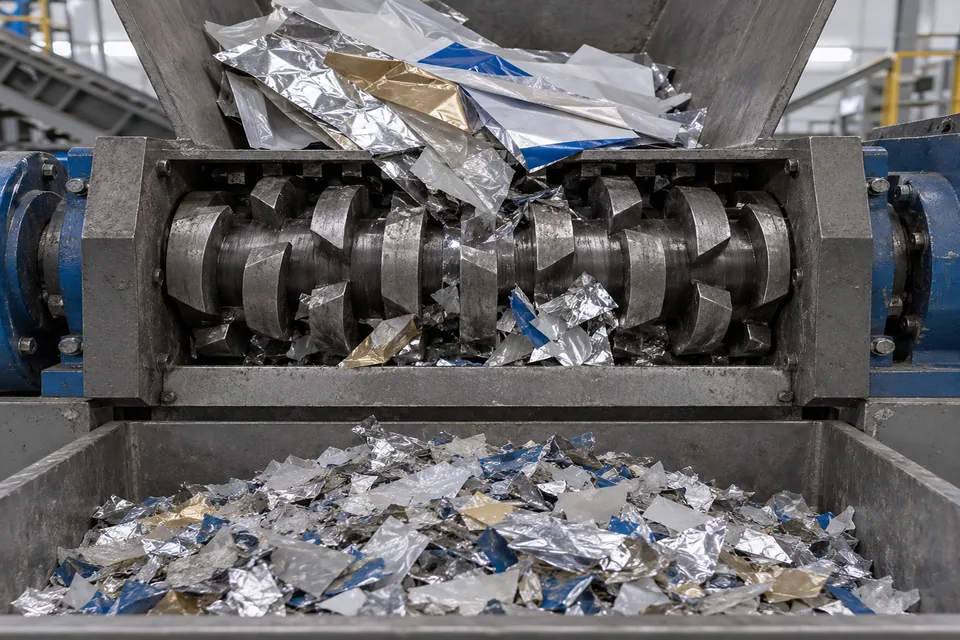
Multilayer pouch production waste may include clean rejected webs, printed trim, zipper offcuts and rejected empty packages. POLYSTAR documents post-industrial laminated film waste from bag making, and EREMA describes recycling challenging multilayer production films. Primary shredding is the first coarse size-reduction stage for bulky, low-density scrap. Its purpose is to turn irregular web or pouch offcuts into pieces that can feed the next stage without wrapping or bridging; it does not separate polymer layers, remove inks or create saleable pellets. Identify the exact PE, PP, PET, PA or EVOH construction and keep incompatible streams apart. Because loose film can wind around rotors, knife selection must be based on the feed form, installed shredder and a real material trial. Output acceptance concerns coarse piece consistency and safe downstream feed, not final resin quality.
Updated
Where This Cutting Application Appears
Define the incoming scrap stream
Sort rejected pouch bodies, roll edges and start-up web by known laminate recipe and print state. Remove non-film items such as metal clips, labels, cores or floor sweepings before the hopper. A mixed stream can hide a rigid contaminant that chips a rotor knife or changes downstream melt behavior.
Feed bulky film without wrapping
Record whether material arrives loose, wound, compacted or in piles. Trial rotor speed, counterknife gap, hopper push and screen or discharge opening on the actual waste. Watch for film loops bridging over the inlet, winding around a shaft or packing in a corner.
Inspect the coarse discharge
Check for long ribbons, fully opened pouches, large folded sheets and excessive small dust. A first shred should reliably expose and reduce bulky pieces, not force an unnecessarily fine cut. Label output by feed lot and reject any foreign material carried through.
Protect the next reduction step
Run coarse pieces through the planned second shredder or granulator feed. Compare surge behavior, bridging and carryover. If the downstream machine accepts the coarse output directly, an extra intermediate stage may be unnecessary; the buyer defines that route.
Define the Required Cut Result
- Convert bulky pouch scrap into manageable coarse pieces.
- Limit wrapping, bridging and unnecessary dust.
- Keep material recipe and contamination status traceable.
- Supply consistent feed to the chosen next stage.
Problems to Diagnose Before Changing the Knife
Long film tails remain in the discharge
- Check screen or discharge opening.
- Inspect knife sharpness and counterknife gap.
- Review film orientation and feed rate.
Web wraps around the rotor
- Inspect infeed geometry and pre-cut roll form.
- Review rotor speed and shaft clearances.
- Use a buyer material trial before changing tool design.
Hard inclusions damage a knife
- Trace feed sorting and metal detection.
- Inspect reject-bin discipline.
- Review upstream roll cores and pouch closures.
Knife Forms That May Be Considered
| Possible knife form | When it may be considered | What must be confirmed |
|---|---|---|
| Low-speed shredder rotor knives with counterknife | For bulky flexible pouch scrap on an installed high-torque shredder. | Confirm holder dimensions, gap, wear and coarse output using actual laminate waste. |
| Four-shaft shear-cutter set | Where the plant already uses paired shafts to pull in irregular flexible waste. | Confirm cutter geometry, anti-wrap behavior and allowed foreign-object content. |
Information to Send for Technical Review
You do not need to know the exact blade name. Send the available workpiece, machine, current-knife and cut-result information so the application can be reviewed against a drawing or sample.
- Exact pouch laminate recipes and incompatible-stream rules
- Input form: loose, roll, bale or rejected pouches
- Maximum feed size and hourly variability
- Rotor/counterknife and screen drawings
- Accepted coarse output and maximum long-tail criterion
- Known closures, labels and foreign materials
- Metal detection and sorting plan
- Downstream machine feed specification
Questions About This Cutting Application
Does shredding separate laminate layers?
No. It reduces size while the polymer, barrier and adhesive layers largely remain together.
Should the first stage make final flakes?
Usually its job is reliable coarse feed; the buyer must define the complete reduction route.
Why distinguish pouch waste from consumer waste?
Clean known production scrap has more traceable recipes and usually different contamination controls.
What causes flexible film to wrap?
Long sheets or ribbons may catch rotating parts when feed shape, discharge and knife action are mismatched.
What proves reuse of the output?
The recycler must qualify sorting, washing, extrusion and the final material separately.
Public references and scope
These public sources provide material, cutting-method or safety context for this guide. Supplier pages describe their own materials or equipment; they do not establish a MEIRENTE blade specification or performance claim. Confirm the actual grade, machine setup and required cut with a drawing or sample.
Related product and service information
- Multilayer Pouch Production Waste Secondary Shredder Knives - multilayer pouch production waste · secondary shredding
- Printed Circuit Board Scrap Primary Shredder Knives - printed circuit board scrap · primary shredding
- Single-Use Bioreactor Bag Film Roll Slitting Blades - single-use bioreactor bag film · roll slitting
Request a Custom Cutting-Knife Review
Send the workpiece details, machine or holder information, current knife photos or sample, required quantity and examples of the present cut problem. Final dimensions, material, edge geometry and tolerances are confirmed from the approved requirements.