
Blade Application Guides / Application Guide / Electronics recycling
Flexible Printed Circuit Scrap Fine-Crusher Knives
Fine crushing is a later size-reduction step after flexible-circuit scrap has been opened and sized upstream. Its purpose must be tied to a downstream liberation or classification requirement, because making the fraction finer can also create more dust and heat. A cutting knife is relevant only if the installed fine-stage machine actually has a cutting rotor and mating edge. An impact mill or disc pulverizer needs its own wear parts instead; identify the mechanism before quoting a blade.
Updated
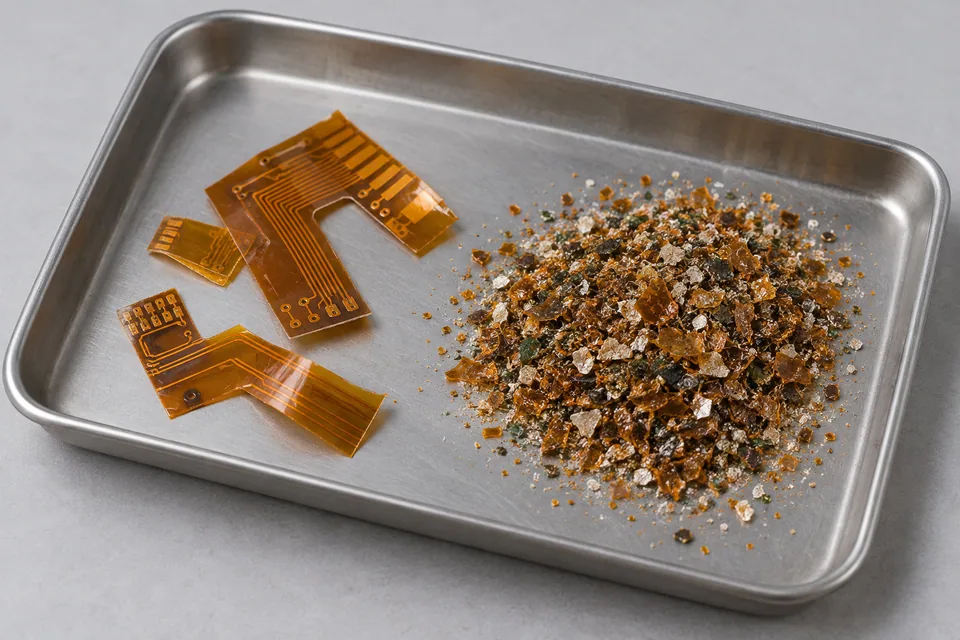
Where This Cutting Application Appears
Start from a measured feed
Use a granulated or otherwise conditioned feed sample with known size range and layer construction. Exclude oversized pieces that fall outside the fine-stage feed specification. Record any residual components or foreign metal separately.
Define the final fraction
Set the target size distribution, maximum coarse residue and maximum fines using the downstream classifier or recovery process. Inspect whether copper and polymer have separated to the required degree; particle size by itself does not prove liberation.
Identify the machine wear set
Read the machine drawing before calling any component a knife. A cutting rotor, fixed edge, impact element and classifier each require different replacement parts and settings. Record the actual cutting gap or impact clearance only where that machine design provides one.
Run a controlled heat and dust check
Sample the discharge at repeatable intervals and track temperature, extraction performance and accumulation. Fine dry particles need the site-specific control plan. Stop the trial if the machine exceeds its documented operating limits.
Define the Required Cut Result
- Deliver the specified fine-fraction distribution to the downstream process.
- Meet a measured material-liberation criterion when one is required.
- Limit unwanted ultrafines, dust accumulation and temperature rise.
- Specify a replacement wear part that matches the actual machine mechanism.
Problems to Diagnose Before Changing the Knife
Fine fraction still contains coarse bonded pieces
- Measure the coarse residue and inspect representative cross-sections.
- Check feed size, wear-set condition and classifier or screen bypass.
- Compare the observed result with the actual downstream recovery target.
Excess ultrafines appear after adjustment
- Compare particle-size distributions before and after the setting change.
- Check residence time, feed rate and classifier setting.
- Review whether the liberation target already was met at the coarser setting.
Temperature rises during fine reduction
- Inspect load, airflow and wear-set condition under site procedures.
- Check whether upstream feed size or composition changed.
- Record temperature by location rather than relying on one reading.
A proposed knife does not match the equipment
- Identify whether the machine cuts, shears or impacts the feed.
- Compare part drawings, mounts and adjustment method.
- Ask the machine owner to approve the correct wear-part type.
Knife Forms That May Be Considered
| Possible knife form | When it may be considered | What must be confirmed |
|---|---|---|
| Fine-stage cutting rotor and mating edge | Only if the installed fine crusher uses a true cutting interface. | Confirm both parts, mounting and permissible gap from the OEM drawing. |
Information to Send for Technical Review
You do not need to know the exact blade name. Send the available workpiece, machine, current-knife and cut-result information so the application can be reviewed against a drawing or sample.
- Measured upstream feed-size distribution
- Layer stack and contaminant description
- Required fine and ultrafine size bands
- Downstream liberation or separation criterion
- Machine make, model and wear-part drawings
- Screen or classifier arrangement and current settings
- Temperature, dust-extraction and load records
Questions About This Cutting Application
Can every fine crusher accept a blade?
No. An impact mill or disc pulverizer does not use a rotor-and-bed-knife pair. Confirm the OEM mechanism; this guide applies to replacement knives only on a cutting-type fine stage.
Is smaller particle size always better for copper recovery?
No. The downstream separation process sets the useful size range; excessive fines can create collection and handling problems.
How is fine crushing different from granulating?
Granulating makes a screened granule fraction with a rotor and bed-knife interface. Fine crushing is a later, equipment-dependent step aimed at a finer specified fraction.
What shows adequate liberation?
Use the downstream separation criterion and representative particle inspection, not visual size alone.
What must be monitored during a trial?
Record feed and output distributions, temperature, dust collection, machine load and wear-set condition.
Public references and scope
These public sources provide material, cutting-method or safety context for this guide. Supplier pages describe their own materials or equipment; they do not establish a MEIRENTE blade specification or performance claim. Confirm the actual grade, machine setup and required cut with a drawing or sample.
Related product and service information
- Conductive Fabric Shielding Tape Kiss-Cutting Blades - conductive fabric shielding tape · kiss cutting
- Printed Circuit Board Scrap Fine Crusher Knives - printed circuit board scrap · fine crushing
- Multilayer Pouch Production Waste Fine Crusher Knives - multilayer pouch production waste · fine crushing
Request a Custom Cutting-Knife Review
Send the workpiece details, machine or holder information, current knife photos or sample, required quantity and examples of the present cut problem. Final dimensions, material, edge geometry and tolerances are confirmed from the approved requirements.