
Blade Application Guides / Application Guide / Electronics recycling
Printed Circuit Board Scrap Fine Crusher Knives
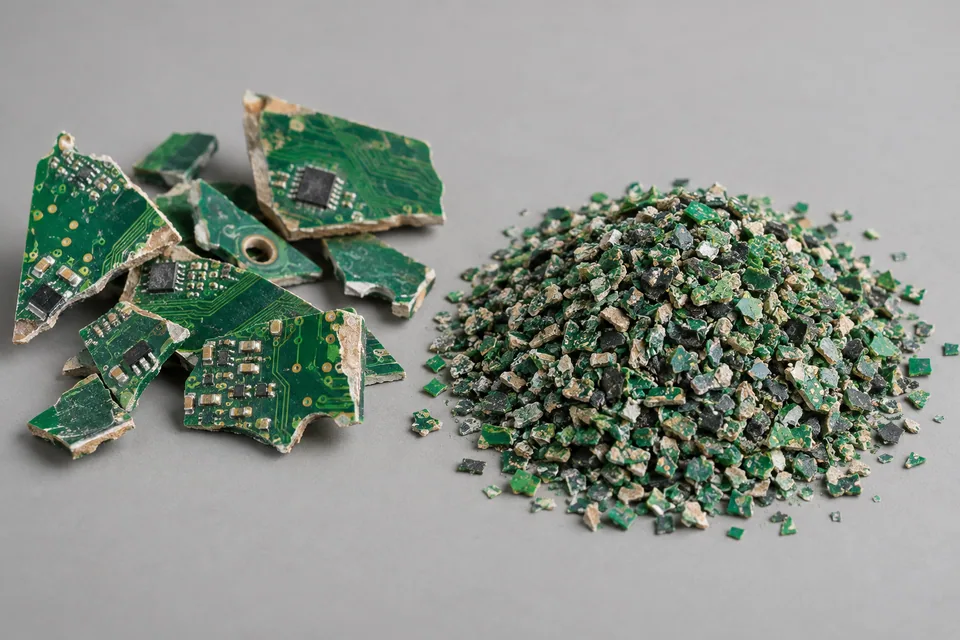
Fine crushing is a later-stage option for printed circuit board scrap that has already been opened and sized upstream. The purpose is to prepare a fine fraction suited to a specified separation test, not simply to make the smallest possible powder. Metal, resin and glass-fiber phases do not break or liberate identically; extra reduction can increase fines, energy demand and dust without improving the buyer’s recovery target. The machine’s actual cutting or crushing mechanism must be confirmed before calling a replaceable part a knife.
Updated
Where This Cutting Application Appears
Feed only prepared scrap
Measure feed top size and composition from the preceding granulator or shredder. If whole boards or large metal pieces remain, resolve the upstream bypass before tightening a fine-stage gap.
Define liberation by the next separation
Sample fine product by sieve fraction and examine whether target metal particles are free or remain locked to resin and glass fiber. Use the buyer’s separator test to decide whether more reduction is useful.
Control gap, classification and residence
Inspect the machine drawing to distinguish cutting edges, impact elements and liners. Record the actual working gap and classifier or screen settings. Compare product distribution and load at each trial condition rather than treating a nominal setting as an output guarantee.
Dust and temperature path
Fine reduction creates a larger airborne-particle handling question than coarse opening. Monitor hot spots, collection performance and accumulated fines according to the site’s material and dust assessment; include captured dust in the mass balance.
Define the Required Cut Result
- Meet the buyer’s fine-fraction distribution without unnecessary overgrinding.
- Achieve the measured liberation needed for the next separation test.
- Keep temperature, dust and residence under the site’s controls.
- Confirm that the replaceable cutting component matches the actual machine design.
Problems to Diagnose Before Changing the Knife
More grinding yields fines but little separation gain
- Compare liberation and recovery across size fractions.
- Inspect whether metal and laminate remain locked in the feed.
- Reassess the target based on the separator rather than a smaller nominal gap.
Fine product heats or darkens
- Check feed rate and recirculation.
- Inspect working gap, wear and classifier blockage.
- Review temperature trend and pause under the site’s operating limits.
Dust collection receives a disproportionate fraction
- Measure captured dust in the product balance.
- Inspect extraction, seals and screen/classifier condition.
- Compare the friable nonmetallic content of feed lots.
Knife Forms That May Be Considered
| Possible knife form | When it may be considered | What must be confirmed |
|---|---|---|
| Fine-stage rotor and stationary knife set | Only where the actual fine crusher is a cutting machine with such edges. | Confirm rotor/stator drawings, mountings, gap and representative fine product. |
| Other wear or impact elements | Where the fine machine uses impact, hammer or abrasive reduction rather than a knife pair. | Identify the actual replaceable component from the OEM drawing before requesting a knife quotation. |
Information to Send for Technical Review
You do not need to know the exact blade name. Send the available workpiece, machine, current-knife and cut-result information so the application can be reviewed against a drawing or sample.
- Prepared feed size distribution and composition
- Required fine-fraction distribution
- Planned separation method and liberation test
- Fine crusher OEM and rotor/stator or impact-component drawings
- Working gap and classifier or screen arrangement
- Feed rate, residence and recirculation data
- Dust extraction, captured-fines and temperature controls
- Representative input, output and separator-test samples
Questions About This Cutting Application
Is the finest possible powder the best target?
No. Judge finer reduction by measured liberation and downstream recovery against energy, dust and fines generated.
Does every fine crusher use knives?
No. Some machines use impact or other wear elements. Confirm the machine drawing before specifying a blade.
Why include captured dust in sampling?
The dust fraction can contain material removed from the product stream and affects both the mass balance and site handling controls.
Can this stage accept whole circuit boards?
A fine stage normally needs prepared feed. Confirm its actual feed envelope and solve oversized bypass upstream.
Public references and scope
These public sources provide material, cutting-method or safety context for this guide. Supplier pages describe their own materials or equipment; they do not establish a MEIRENTE blade specification or performance claim. Confirm the actual grade, machine setup and required cut with a drawing or sample.
Related product and service information
- Printed Circuit Board Scrap Granulator Knives - printed circuit board scrap · granulating
- Flexible Printed Circuit Scrap Fine-Crusher Knives - flexible printed circuit scrap · fine crushing
- Multilayer Pouch Production Waste Fine Crusher Knives - multilayer pouch production waste · fine crushing
Request a Custom Cutting-Knife Review
Send the workpiece details, machine or holder information, current knife photos or sample, required quantity and examples of the present cut problem. Final dimensions, material, edge geometry and tolerances are confirmed from the approved requirements.