
Blade Application Guides / Application Guide / Electronics recycling
Printed Circuit Board Scrap Granulator Knives
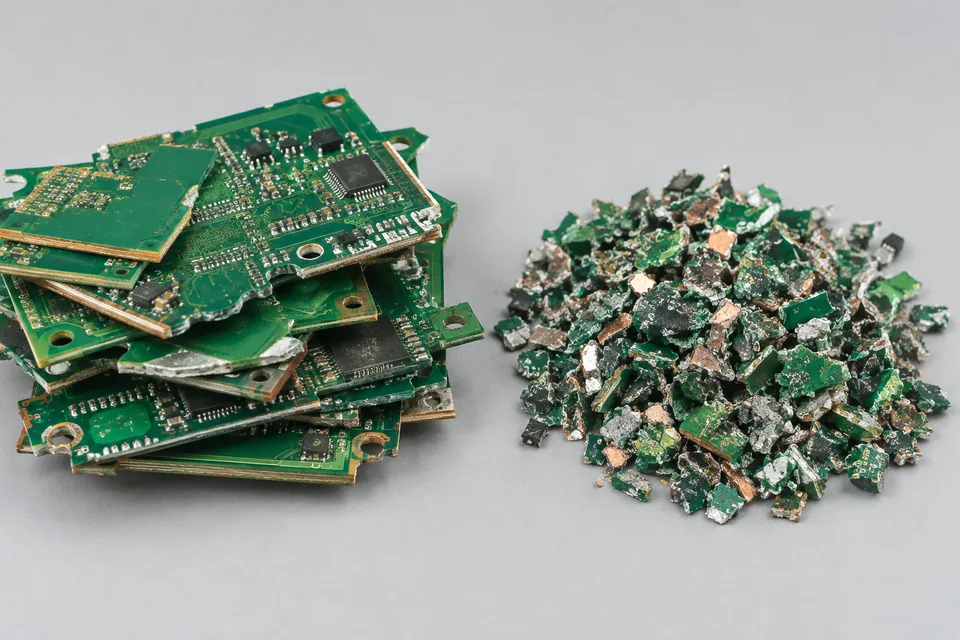
Granulation takes already reduced printed circuit board scrap and makes a controlled granular feed for downstream classification or separation. The cutter system is typically assessed together with rotor knives, stationary bed knives, a screen and discharge. Screen opening alone does not guarantee the delivered particle-size distribution: feed mix, residence, knife condition and recirculation also matter. Trial the actual upstream product, then sieve the discharge and inspect mixed or liberated metal, resin and glass in each size fraction.
Updated
Where This Cutting Application Appears
Pre-sized feed for the granulator
Confirm that the preceding shredder sends pieces within the granulator’s feed envelope. Large rigid fragments and attached wire bundles can change rotor loading and create atypical fines or jams.
Rotor-to-bed-knife cutting
Inspect the actual rotor and stationary edge as a pair. Record their condition and measured working gap from the machine procedure, then compare output before and after any adjustment.
Screened residence and output
Identify the installed screen and quantify retained oversize, target fraction and fines with a representative sieve sample. The screen retains pieces for further cutting; a worn edge or overloaded chamber can change residence and heat.
Preparation for separation
Check particle shape and composition as well as size. Mixed copper, resin and glass-fiber particles may still be locked together; the appropriate size is set by the planned separation method and measured liberation, not by a universal screen number.
Define the Required Cut Result
- Deliver the agreed granule-size distribution to the next stage.
- Control oversize and excessive fines together.
- Maintain stable chamber load and temperature during the trial.
- Preserve a useful separation feed without assuming complete liberation.
Problems to Diagnose Before Changing the Knife
Oversize persists despite the selected screen
- Inspect screen damage, bypass and seating.
- Check rotor and bed-knife condition and the actual working gap.
- Compare the incoming feed size with the machine envelope.
Fines rise while useful granule yield falls
- Review recirculation and residence time.
- Inspect knife wear and screen blockage.
- Separate friable glass/resin fines from metal-rich particles in the sample.
Mixed particles limit downstream separation
- Analyze size fractions and liberation, not only top size.
- Compare upstream board construction and degree of pre-removal.
- Trial a different reduction point only against the separation result.
Knife Forms That May Be Considered
| Possible knife form | When it may be considered | What must be confirmed |
|---|---|---|
| Granulator rotor knives | For screened rotary cutting of pre-sized PCB scrap. | Confirm rotor drawing, clamp method, compatible material trial and wear record. |
| Stationary bed-knife set | As the mating fixed edge for an existing granulator. | Confirm bed mounting, alignment, working gap and screen relationship together with the rotor. |
Information to Send for Technical Review
You do not need to know the exact blade name. Send the available workpiece, machine, current-knife and cut-result information so the application can be reviewed against a drawing or sample.
- Actual upstream fragment sample and size distribution
- Board composition and pre-sort status
- Target granule distribution and downstream separator requirements
- Rotor and bed-knife drawings and edge condition
- Working gap and adjustment procedure
- Screen opening, condition and seating
- Feed rate, chamber loading and discharge method
- Oversize, fines, temperature and dust observations
- Size-fraction or liberation test method
Questions About This Cutting Application
Does a screen opening equal finished particle size?
No. It is one control on residence and passage; measure the actual output distribution, including oversize and fines.
Why inspect rotor and bed knives together?
The active cut depends on their interface and alignment, so one worn or mis-set edge can change size and load.
Can granulation guarantee metal liberation?
No. Liberation varies with board construction and particle size and must be measured for the planned separation process.
What feed should be supplied for a trial?
Send representative output from the preceding reduction stage, not only a photograph of intact boards.
Public references and scope
These public sources provide material, cutting-method or safety context for this guide. Supplier pages describe their own materials or equipment; they do not establish a MEIRENTE blade specification or performance claim. Confirm the actual grade, machine setup and required cut with a drawing or sample.
Related product and service information
- Printed Circuit Board Scrap Primary Shredder Knives - printed circuit board scrap · primary shredding
- Discarded Fishing Net Granulating Blades - discarded fishing net · granulating
- Automotive Carpet Scrap Granulating Blades - automotive carpet scrap · granulating
Request a Custom Cutting-Knife Review
Send the workpiece details, machine or holder information, current knife photos or sample, required quantity and examples of the present cut problem. Final dimensions, material, edge geometry and tolerances are confirmed from the approved requirements.