
Blade Application Guides / Application Guide / Plastic recycling
Multilayer Pouch Production Waste Fine Crusher Knives
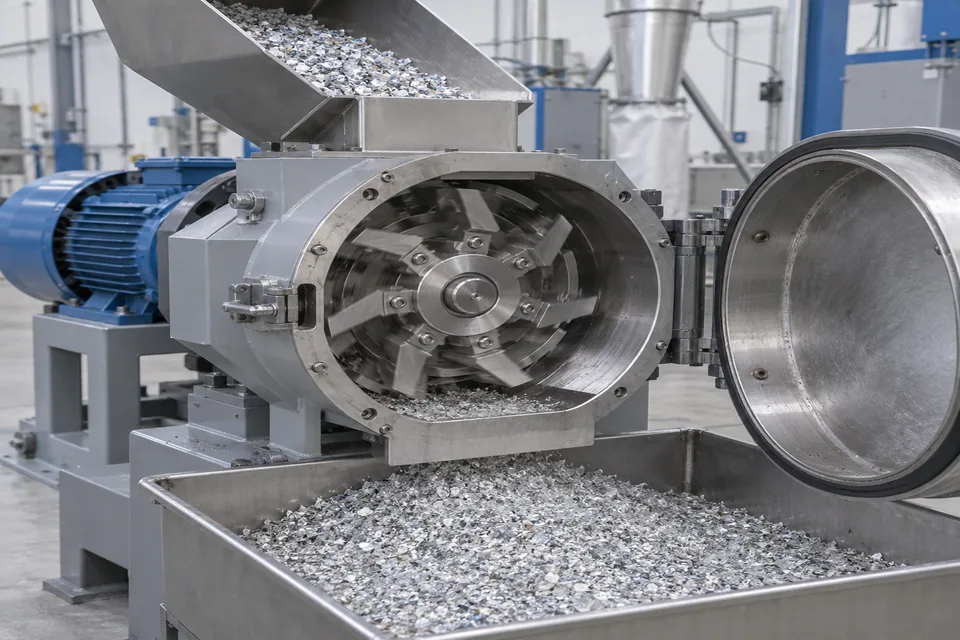
Fine crushing is a later optional cutting stage for already pre-sized multilayer pouch production scrap. It should not be interpreted as feeding whole loose pouches directly to a pulverizer. EREMA documents multilayer film production waste; HERBOLD documents a rotor/stator fine granulator and lists film processing among its applications; Siempelkamp/Pallmann distinguishes knife granulation and fine grinding of pre-cut plastics. That manufacturer evidence does not establish suitability for this particular pouch laminate. Flexible film, adhesive and mixed layers may heat, smear or bridge before reaching a meaningful finer output. The buyer must first specify the exact laminate recipe, prior shred/flake form and what smaller particle distribution accomplishes in the next process. A fine crusher may be unnecessary or unsuitable on the supplied stock; only a real material trial can justify its selection. The cut cannot separate polymers or certify recycled resin quality.
Updated
Where This Cutting Application Appears
Prove the downstream need
Ask whether washing, compounding, separation or a specific feeder actually requires finer particles than the granulator already supplies. State a target distribution and maximum residual long piece. If no measurable advantage exists, avoid adding another heat-generating cut stage.
Feed only suitably pre-sized material
Inspect the previous-stage flakes for folded film, sticky seal regions, residual pouches and foreign particles. Confirm the fine mill’s infeed form and metering design. A thin laminate sheet can wrap or flutter differently from a pre-cut plastic chip.
Trial fine knife and cooling arrangement
Record rotor/stator edge condition, gap, screen and heat-removal provisions. Compare output samples through a sustained run for smeared sealant, metal wear, film fluff, dust and temperature rise. Do not infer that a fine granulator’s stated ability with generic plastic waste proves this laminate grade.
Judge the fine fraction after transfer
Measure particle distribution and flow in the next hopper or classifier, not only at the cutter. Very fine laminate can bridge, cling electrostatically or carry ink-rich dust. The recycler remains responsible for compatibility and eventual melt or separation performance.
Define the Required Cut Result
- Reach a buyer-defined finer particle range only if useful.
- Limit heat, smearing, dust and knife wear.
- Prevent long flexible tails from entering a fine cutting chamber.
- Provide evidence that next-stage feeding or processing improves.
Problems to Diagnose Before Changing the Knife
Film clumps on a fine rotor
- Check incoming flake size and adhesive content.
- Review temperature and residence time.
- Inspect counterknife gap and feed metering.
Powdery dust increases without benefit
- Compare size distribution with downstream requirement.
- Check over-recirculation and screen choice.
- Review classifier and collection efficiency.
Fine particles bridge in a hopper
- Test actual next-stage feeding.
- Compare bulk density and static behavior.
- Assess whether a coarser cut is more suitable.
Knife Forms That May Be Considered
| Possible knife form | When it may be considered | What must be confirmed |
|---|---|---|
| Fine granulator rotor/stator knife set | Only for pre-sized laminate that passes a controlled material trial. | Confirm holder dimensions, heat control and target particle distribution. |
| Multi-row high-frequency knife mill set | Where an existing fine mill supports the feed and required output. | Confirm wear, layer smearing, dust and downstream handling on the real waste. |
Information to Send for Technical Review
You do not need to know the exact blade name. Send the available workpiece, machine, current-knife and cut-result information so the application can be reviewed against a drawing or sample.
- Exact multilayer recipe including adhesive, foil or barrier layer
- Incoming pre-sized particle distribution and bulk density
- Reason for finer output and next-process specification
- Fine mill rotor/stator, gap and screen drawings
- Temperature, cooling and dust controls
- Accepted smearing, metal-wear and dust limits
- Sustained trial and before/after flow measurements
- Recycler final resin or separation qualification plan
Questions About This Cutting Application
Is fine crushing mandatory after granulation?
No. Use it only if the next process has a justified particle requirement.
Can intact pouches go straight into a fine mill?
This guide assumes pre-sized feed; whole flexible pouches may wrap or overload the fine chamber.
Does a fine cut separate PE from PET?
No. The laminate layers remain mixed unless another process separates them.
Why monitor temperature closely?
Adhesives and heat-seal polymers may soften, smear and block knives or screens.
What is a pass result?
A sustained trial must meet the buyer particle target and show useful downstream handling without unacceptable contamination.
Public references and scope
These public sources provide material, cutting-method or safety context for this guide. Supplier pages describe their own materials or equipment; they do not establish a MEIRENTE blade specification or performance claim. Confirm the actual grade, machine setup and required cut with a drawing or sample.
Related product and service information
- Multilayer Pouch Production Waste Granulator Knives - multilayer pouch production waste · granulating
- Printed Circuit Board Scrap Fine Crusher Knives - printed circuit board scrap · fine crushing
- Flexible Printed Circuit Scrap Fine-Crusher Knives - flexible printed circuit scrap · fine crushing
Request a Custom Cutting-Knife Review
Send the workpiece details, machine or holder information, current knife photos or sample, required quantity and examples of the present cut problem. Final dimensions, material, edge geometry and tolerances are confirmed from the approved requirements.