
Blade Application Guides / Application Guide / Hydrogen equipment manufacturing
PEM Electrolyzer Membrane Contour-cutting Blades
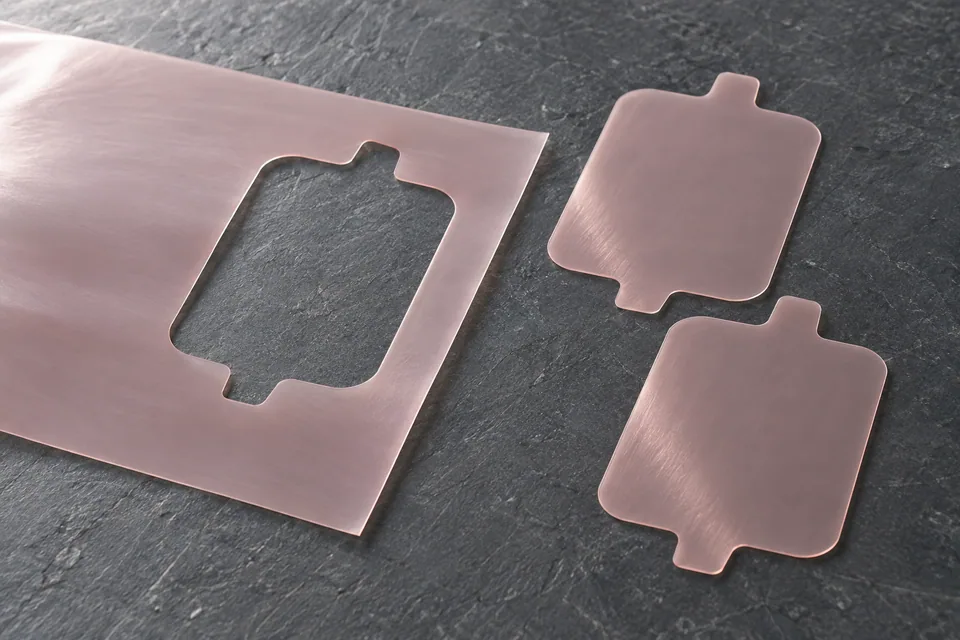
Contour cutting releases an individual PEM water-electrolyzer membrane blank with the perimeter and any openings required by a particular cell drawing. It is not longitudinal slitting of a roll into lanes. Gore describes electrolyzer PEM in sheet and roll formats; Chemours describes supported PFSA rolls with a backing and coversheet for controlled handling. The supplied configuration and the buyer’s cell architecture determine whether a carrier stays under the membrane during the cut. A tool trial must verify profile, registration and clean release without nicks or punctures in the active region. It cannot by itself qualify the membrane’s electrochemical performance.
Updated
Where This Cutting Application Appears
Register to the cell drawing
Use common datums for outer boundary, gasket interface and any port openings. Separate membrane-only geometry from carrier or cover-film geometry if those layers will be removed at different stages.
Plan openings and scrap
Small internal slugs require a controlled ejection path. Check that no slug, particle or adhesive fragment stays on the active membrane face. Do not add relief cuts that intrude into the cell’s sealing land.
Support during release
Thin films can stretch when peeled from a cutting surface. Trial hold-down and transfer in the same sequence intended for production. Compare dimensions before and after carrier removal under the specified conditioning state.
Inspect critical regions
Check corners, ports and seal-adjacent edges for nicks, wrinkles, layer separation and surface marks. Fit an accepted blank to the stack fixture and retain traceable samples for the cell owner’s testing.
Define the Required Cut Result
- Match membrane outline and openings to the approved cell drawing.
- Keep active and seal areas free of damage and debris.
- Preserve specified backing and coversheet handling.
- Release a traceable blank without stretch or orientation reversal.
Problems to Diagnose Before Changing the Knife
Port opening is ragged
- Inspect tool condition and local support.
- Check slug ejection direction.
- Compare membrane and carrier edges separately.
Blank changes size after release
- Record humidity and conditioning state.
- Measure while backed and after planned peel sequence.
- Review excessive hold-down or peel force.
Visible specks remain on membrane
- Trace particles to incoming stock, tool or slug handling.
- Review clean transfer and packaging.
- Apply the buyer’s cleanliness acceptance method.
Knife Forms That May Be Considered
| Possible knife form | When it may be considered | What must be confirmed |
|---|---|---|
| Matched contour die | For repeated cell outlines on a compatible press and supported membrane. | Confirm layer cut depth, registration and part/slug release in a trial. |
| Programmed profile knife | For variable outlines or development lots on a compatible cutting table. | Confirm support, path repeatability and active-surface protection at each turn. |
Information to Send for Technical Review
You do not need to know the exact blade name. Send the available workpiece, machine, current-knife and cut-result information so the application can be reviewed against a drawing or sample.
- Membrane grade and whether catalyst or reinforcement is present
- Cell outline, ports, gasket area and registration datum
- Backing, coversheet and carrier-removal sequence
- Sheet or roll incoming format and conditioning rules
- Accepted edge, puncture and cleanliness examples
- Machine support, ejection and transfer arrangement
- Cell owner’s dimensional and functional acceptance plan
Questions About This Cutting Application
Can a fuel-cell membrane die be assumed suitable?
No. Verify the actual electrolyzer membrane stack, geometry and accepted edge in a trial.
Are openings only a tooling detail?
No. Their location and edge affect cell assembly and sealing, so they belong to the approved cell drawing.
Should protective films always be removed first?
No. Follow the specific material supplier and buyer handling sequence; backing can aid transport and stability.
Does a profile pass prove operating life?
No. It verifies a cut part against agreed conversion criteria; durability belongs to separate cell testing.
Public references and scope
These public sources provide material, cutting-method or safety context for this guide. Supplier pages describe their own materials or equipment; they do not establish a MEIRENTE blade specification or performance claim. Confirm the actual grade, machine setup and required cut with a drawing or sample.
Related product and service information
- PEM Electrolyzer Membrane Edge-trimming Blades - PEM electrolyzer membrane · edge trimming
- Titanium Porous Transport Layer Contour Cutting Blades - titanium porous transport layer · contour cutting
- Electrolyzer Catalyst Decal Film Contour Cutting Blades - electrolyzer catalyst decal film · contour cutting
Request a Custom Cutting-Knife Review
Send the workpiece details, machine or holder information, current knife photos or sample, required quantity and examples of the present cut problem. Final dimensions, material, edge geometry and tolerances are confirmed from the approved requirements.