
Blade Application Guides / Application Guide / Protective packaging
Paperboard Edge Protector Cutting for Square Ends
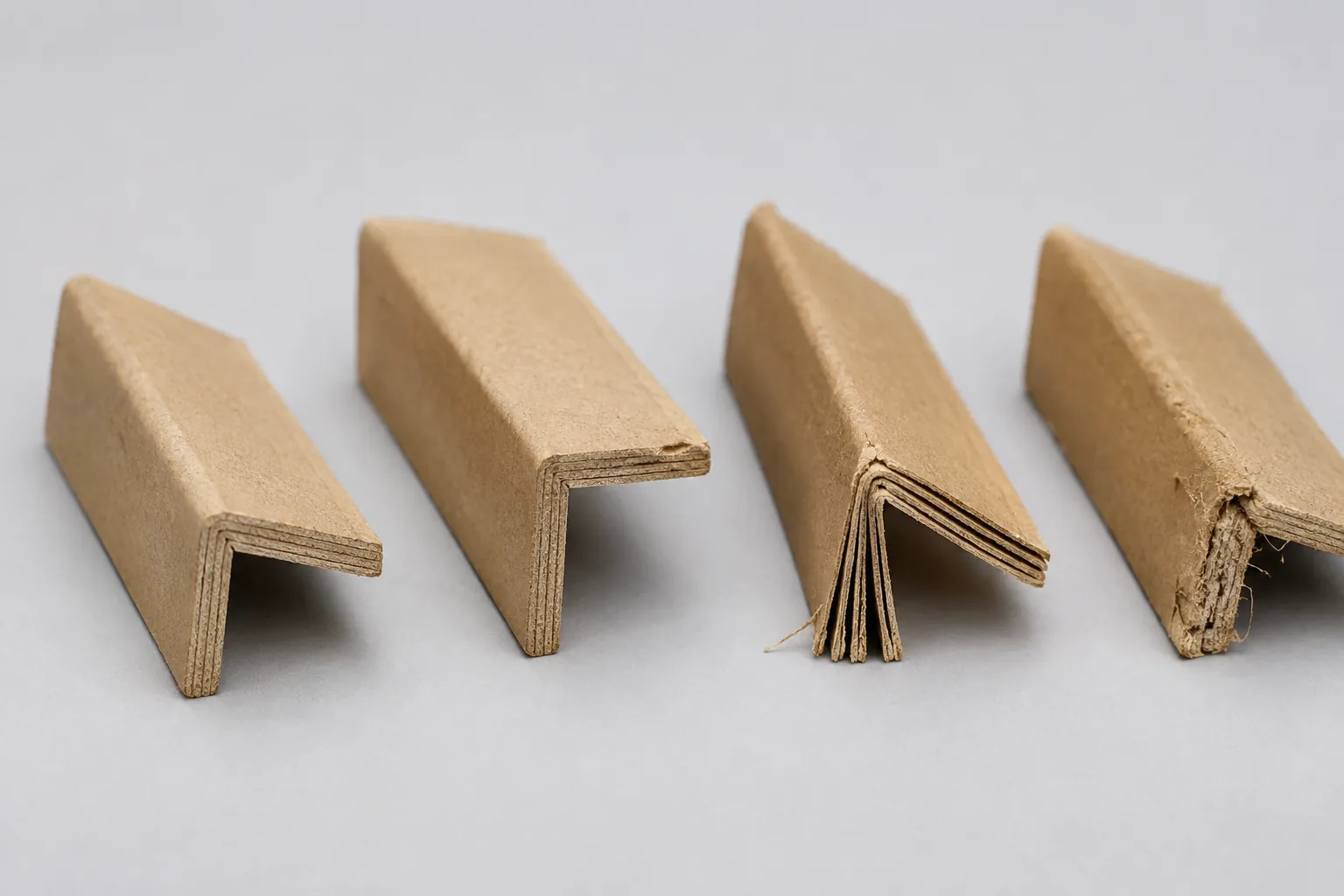
Paperboard edge protectors are laminated angle profiles whose two legs must remain square and bonded after cutoff. Profile size, wall build, adhesive cure, moisture, support, and cut orientation determine whether the end fits a pallet or packaging kit.
Updated
Where This Cutting Application Appears
Pallet corner-protection sizing
Long angle board is cut to pallet or load height so each protector seats squarely under straps or stretch wrap.
Appliance and furniture edge kits
Protectors are portioned into matched lengths for vertical and horizontal edges, with clean visible ends and reliable fit.
Short corner guards for cartons
Smaller pieces are cut for local reinforcement where crushed profile tips or loose layers can hinder packing.
Length Cutting process boundary
Length cutting repeatedly separates continuous, bundled or elongated stock to a specified linear dimension; it differs from end cleanup, outline profiling and cuts that form notches or other local features.
Length Cutting setup checkpoint
Confirm the finished length, indexing or feed reference, stock straightness, support on both sides of separation and compensation for material recovery after release.
Length Cutting acceptance checkpoint
Check length distribution, end-face angle, deformation, incomplete separation and repeatability from the first piece through a representative production interval.
Define the Required Cut Result
- Keep both legs square to the protector length
- Preserve the laminated corner without opening bonded plies
- Avoid crushing the hollow inside angle or rounding the tip
- Produce matched kit lengths with fiber-clean visible ends
Problems to Diagnose Before Changing the Knife
One leg is longer than the other at the cut face
Check profile twist, support of both legs, feed datum, cutoff angle, profile orientation, and length readings from each edge.
Laminated plies open near the corner
Review adhesive cure, moisture, paper grades, wall build, corner density, cut direction, and where delamination starts.
Profile corner crushes or flattens
Compare internal support, clamp force, leg dimensions, wall thickness, entry direction, and recovery after handling.
Loose fibers and ragged visible ends
Inspect outer wrap, fiber direction, moisture, exit support, wear distribution, extraction, and accepted display-side finish.
Knife Forms That May Be Considered
| Possible knife form | When it may be considered | What must be confirmed |
|---|---|---|
| Straight cutoff form | Consider where both legs of the angle profile are fully supported during an indexed cut. | Confirm profile section, support, orientation, stroke, mounting, length range, and approved drawing. |
| Profiled cutoff form | Consider where the existing equipment supports the V or L section with a matching cutting path. | Confirm included angle, leg widths, wall build, corner radius, clearance, motion, and representative profiles. |
Information to Send for Technical Review
You do not need to know the exact blade name. Send the available workpiece, machine, current-knife and cut-result information so the application can be reviewed against a drawing or sample.
- L- or V-profile geometry, included angle, and corner radius
- Leg widths, wall thickness, ply count, and paper grades
- Outer wrap, surface coating, color, and visible-face requirement
- Adhesive system, cure time, moisture, and storage condition
- Finished length range, tolerances, and matched-kit rules
- Profile orientation, feed, support, clamping, and cutoff cycle
- Photos of unequal legs, delamination, corner crush, and fiber breakout
- Existing cutoff sample or drawing, mounting interface, volume, and packing method
Questions About This Cutting Application
Why can two legs of an angle board finish at different lengths?
Profile twist, unequal support, a skewed cutoff plane, or using only one leg as the datum can create the difference. Measure and mark both legs.
How should corner crush be evaluated after cutting?
Inspect the internal angle, tip radius, leg spacing, springback, and fit against the intended carton or pallet corner after normal handling.
Does adhesive cure affect edge-protector cutoff?
Yes. Under-cured layers may pull apart, while moisture and storage can also change stiffness. Record production age and conditioning of the sample.
What is required for matched protector kits?
Define each length, quantity per kit, tolerance, labeling or grouping, visible-face orientation, and how paired pieces are inspected and packed.
Can a flat paperboard cutting setup be used for angle profiles?
Do not assume so. The profile needs support on both legs and at the corner, and the motion and interface must be confirmed from samples and an approved drawing.
Related product and service information
- Plastic Strapping Cutoff Without Splitting or Tails - plastic packaging strap · cutoff
- Folding Carton Die Cutting and Crease-Area Integrity - folding carton blanks · die cutting
- Solid Board Guillotine Cutting for Square Stacks - solid paperboard sheets · guillotine cutting
Request a Custom Cutting-Knife Review
Send the workpiece details, machine or holder information, current knife photos or sample, required quantity and examples of the present cut problem. Final dimensions, material, edge geometry and tolerances are confirmed from the approved requirements.