
Blade Application Guides / Application Guide / Electrical equipment manufacturing
NMN Motor-Insulation Laminate Precision-Trimming Blades
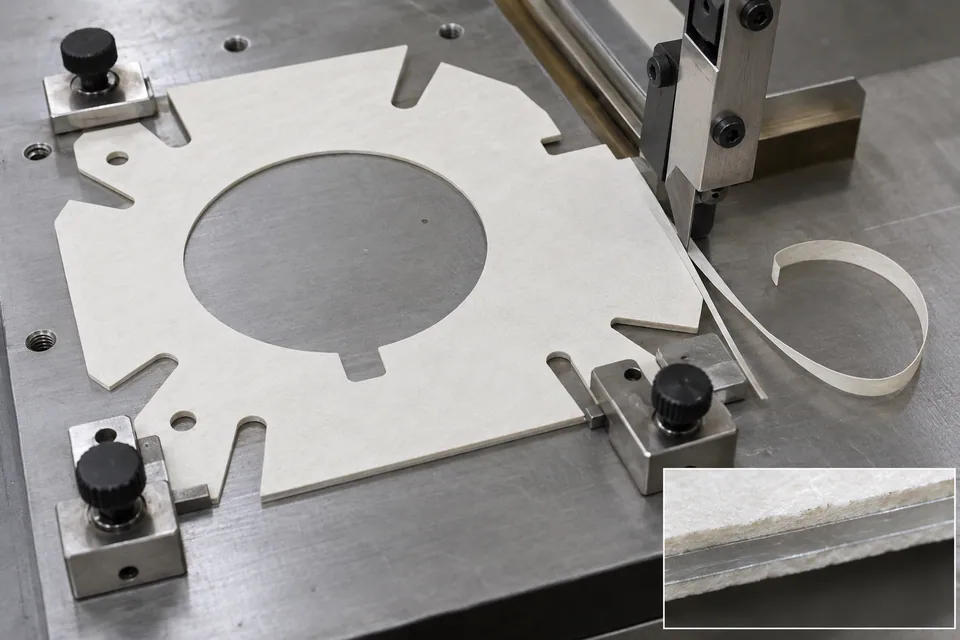
NMN is a bonded Nomex/PET/Nomex electrical laminate, and suppliers offer it as slit widths and shaped motor parts. A precision trim is a later, limited correction to an already converted part: for example a measured overhang at one side of a slot blank or a final edge allowance after a buyer-approved forming trial. It is not a generic instruction to re-cut every part. The exact stack and tolerance come from the motor drawing. The trial must show that the trim reduces the documented excess without lifting aramid paper, exposing a projecting polyester lip or shortening a required creepage path. The buyer still validates fit and insulation after installation.
Updated
Where This Cutting Application Appears
Document why a finished edge must move
Compare the incoming blank with the released final-fit drawing and mark only the excess allowance. Note whether the piece has already been creased or formed; cutting against an unsupported fold can shift the plies. Keep a no-trim control when the original piece may already be acceptable.
Support the part at the final edge
Use a guided straight blade or profile trim tool against a fixture that references a stable datum, not the frayed edge being removed. Trial one representative lot. Collect thin offcuts so they cannot cling to the paper face or enter a motor slot.
Inspect dimension and laminate together
Measure final edge position, corner shape and retained insulation overlap. Look for PET film lip, lifted Nomex and adhesive residue on both faces. Compare cut-side evidence with the pre-trim defect; a dimensionally closer part is not an improvement if the edge becomes delaminated.
Confirm in the motor fixture
Insert or place sample parts in the buyer’s fixture and check the intended clearance and overlap. Preserve part ID and trim orientation in packing. The electrical equipment maker owns final creepage, dielectric and thermal-system acceptance.
Define the Required Cut Result
- Remove only a measured surplus edge allowance.
- Hold final part geometry without ply separation.
- Keep offcuts and adhesive debris away from assemblies.
- Document fit improvement on real hardware.
Problems to Diagnose Before Changing the Knife
Thin offcuts stick to Nomex
- Review collection and static/adhesive condition.
- Inspect packed parts before release.
Trim causes polyester overhang
- Check blade support and face orientation.
- Section both ends of the trial cut.
Final part loses required overlap
- Review datum and drawing interpretation.
- Fit test against actual motor slot geometry.
Knife Forms That May Be Considered
| Possible knife form | When it may be considered | What must be confirmed |
|---|---|---|
| Guided straight trim blade | For a simple measured surplus edge on a flat NMN blank. | Check retained dimensions and all three plies. |
| Matched profile trim tool | For a local curved edge tied to a released part drawing. | Check location, scrap removal and assembly fit. |
Information to Send for Technical Review
You do not need to know the exact blade name. Send the available workpiece, machine, current-knife and cut-result information so the application can be reviewed against a drawing or sample.
- Named NMN grade and original blank drawing
- Measured overhang or final-fit mismatch
- Flat versus preformed condition
- Datum and retained overlap requirement
- Allowed film lip, fiber and delamination
- Fixture and offcut-removal method
- Before-and-after part samples
- Motor fit and electrical test owner
Questions About This Cutting Application
Is precision trimming an automatic extra step?
No. Use it only for a measured final-fit allowance.
Can a trim repair a bond defect inside the part?
No. A lifted layer extending past the new edge needs material disposition.
Why reference from a stable datum?
The original damaged edge may be crooked and cannot locate a repeatable finishing cut.
Does a better fit prove electrical safety?
No. The assembled motor insulation requires its own qualification.
What sample is required?
Send the original blank, final-fit drawing and marked surplus edge.
Public references and scope
These public sources provide material, cutting-method or safety context for this guide. Supplier pages describe their own materials or equipment; they do not establish a MEIRENTE blade specification or performance claim. Confirm the actual grade, machine setup and required cut with a drawing or sample.
Related product and service information
- NMN Motor-Insulation Laminate Sheet Slitting Blades - NMN motor-insulation laminate · sheet slitting
- Polyimide-Mica Insulation Laminate Precision-Trimming Blades - polyimide-mica insulation laminate · precision trimming
- Transformer Electrical Pressboard Precision-Trimming Blades - transformer electrical pressboard · precision trimming
Request a Custom Cutting-Knife Review
Send the workpiece details, machine or holder information, current knife photos or sample, required quantity and examples of the present cut problem. Final dimensions, material, edge geometry and tolerances are confirmed from the approved requirements.