
Blade Application Guides / Application Guide / Specialty metal converting
Niobium Metal Foil Strip Edge-Trimming Blades
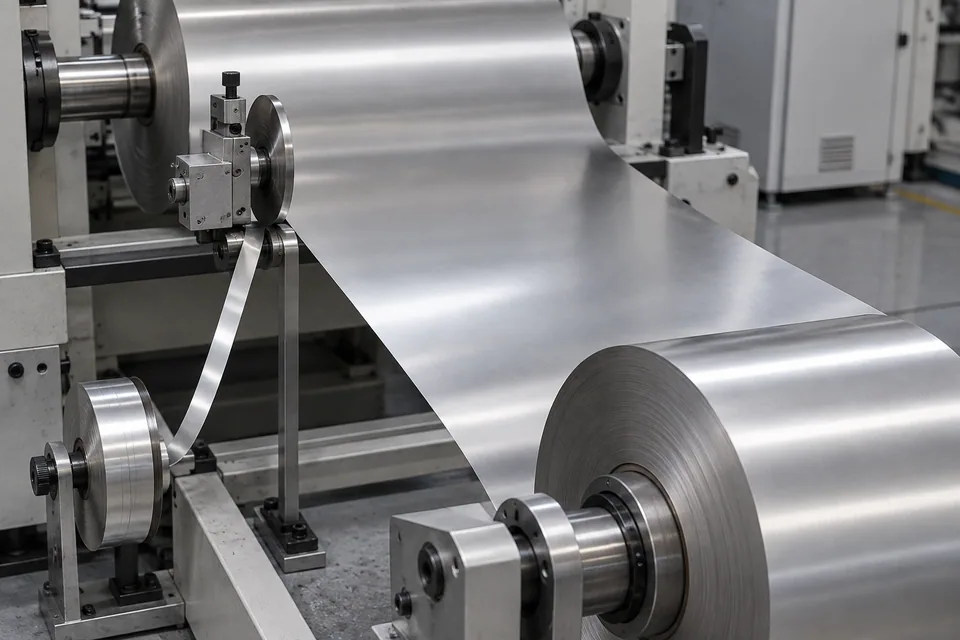
Admat and Eagle Alloys supply niobium foil as strip or coil, and Ulbrich describes the importance of edge condition during precision strip conversion. An edge trim removes a narrow longitudinal scrap ribbon from the outside of a retained niobium web. It does not divide a master coil into multiple useful lanes, crosscut sheets or blank profiles. The buyer’s drawing must allow the resulting width, including any later weld, feed or forming margin. A sound-looking edge can still fail if the thin strip curls or tracks poorly after rewinding, so inspection extends beyond the knife exit.
Updated
Where This Cutting Application Appears
Authorize the margin
Identify which incoming side carries a mill-edge irregularity, handling nick or other documented defect. Mark the maximum permitted trim and the minimum retained width. Confirm whether the foil’s rolling direction or later connection land changes which edge may be removed. If damage is too deep, request a new disposition instead of widening the cut without approval.
Feed and capture the outside strip
Support the foil close to the tool and route a narrow scrap ribbon away from the main web. Trial edge-knife contact on the real grade and gauge. An unsupported ribbon may curl around the knife and pull the useful foil, while guide pressure can mark the untouched side.
Inspect width and edge state
Measure retained width over the roll and examine the fresh edge for burr, rollover, slivers, short tears and waviness. Compare top and underside, then check the opposite original edge for guide damage. Assess camber after relaxation; a roll can appear straight under tension yet wander in the downstream feeder.
Rewind with traceability
Label niobium grade, lot, trim side and final width. Keep scrap segregated and use only buyer-approved cores or interleaves. If the next process has a sensitive surface requirement, document any tool lubricant or cleaning step rather than assuming it is acceptable.
Test the next operation
Unwind a full turn at the receiving station. Confirm that the retained band covers the planned formed or joined feature and that the fresh edge does not snag the feeder. Inspect the rewound face for tight edge build or trapped slivers, then compare the cut side with a pre-trim control. Record which side was removed. Final part integrity still requires its own forming or joining inspection.
Define the Required Cut Result
- Remove only permitted outside niobium foil waste.
- Keep useful width and orientation.
- Avoid burr, camber and scrap entanglement.
- Preserve grade and lot records.
Problems to Diagnose Before Changing the Knife
Thin scrap wraps the blade
- Improve waste capture and support.
- Check knife condition.
- Inspect retained strip for pull marks.
Trimmed strip develops camber
- Review side loading and guides.
- Measure after relaxation.
- Trial the actual feeder.
Knife Forms That May Be Considered
| Possible knife form | When it may be considered | What must be confirmed |
|---|---|---|
| Supported longitudinal edge-trim shear | For a named niobium foil condition. | Verify width and burr direction. |
| Paired circular edge station | Where the line can control thin foil and scrap. | Check both edge faces and coil build. |
Information to Send for Technical Review
You do not need to know the exact blade name. Send the available workpiece, machine, current-knife and cut-result information so the application can be reviewed against a drawing or sample.
- Niobium grade, foil gauge and condition
- Incoming and minimum retained width
- Affected edge and permitted trim
- Scrap and winding path
- Burr, camber and feed criteria
Questions About This Cutting Application
Is edge trimming ordinary multi-lane slitting?
No. It removes outside waste while retaining one principal strip.
Can any damaged edge be trimmed away?
Only if the final width still meets the drawing.
Why check the opposite edge?
Guides can damage the side that was not cut.
Does a clean trim prove a welded assembly?
No. Joining and functional testing are separate.
Public references and scope
These public sources provide material, cutting-method or safety context for this guide. Supplier pages describe their own materials or equipment; they do not establish a MEIRENTE blade specification or performance claim. Confirm the actual grade, machine setup and required cut with a drawing or sample.
Related product and service information
- Tantalum Metal Foil Cut-To-Length Blades - tantalum metal foil · cut to length
- Amorphous Metal Ribbon Strip Edge-Trimming Blades - amorphous metal ribbon · strip edge trimming
- Nanocrystalline-Alloy Precursor Ribbon Strip Edge-Trimming Blades - nanocrystalline-alloy amorphous precursor ribbon · strip edge trimming
Request a Custom Cutting-Knife Review
Send the workpiece details, machine or holder information, current knife photos or sample, required quantity and examples of the present cut problem. Final dimensions, material, edge geometry and tolerances are confirmed from the approved requirements.