
Blade Application Guides / Application Guide / Hydrogen equipment manufacturing
AEM Electrolyzer Membrane Sheet Slitting Blades
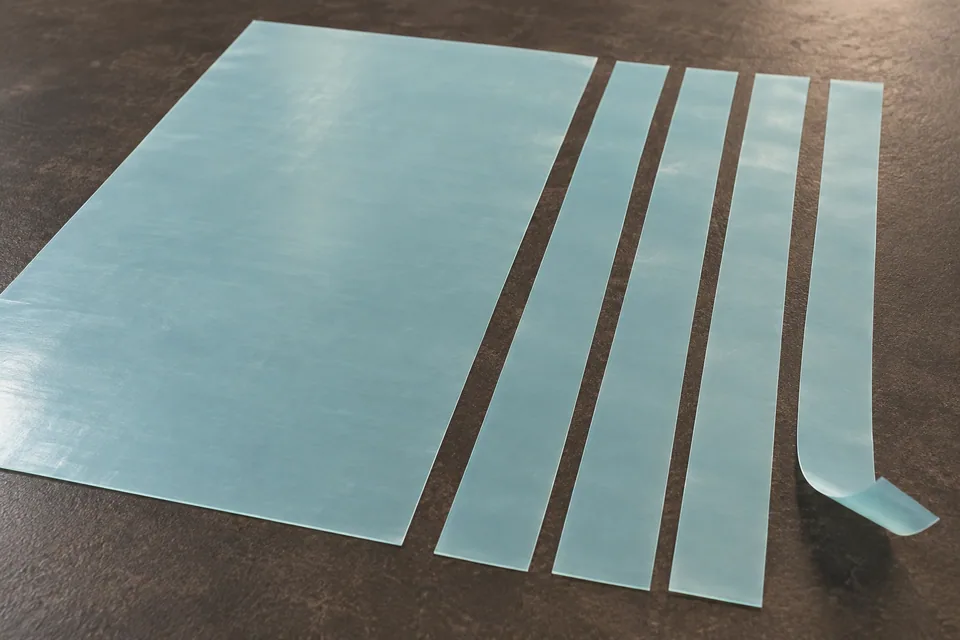
Sheet slitting produces straight, usable strips from an AEM electrolyzer membrane web or sheet. The polymer membrane is an ion-conducting stack component, and suppliers offer both free-standing and reinforced constructions. A manufacturer’s handling guide calls for clean contact surfaces and sharp blades; it also describes dimensional changes when the membrane is wet. Define the supplied grade, dry or conditioned state and strip layout before any knife trial. Width and visual edge acceptance do not by themselves establish gas separation or electrochemical performance.
Updated
Where This Cutting Application Appears
Set the membrane state before measuring
Identify the exact grade, reinforcement and supplied ion form. Record whether the parent stock is dry or conditioned, because comparing a wet strip with a dry drawing can make a dimensional change look like a slitting error. Use the buyer’s measurement state for all samples.
Support a clean longitudinal cut
Lay out every strip width and edge margin. Keep the support, guide and blade contact surfaces smooth and free of particles; trial a sharp blade on representative stock. Note any stretching or skew as the web enters the cutting line, especially at the narrowest lane.
Examine both slit edges
Inspect each lane for nicks, tearing, curled lips and loose particles. Check both faces against an untouched control and look for any reinforcement exposure. Measure strip width near the beginning and end of the trial under the same handling condition.
Protect the accepted strips
Separate usable strips from trim without dragging the membrane over a rough takeoff edge. Package test pieces according to the membrane supplier’s handling instructions and repeat inspection after transfer; a fold or puncture introduced after slitting still makes a strip unusable.
Define the Required Cut Result
- Deliver the specified straight strip widths in a defined membrane condition.
- Avoid punctures, tears, creases and particulate contamination.
- Keep reinforcement and both membrane faces within buyer edge limits.
- Preserve traceability from parent stock to trial lanes.
Problems to Diagnose Before Changing the Knife
Width changes between cut and inspection
- Confirm whether the measurement was made dry or conditioned.
- Review web tension and guide alignment.
- Compare with an uncut control conditioned the same way.
A slit develops small edge tears
- Inspect blade sharpness and support at the cut.
- Check whether the membrane stretches before engagement.
- Map tears by lane and parent-stock orientation.
Particles appear on accepted strips
- Inspect support, guides and trim takeoff for debris.
- Compare the untouched stock and post-cut handling samples.
- Review the clean collection method.
Knife Forms That May Be Considered
| Possible knife form | When it may be considered | What must be confirmed |
|---|---|---|
| Supported straight-slitting blade | For a machine that can hold the actual membrane flat during a continuous straight cut. | Confirm edge geometry, mounting and clean-cut trial without imposing a universal setup. |
| Paired rotary slitting edges | Only where the existing line and membrane grade are compatible with that arrangement. | Confirm side clearance, support, lane width and actual edge sample. |
Information to Send for Technical Review
You do not need to know the exact blade name. Send the available workpiece, machine, current-knife and cut-result information so the application can be reviewed against a drawing or sample.
- Exact AEM membrane grade, reinforcement and supplied condition
- Dry or conditioned measurement requirement
- Parent sheet size and finished strip-width schedule
- Accepted edge, particle and handling samples
- Blade holder, support and guide drawings
- Web feed and collection method
- Supplier handling and storage instructions
- Buyer functional inspection plan after conversion
Questions About This Cutting Application
Can an AEM membrane be slit from thickness alone?
No. Reinforcement, hydration state, support and accepted edge condition all affect the trial.
Why record dry or wet condition?
Ionomr describes dimensional change on conditioning. A width comparison is meaningful only when the stock and measured strip share the specified state.
What defects matter beyond width?
Check tears, punctures, creases, particles and any exposed reinforcement on both faces and cut edges.
Does a clean slit prove electrolyzer performance?
No. The stack designer must separately test the specified membrane and assembly for its functional requirements.
What should be sent for a tooling review?
Send an actual membrane sample, handling instructions, strip drawing, machine support details and accepted edge examples.
Public references and scope
These public sources provide material, cutting-method or safety context for this guide. Supplier pages describe their own materials or equipment; they do not establish a MEIRENTE blade specification or performance claim. Confirm the actual grade, machine setup and required cut with a drawing or sample.
Related product and service information
- Electrolyzer Catalyst Decal Film Contour Cutting Blades - electrolyzer catalyst decal film · contour cutting
- Nickel Foam Electrode Sheet Slitting Blades - nickel foam electrode · sheet slitting
- AEM Electrolyzer Membrane Contour-Cutting Blades - AEM electrolyzer membrane · contour cutting
Request a Custom Cutting-Knife Review
Send the workpiece details, machine or holder information, current knife photos or sample, required quantity and examples of the present cut problem. Final dimensions, material, edge geometry and tolerances are confirmed from the approved requirements.