
Blade Application Guides / Application Guide / Hydrogen equipment manufacturing
Nickel Foam Electrode Contour-Cutting Blades
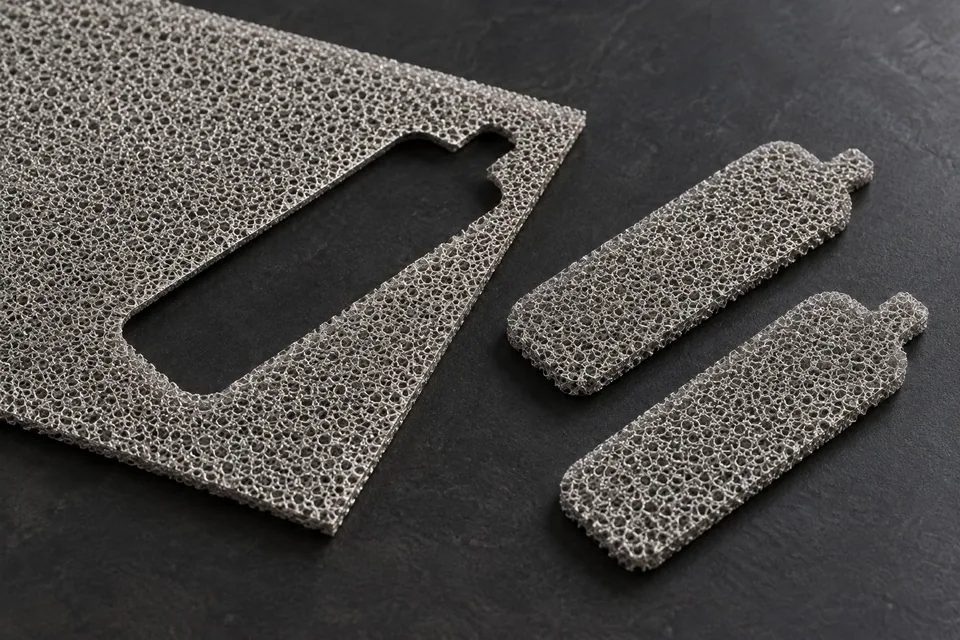
Contour cutting releases an electrode shape from a nickel foam sheet. The foam’s open metallic ligaments can snag at a narrow slot, flatten under hold-down or shed loose pieces during ejection. The customer may supply bare foam, a coated electrode or a design with a denser contact backing; none should be assumed from the title alone. Trial the actual drawing and material, then inspect the complete profile and both faces after the part leaves the cutting support. Cell function remains the buyer’s test.
Updated
Where This Cutting Application Appears
Review ports, tabs and contact zones
Mark every outside radius, slot and contact tab on the part drawing. Identify any region where the foam must remain open and any dense backing that must stay attached; a correct outer dimension can conceal damage around a tab.
Support the porous sheet at cutouts
Compare hold-down and backing on representative stock. A die can compress cells before it shears them, while insufficient support can bend metal ligaments into the opening; record the pressure and contact footprint used for accepted samples.
Inspect the released electrode
Remove internal slugs, then check the slot walls, narrow bridges and full outer edge for hanging ligaments, flattened cells and loose fragments. Examine any activated or coated face for scuffing after ejection.
Retain the matrix for diagnosis
Keep the skeleton and cutout pieces to see whether metal bridges were completely severed. Recheck a collected part after normal stacking; foam debris can be generated by handling even when the initial profile looked sound.
Define the Required Cut Result
- Meet the complete profile and registration drawing.
- Keep the buyer-defined open-pore edge zone.
- Release internal waste without metal bridges or particles.
- Protect any coating and contact side during ejection.
Problems to Diagnose Before Changing the Knife
A narrow slot retains metal strands
- Inspect tool penetration at the slot.
- Compare backing support beneath the feature.
- Check whether the slug is fully discharged.
Contact tab bends after ejection
- Observe hold-down and release sequence.
- Inspect tab support and collection contact.
- Compare pre-ejection and post-ejection samples.
Particles detach from a coated face
- Check whether damage existed before cutting.
- Map particles to cut edge versus ejector contact.
- Trial different part-handling method within buyer approval.
Knife Forms That May Be Considered
| Possible knife form | When it may be considered | What must be confirmed |
|---|---|---|
| Profile die and matched support | For repeated electrode profiles on a compatible press. | Confirm edge-crush zone, feature release and coating condition with actual foam. |
| Programmed profile cutter | For a supported machine able to follow the drawing. | Confirm smallest radius, cut completeness and loose-metal control in a trial. |
Information to Send for Technical Review
You do not need to know the exact blade name. Send the available workpiece, machine, current-knife and cut-result information so the application can be reviewed against a drawing or sample.
- Actual foam grade and electrode processing state
- Complete part and contact-zone drawing
- Coating or backing orientation
- Permitted pore compression and particle level
- Press or cutter setup and support drawing
- Smallest slot and bridge dimensions
- Ejection and skeleton plan
- Post-cut electrical or cell test specified by buyer
Questions About This Cutting Application
Why does a foam tab need separate inspection?
A narrow tab can bend or lose ligaments while the broad part stays dimensionally acceptable.
What matters around an internal slot?
Check complete slug removal, protruding strands and the width of any crushed-pore zone.
Does a die automatically suit coated foam?
No. Test the actual coating and support because hold-down or ejection may mark it.
What is inspected after release?
Measure the full profile and look for loose fragments, compressed cells and coating damage after normal collection.
Can cutting guarantee electrolyzer current distribution?
No. That depends on the specified electrode and cell design, which the buyer must test.
Public references and scope
These public sources provide material, cutting-method or safety context for this guide. Supplier pages describe their own materials or equipment; they do not establish a MEIRENTE blade specification or performance claim. Confirm the actual grade, machine setup and required cut with a drawing or sample.
Related product and service information
- Nickel Foam Electrode Edge-Trimming Blades - nickel foam electrode · edge trimming
- Titanium Porous Transport Layer Contour Cutting Blades - titanium porous transport layer · contour cutting
- Electrolyzer Catalyst Decal Film Contour Cutting Blades - electrolyzer catalyst decal film · contour cutting
Request a Custom Cutting-Knife Review
Send the workpiece details, machine or holder information, current knife photos or sample, required quantity and examples of the present cut problem. Final dimensions, material, edge geometry and tolerances are confirmed from the approved requirements.