
Blade Application Guides / Application Guide / High-efficiency filter media converting
Nanofiber-Coated Filter Media Slitting Blades
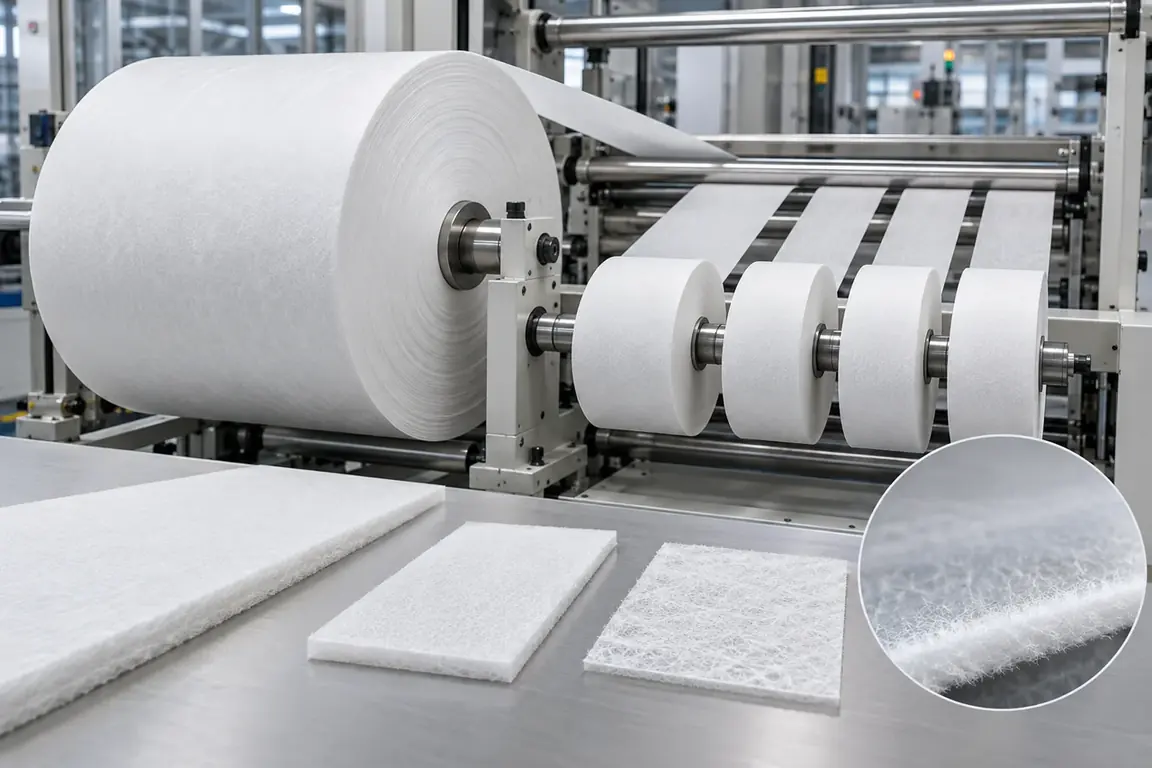
Nanofiber-coated filter media slitting blades divide coated cellulose or synthetic substrates into widths required for later pleating and filter-element production. The review must identify the nanofiber-coated face, substrate construction, roll orientation, parent-web condition, lane plan, edge acceptance and rewinding method because damage to a functional surface cannot be assessed as ordinary nonwoven edge fuzz.
Updated
Where This Cutting Application Appears
Filter-media width conversion
Coated master rolls are slit into production widths for downstream pleating, corrugating or element assembly.
Damaged-edge removal
Outer parent-roll edges are trimmed before usable lanes are separated and rewound.
Narrow reel preparation
Converted media is wound into controlled reels while the functional coated surface is protected from avoidable contact.
Precision Roll Slitting And Edge Trimming process boundary
Precision roll slitting and edge trimming for Nanofiber-coated filter media is a linked sequence: the output condition and datum from each operation become the controlled input for the next. It should not be evaluated as one generic cut or accepted only by the final dimension.
Precision Roll Slitting And Edge Trimming setup checkpoint
For Nanofiber-coated filter media, define the operation order, intermediate dimensions, registration transfer, material support, web or part handling and waste route for every stage of Precision roll slitting and edge trimming.
Precision Roll Slitting And Edge Trimming acceptance checkpoint
Verify both intermediate and final results from Precision roll slitting and edge trimming, including dimensions, registration, edge or feature quality, material damage, waste separation and stable transfer between stages.
Define the Required Cut Result
- Continuous slit edges without substrate pullout, loose fragments or coating lift.
- Protected nanofiber-coated surfaces with controlled contact through the web path.
- Stable lane width and tracking across the planned converting layout.
- Even finished reels with aligned faces and no transferred edge debris.
Problems to Diagnose Before Changing the Knife
Nanofiber coating is disturbed near the slit edge
- Identify the coated face and document where it contacts machine surfaces.
- Compare the incoming surface, freshly cut edge and rewound material.
- Use the customer's inspection method to distinguish coating disturbance from loose substrate fibers.
Edge debris transfers onto the functional surface
- Determine whether debris is produced at cutting or introduced during separation and winding.
- Inspect web-contact and cleaning points before each finished reel.
- Compare debris location by lane and roll face on representative samples.
Coated substrate delaminates at the edge
- Confirm the complete supplied media construction without assuming hidden layers.
- Identify the interface that opens and whether separation is local or continuous.
- Compare parent-roll, slit and rewound edges from the same material section.
Finished reel develops an uneven face
- Review lane tracking from the slitting point through separation to winding.
- Record whether the condition follows one lane or changes during the run.
- Inspect incoming roll alignment and downstream contact before assigning a cutting cause.
Knife Forms That May Be Considered
| Possible knife form | When it may be considered | What must be confirmed |
|---|---|---|
| Rotary shear-slitting knife pair | For supported nanofiber-coated media when paired circular shear knives suit the existing converting line. | Holder interface, substrate construction, coated-face orientation, overlap and clearance controls, web support and edge sample. |
| Supported razor-slitting blade arrangement | For thin coated filter media when trials confirm that low-contact razor entry preserves the required surface and edge. | Blade presentation, support geometry, coated-face contact, web path, debris control and finished-reel condition. |
| Score-slitting knife against hardened anvil | When the installed machine uses score slitting and material trials confirm acceptable coating and substrate separation. | Substrate construction, coating side, anvil condition, loading control, lane layout and approved edge result. |
Information to Send for Technical Review
You do not need to know the exact blade name. Send the available workpiece, machine, current-knife and cut-result information so the application can be reviewed against a drawing or sample.
- Filter-media product description, substrate construction and representative roll sample.
- Nanofiber-coated face identification and allowed surface-contact conditions.
- Parent-roll format, finished widths, lane count and edge-trim plan.
- Machine station, holder interface, web path, support, separation and winding arrangement.
- Photos of parent-roll edges, accepted slit edges and finished reel faces.
- Rejected examples showing coating disturbance, debris, delamination or tracking problems.
- Inspection, cleanliness, contact, collection and packaging requirements.
- Trial quantity, downstream pleating process and current tooling information if available.
Questions About This Cutting Application
Why must the nanofiber-coated face be identified?
It allows contact points and surface disturbance to be traced through slitting, separation, rewinding and inspection.
Is nanofiber media slitting the same as generic nonwoven slitting?
No. The functional coating, supporting substrate and accepted surface condition require separate review.
What should be inspected after rewinding?
Check slit edges, reel-face alignment, surface debris, coating condition and any change linked to lane position.
Can coating damage be identified from an edge photograph alone?
Not always. Include surface views and use the customer's established inspection method on representative samples.
Should unknown coating details be estimated?
No. Keep proprietary or missing information unconfirmed and base review on supplied samples and observed behavior.
Related product and service information
- Anisotropic Conductive Film Matrix-Trimming Blades - anisotropic conductive film · matrix trimming
- Kraft Paper Roll Slitting: Edge Quality and Dust - kraft paper rolls · roll slitting
- Printed Paper Web Edge Trimming and Register Protection - printed paper webs · web edge trimming
Request a Custom Cutting-Knife Review
Send the workpiece details, machine or holder information, current knife photos or sample, required quantity and examples of the present cut problem. Final dimensions, material, edge geometry and tolerances are confirmed from the approved requirements.