
Blade Application Guides / Application Guide / Specialty metal converting
Nanocrystalline-Alloy Precursor Ribbon Precision Coil Slitting Blades
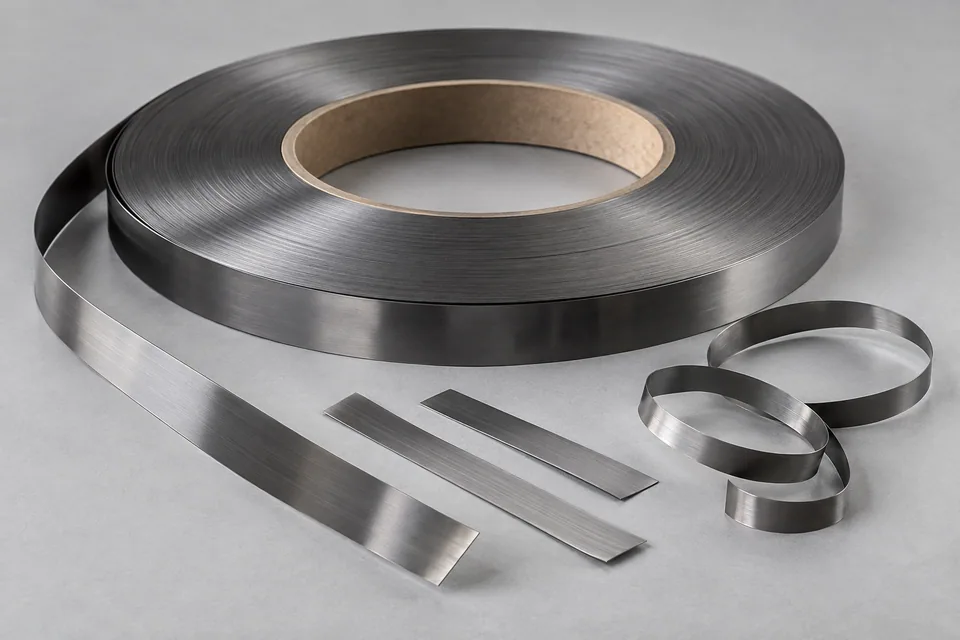
The term “nanocrystalline ribbon” often names an alloy intended to become nanocrystalline, rather than its structure on the incoming coil. Metglas identifies FT-3W as a fully amorphous precursor and reports magnetic measurements on strands slit from different cast-width positions. Proterial shows the FINEMET sequence: cast amorphous ribbon, form the core, then heat-treat it to create the nanocrystalline structure. King Magnetics likewise describes slitting wide ribbon before winding and final heat treatment. This guide therefore covers only the unannealed, flexible Fe-Si-B-Nb-Cu precursor coil. It does not suggest feeding an already crystallized bare ribbon through ordinary rotary knives. DIENES describes paired shear slitting for thin webs, but the exact precursor alloy and width plan must be qualified by sample.
Updated
Where This Cutting Application Appears
Verify the material state before loading
Read the mill’s alloy and heat-history record, not just the commercial label. Confirm that no nanocrystallizing anneal has occurred. Mark wheel side, free side and casting or machine direction; the source coil may already have the width needed for the planned core, so an extra slit requires a documented reason.
Develop a lane plan around later core winding
Choose child widths from the approved toroid or cut-core design, allowing for any unusable casting-edge margin. Track where each lane came from across the cast width. The Metglas FT-3W example tests slit strands from edge and center regions, so position traceability matters when comparing trial outcomes.
Trial shear engagement and rewind
Run a short trial with matched upper and lower circular knives, recording engagement, support, web tension and takeoff. Inspect both new edges for chips and fracture origins, then rewind each lane separately without telescoping or edge contact. A thin strand broken in rewind is not an acceptable cutting result.
Check after the real thermal route
Send identified sample lanes to the core maker for winding and its specified field or stress anneal. The final core requires magnetic testing under the buyer’s method; a good-looking pre-anneal edge cannot establish permeability or loss. Keep uncut controls to separate conversion effects from heat-treatment effects.
Define the Required Cut Result
- Create the core maker’s specified precursor widths.
- Prevent edge chips that start breaks during winding.
- Retain cross-width origin and material-state traceability.
- Supply trials for downstream nanocrystallizing anneal.
Problems to Diagnose Before Changing the Knife
Slit strands break on the winding mandrel
- Inspect new-edge notches and winding tension.
- Compare the uncut cast-edge control and bend path.
Outer and center lanes behave differently
- Map child-coil position in the source casting.
- Compare incoming thickness and surface texture.
Fine metal chips reach finished reels
- Check blade wear and trim takeoff.
- Inspect guides and both cut faces under magnification.
Knife Forms That May Be Considered
| Possible knife form | When it may be considered | What must be confirmed |
|---|---|---|
| Paired rotary shear knives | For unannealed precursor ribbon with a proven lane and tension trial. | Confirm both-edge integrity and successful sample core winding. |
| Directly cast or mill-slit finished width | When the owner can provide the required width without another pass. | Compare delivered edge condition and downstream core yield. |
Information to Send for Technical Review
You do not need to know the exact blade name. Send the available workpiece, machine, current-knife and cut-result information so the application can be reviewed against a drawing or sample.
- Fe-Si-B-Nb-Cu alloy identity and heat history
- Proof that the stock is still amorphous
- Cast width, thickness and position map
- Core winding width and lane layout
- Wheel/free side and unwind direction
- Knife engagement and rewinding plan
- Allowed edge-chip and fragment criteria
- Core anneal and magnetic acceptance owner
Questions About This Cutting Application
Is the incoming ribbon already nanocrystalline?
No. This guide concerns an amorphous precursor that can become nanocrystalline after the owner’s heat treatment.
Why does this distinction change the blade trial?
Annealed bare ribbon can be much less tolerant of bending and ordinary rewinding.
Do all cast coils need slitting?
No. Some are supplied at the intended core width.
Can edge appearance predict permeability?
No. Test the completed heat-treated core.
What should the RFQ show?
Provide the precursor alloy certificate, lane map and intended anneal route.
Public references and scope
These public sources provide material, cutting-method or safety context for this guide. Supplier pages describe their own materials or equipment; they do not establish a MEIRENTE blade specification or performance claim. Confirm the actual grade, machine setup and required cut with a drawing or sample.
Related product and service information
- Nanocrystalline-Alloy Precursor Ribbon Strip Edge-Trimming Blades - nanocrystalline-alloy amorphous precursor ribbon · strip edge trimming
- Amorphous Metal Ribbon Precision Coil Slitting Blades - amorphous metal ribbon · precision coil slitting
- Beryllium-Copper Foil Precision Coil Slitting Blades - beryllium-copper foil · precision coil slitting
Request a Custom Cutting-Knife Review
Send the workpiece details, machine or holder information, current knife photos or sample, required quantity and examples of the present cut problem. Final dimensions, material, edge geometry and tolerances are confirmed from the approved requirements.