
Blade Application Guides / Application Guide / Specialty metal converting
Beryllium-Copper Foil Precision Coil Slitting Blades
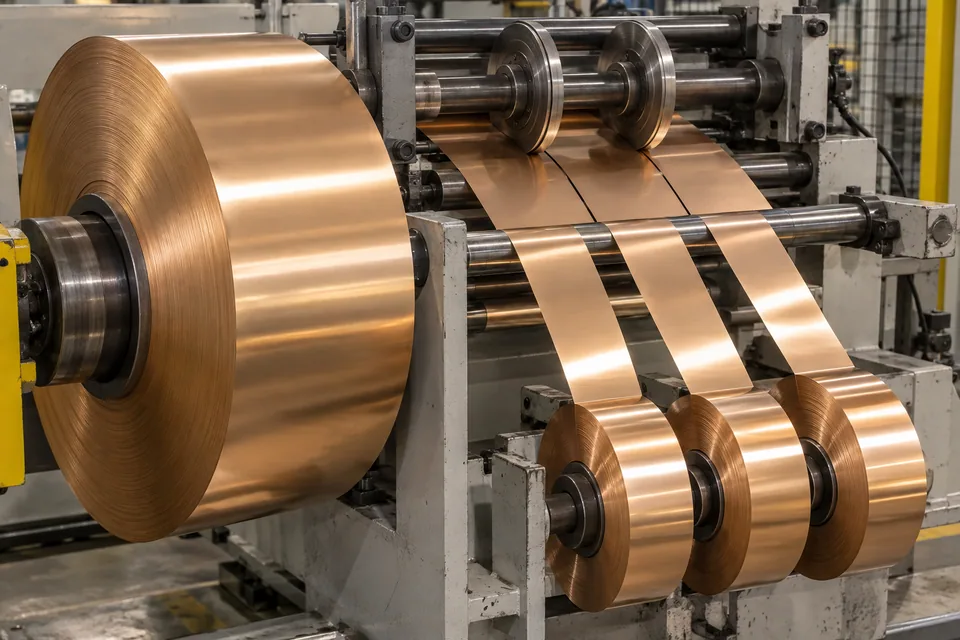
NGK Berylco supplies copper-beryllium in coil and strip forms and identifies slitting as part of its own continuous processing. TOKKIN lists C1720 copper-beryllium and describes ultra-thin foil and slitting among its available processing options. Its alloy and temper guidance shows why a flexible cold-worked strip and a mill-hardened strip should not share an assumed knife setup. This page concerns an identified thin foil or strip coil divided lengthwise into narrower coils for later spring-contact or connector stamping. “Foil” is a buyer-specified thickness class here, not a promise that every NGK strip grade is available at an arbitrary gauge. Paired rotary shear knives are a candidate for metal web slitting, as DIENES describes. NGK also documents the need to control fine airborne beryllium-containing particulate in processing; scrap and cleaning must follow the material owner’s safety program.
Updated
Where This Cutting Application Appears
Confirm alloy, temper and downstream forming
Identify whether the customer uses C17200 or a higher-conductivity copper-beryllium grade, and whether aging occurs before or after connector stamping. Record the source coil gauge and rolling direction. Lane-width choice must leave enough feed margin for the subsequent die and cannot be set from nominal part width alone.
Trial upper and lower shear engagement
Run the specified temper through a short shear trial and preserve samples from both sides of each cut. Compare edge rollover, burr and camber, since the harder supply state can respond differently from a softer age-hardenable condition. Record blade condition rather than copying a setting from another copper alloy.
Collect trim without spreading fine debris
Route narrow scrap to a defined collection point and use the site’s approved ventilation and housekeeping controls. Inspect guides and rewind surfaces for loose metallic particles. Avoid dry brushing or unreviewed abrasive cleanup that could create airborne dust.
Release slit coils for connector tooling
Measure width and edge straightness over the wound coil, then check burr direction against the planned punch or forming operation. Protect coil edges during storage. The buyer must confirm finished spring force, conductivity and plating fit on stamped and heat-treated components.
Define the Required Cut Result
- Hold specified slit-coil width and rolling-direction identity.
- Limit burrs and edge waviness at the connector feed margin.
- Contain scrap and metallic particulate.
- Deliver temper-traceable coils to downstream forming.
Problems to Diagnose Before Changing the Knife
Burr height rises later in the run
- Inspect circular-knife wear and side load.
- Compare both child edges and coil positions.
A narrow lane develops camber
- Check strip tracking, coil set and asymmetric cut forces.
- Measure after rewind and relaxation.
Fine metal particles accumulate at guides
- Inspect trim takeoff and blade engagement.
- Review approved extraction and cleaning controls.
Knife Forms That May Be Considered
| Possible knife form | When it may be considered | What must be confirmed |
|---|---|---|
| Matched rotary shear pair | For a verified copper-beryllium coil and released lane pattern. | Confirm both edge profiles, width stability and controlled waste collection. |
| Mill-slit strip supply | When the alloy producer can supply the final width with established control. | Compare procurement and full process yield with another conversion pass. |
Information to Send for Technical Review
You do not need to know the exact blade name. Send the available workpiece, machine, current-knife and cut-result information so the application can be reviewed against a drawing or sample.
- Copper-beryllium alloy and temper certificate
- Exact gauge, width, rolling direction and coil ID
- Lane layout and later die-feed allowance
- Allowed burr, camber and width variation
- Rotary knife, spacer and rewind arrangement
- Scrap, extraction and cleaning program
- Coil-edge protection and traceability
- Downstream stamping and aging sequence
Questions About This Cutting Application
Are all beryllium-copper foils the same to slit?
No. Alloy, temper and gauge affect the trial and later forming route.
Why label rolling direction?
Connector parts may have direction-sensitive forming and must keep their approved orientation.
Does a clean slit certify contact performance?
No. The finished stamped and aged contact requires its own tests.
What happens to thin trim?
It should enter the site’s controlled scrap collection, with approved particulate practices.
What should the first quote include?
Provide alloy and temper data, a coil sample, lane plan and burr acceptance method.
Public references and scope
These public sources provide material, cutting-method or safety context for this guide. Supplier pages describe their own materials or equipment; they do not establish a MEIRENTE blade specification or performance claim. Confirm the actual grade, machine setup and required cut with a drawing or sample.
Related product and service information
- Beryllium-Copper Foil Strip Edge-Trimming Blades - beryllium-copper foil · strip edge trimming
- Amorphous Metal Ribbon Precision Coil Slitting Blades - amorphous metal ribbon · precision coil slitting
- Nanocrystalline-Alloy Precursor Ribbon Precision Coil Slitting Blades - nanocrystalline-alloy amorphous precursor ribbon · precision coil slitting
Request a Custom Cutting-Knife Review
Send the workpiece details, machine or holder information, current knife photos or sample, required quantity and examples of the present cut problem. Final dimensions, material, edge geometry and tolerances are confirmed from the approved requirements.