
Blade Application Guides / Application Guide / Specialty metal converting
Nanocrystalline-Alloy Precursor Ribbon Cut-to-Length Blades
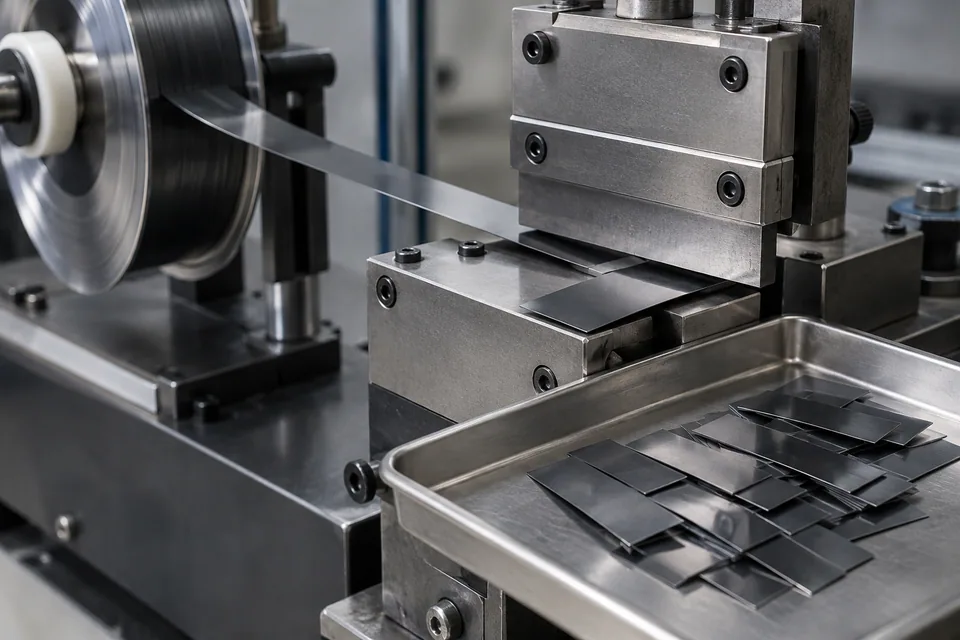
Proterial’s FINEMET manufacturing description makes the order of operations explicit: rapidly quenched amorphous ribbon is formed and subsequently heat-treated to create a nanocrystalline core. A primary experiment on a Fe-Ni-B-Nb-Si amorphous precursor cut ribbon across its width with shears before annealing the pieces. That laboratory route supports the concept of pre-anneal crosscutting, but its composition differs from the Fe-Si-B-Nb-Cu family discussed here. Metglas identifies FT-3W as an amorphous precursor capable of later nanocrystallization. This guide concerns discrete flat lengths cut from an unannealed Fe-Si-B-Nb-Cu-type precursor, only where the buyer’s stack or test-piece process calls for them. It does not imply that ordinary bare FINEMET wound cores are routinely chopped into strips, nor that a sheared edge guarantees magnetic properties after anneal.
Updated
Where This Cutting Application Appears
Confirm why discrete lengths are needed
Start with a released lamination or coupon drawing rather than a generic core-width request. Define whether the lengths form a flat magnetic sheet precursor, a stack experiment or another buyer-approved configuration. Most toroidal core routes wind continuous ribbon instead; do not insert an unnecessary crosscut step into that process.
Control feed and transverse support
Hold the very thin web flat at the shear line without stretching it. Record unwind direction, free-side orientation and feed registration. Inspect both sides of the transverse cut for folded lips, small cracks and brittle flakes; the first end of the next length deserves the same inspection as the outgoing blank.
Preserve the sequence of fragile strips
Measure length and squareness on a supported fixture. Transfer pieces to an agreed tray or interleaf so that a sharp end does not kink the next piece. Keep source-coil position and cut direction with the stack because the buyer may compare edge location after heat treatment.
Validate after the buyer’s anneal
Build a small representative stack and apply only the approved thermal cycle. Check post-anneal part integrity and magnetic behavior under the customer’s test conditions. An experimental shear-cut example supports feasibility, not a universal production tolerance or performance claim.
Define the Required Cut Result
- Create documented flat lengths from still-amorphous precursor.
- Keep both transverse ends free of cracks and loose chips.
- Avoid handling damage during stacking.
- Maintain traceability through annealing and testing.
Problems to Diagnose Before Changing the Knife
A cut end curls or buckles
- Review strip support, blade contact and feed pressure.
- Compare both cut directions and faces.
Short lengths fracture during pickup
- Inspect end chips and tray support.
- Review whether the part was already annealed.
Measured lengths vary through the reel
- Check feed slip, registration and coil tension.
- Sample a sequence across reel positions.
Knife Forms That May Be Considered
| Possible knife form | When it may be considered | What must be confirmed |
|---|---|---|
| Supported transverse shear blades | For unannealed precursor strips with a released straight-end drawing. | Confirm both-end quality, length and handling survival. |
| Alternative owner-approved cut route | Where a required contour or fragile state defeats a straight shear trial. | Validate edge and post-anneal performance using the specified material. |
Information to Send for Technical Review
You do not need to know the exact blade name. Send the available workpiece, machine, current-knife and cut-result information so the application can be reviewed against a drawing or sample.
- Alloy composition and proof of unannealed state
- Purpose of flat lengths versus continuous winding
- Cut length, squareness and orientation drawing
- Source roll width, thickness and lot
- Strip support and transfer fixture
- Allowed curl, crack and particle examples
- Stack/interleaf and anneal instructions
- Post-anneal magnetic test plan
Questions About This Cutting Application
When does the ribbon become nanocrystalline?
After the owner’s controlled heat treatment, not during this unannealed crosscut step.
Do normal wound cores require this cut?
Not generally. Use it only for a specified discrete-strip route.
Does a study prove production shears work for every alloy?
No. The cited experiment used a different Fe-Ni-bearing alloy; the exact Fe-Si-B-Nb-Cu grade and line need their own trial.
Why examine both ends?
One shear stroke creates an outgoing-piece end and the next incoming end.
What belongs in the first RFQ?
Send the material-state certificate, piece drawing and intended anneal sequence.
Public references and scope
These public sources provide material, cutting-method or safety context for this guide. Supplier pages describe their own materials or equipment; they do not establish a MEIRENTE blade specification or performance claim. Confirm the actual grade, machine setup and required cut with a drawing or sample.
Related product and service information
- Nanocrystalline-Alloy Precursor Ribbon Precision Coil Slitting Blades - nanocrystalline-alloy amorphous precursor ribbon · precision coil slitting
- Amorphous Metal Ribbon Cut-to-Length Blades - amorphous metal ribbon · cut to length
- Beryllium-Copper Foil Cut-to-Length Blades - beryllium-copper foil · cut to length
Request a Custom Cutting-Knife Review
Send the workpiece details, machine or holder information, current knife photos or sample, required quantity and examples of the present cut problem. Final dimensions, material, edge geometry and tolerances are confirmed from the approved requirements.