
Blade Application Guides / Application Guide / Specialty metal converting
Amorphous Metal Ribbon Cut-to-Length Blades
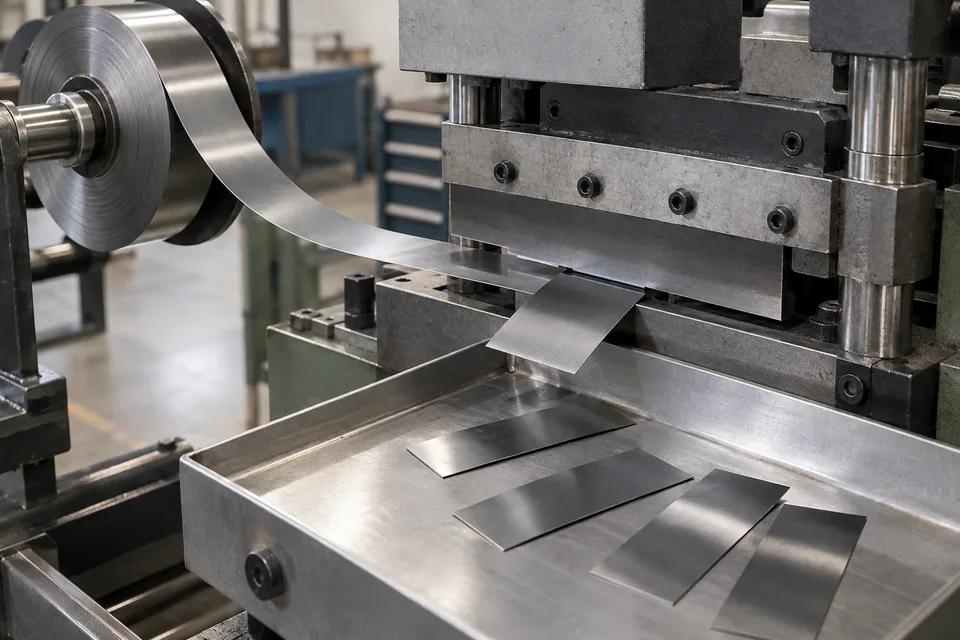
Metglas identifies amorphous alloy as rapidly cast thin ribbon that can be punched, stamped or wound. Its transformer brochure shows ribbon entering coiled core production, while magnetic properties depend on alloy and processing state. This page addresses transverse cutting of a loose ribbon into flat lengths under a core maker’s drawing, before stacking, lap-joint assembly or final annealing. The route is not a request to chop a fully built transformer core with a web blade. Hard ribbon and sharp edges call for supported feed, clear length control and careful part pickup. The buyer must validate how cut ends fit the actual core joint and then verify finished magnetic performance.
Updated
Where This Cutting Application Appears
Translate a core drawing into strip lengths
Define strip length, end geometry, sequence number and which ends form the lap joint. Identify whether sheets will be nested, stacked or built into a wound-core joint. Record machine direction so every cut piece enters the stack in the intended orientation.
Support the cross-cut line
Use a clamped or otherwise restrained feed during a trial so the thin strip cannot buckle at blade entry. Compare first and second ends of each length for squareness, curling and local cracks. Collect a reference cut from the source ribbon without handling it through the production stacker.
Handle pieces without edge damage
Transfer short ribbons with a defined support surface and interleaf where required. Check whether the cut edge catches on neighboring laminations or creates loose shards as the stack is built. Reject bent or kinked lengths before they hide inside the packet.
Check the assembled joint separately
Measure individual length on a flat fixture and inspect the cut face, then build a small trial stack with the buyer’s lap pattern. Gap and overlap performance cannot be inferred from flat-strip dimensions alone. Follow the core maker’s anneal and magnetic test sequence before release.
Define the Required Cut Result
- Cut documented ribbon lengths with end orientation traceability.
- Keep both cut ends free of chips, folds and loose particles.
- Prevent handling kinks in thin core laminations.
- Support downstream stack and joint fit trials.
Problems to Diagnose Before Changing the Knife
Cut ends curl upward
- Review blade entry and strip restraint.
- Compare the two faces and cut directions.
Repeated lengths drift
- Check feed registration, slip and measured coil tension.
- Measure lengths at reel start, middle and end.
Lap joint shows inconsistent gap
- Inspect stack sequence and end squareness.
- Separate cutting variation from assembly placement.
Knife Forms That May Be Considered
| Possible knife form | When it may be considered | What must be confirmed |
|---|---|---|
| Supported transverse shear pair | When straight ribbon lengths are released for stacking. | Confirm squareness, both-edge condition and repeatable length. |
| Profiled die or staged cut | Where the approved joint drawing requires a shaped end rather than a straight shear. | Verify registered profile and tool wear on the actual thin alloy. |
Information to Send for Technical Review
You do not need to know the exact blade name. Send the available workpiece, machine, current-knife and cut-result information so the application can be reviewed against a drawing or sample.
- Alloy grade and processing state
- Ribbon width, thickness and coil orientation
- Core strip length and lap-joint drawing
- Allowed end squareness, curl and particle limits
- Feed registration and strip support method
- Cut-piece stacking and interleaf instructions
- Lot and sequence labeling
- Finished core anneal and magnetic test responsibility
Questions About This Cutting Application
Is cut to length the same as slitting?
No. It separates across ribbon travel to make discrete lengths; slitting divides width along travel.
Can a blade cut a completed core here?
No. This guide covers a loose ribbon before core assembly.
What defect hides during stacking?
A small kink or chip at one end can be buried under later laminations.
Does end squareness guarantee low loss?
No. Stack geometry, anneal and final magnetic tests determine finished performance.
What drawing must accompany an RFQ?
Provide the strip schedule and joint sequence, including any staggered end lengths.
Public references and scope
These public sources provide material, cutting-method or safety context for this guide. Supplier pages describe their own materials or equipment; they do not establish a MEIRENTE blade specification or performance claim. Confirm the actual grade, machine setup and required cut with a drawing or sample.
Related product and service information
- Amorphous Metal Ribbon Precision Blanking Blades - amorphous metal ribbon · precision blanking
- Nanocrystalline-Alloy Precursor Ribbon Cut-to-Length Blades - nanocrystalline-alloy amorphous precursor ribbon · cut to length
- Beryllium-Copper Foil Cut-to-Length Blades - beryllium-copper foil · cut to length
Request a Custom Cutting-Knife Review
Send the workpiece details, machine or holder information, current knife photos or sample, required quantity and examples of the present cut problem. Final dimensions, material, edge geometry and tolerances are confirmed from the approved requirements.