
Blade Application Guides / Application Guide / Specialty metal converting
Beryllium-Copper Foil Cut-to-Length Blades
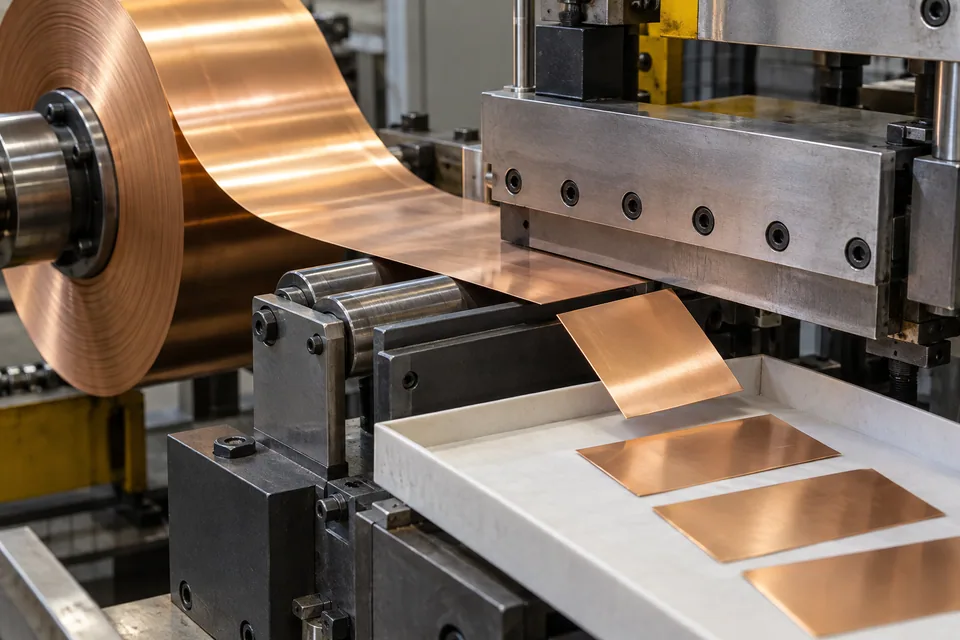
NGK describes copper-beryllium strip in coil and cut-to-length forms and lists several alloys and tempers. TOKKIN also lists C1720 copper-beryllium with ultra-thin foil processing options. This guide addresses a straight transverse cut from an identified foil or thin strip coil to make flat rectangular blanks; it does not cover punching finished connector profiles. The buyer must specify alloy, temper, gauge and blank length, since a cut in age-hardenable stock may behave differently from one in a harder mill-hardened coil. The cutting station should restrain the strip, retain rolling-direction identity and collect scrap under the site’s beryllium-containing material controls. A flat blank is only an input to subsequent forming, aging, plating or assembly tests.
Updated
Where This Cutting Application Appears
Set the blank orientation from the part route
Take length and width from the approved process drawing, including grip or trimming allowance. Mark rolling direction if later bends or stamped spring fingers depend on it. Keep grade and temper identifiers with every stack; appearance alone will not distinguish copper-beryllium alloy variants.
Support the thin strip at the transverse blade
Feed the coil across a flat support and trial a matched shear on a representative sample. Check whether the blank tail kicks upward, twists or develops a raised lip. Inspect both newly created ends, including the end remaining on the parent coil.
Measure after the blank relaxes
Record length, squareness and flatness after cutting and safe handling. Check for edge burrs that could snag a forming tool or contaminate plating. Compare first and last pieces to catch feed slip or blade wear instead of relying only on the setup sample.
Transfer blanks into controlled downstream work
Stack with agreed interleaf or trays to prevent metal-to-metal scratches and preserve direction. Follow the material owner’s housekeeping instructions for particles and offcuts. The connector maker must validate bend quality and electrical or spring performance after its complete forming and heat-treatment route.
Define the Required Cut Result
- Produce released rectangular blank lengths.
- Keep both transverse edges within the buyer’s burr and squareness criteria.
- Avoid kinks and surface scratches during stacking.
- Maintain alloy and temper traceability.
Problems to Diagnose Before Changing the Knife
One end has a lifted lip
- Check shear support, blade engagement and temper.
- Inspect both cut ends and both foil faces.
Blank length drifts through the coil
- Review feed registration and slip at changing coil diameter.
- Measure a sequence across the production run.
Blanks curl in the stack
- Compare incoming coil set, handling pressure and cut direction.
- Check after relaxation under the buyer’s method.
Knife Forms That May Be Considered
| Possible knife form | When it may be considered | What must be confirmed |
|---|---|---|
| Supported transverse shear blades | For a straight rectangular blank made from a released coil specification. | Confirm two-end burr shape, length, squareness and flatness. |
| Profile die for later part operation | Only when the buyer also specifies contour features that a straight cut cannot make. | Approve the added die step separately from basic blank-length acceptance. |
Information to Send for Technical Review
You do not need to know the exact blade name. Send the available workpiece, machine, current-knife and cut-result information so the application can be reviewed against a drawing or sample.
- Alloy grade, temper and coil certification
- Foil gauge, width and rolling direction
- Blank length, squareness and flatness drawing
- Allowed burr and surface damage examples
- Feed support and shear blade setup
- Handling, stack and packaging instructions
- Site extraction and scrap procedure
- Subsequent forming, aging and electrical test owner
Questions About This Cutting Application
Is cutting foil lengths the same as blanking contacts?
No. These are simple rectangular feed blanks; contact profiles need a separate die process.
Why does temper matter for a straight cut?
A harder or softer supply state changes cut-edge and flatness behavior.
Does the blade establish final spring force?
No. Forming, aging and component tests remain downstream.
Why inspect the parent-coil end too?
It becomes the first end of the next blank and may carry a different lip.
What is needed to quote the job?
Send the exact alloy and temper, roll sample, cut length and edge inspection standard.
Public references and scope
These public sources provide material, cutting-method or safety context for this guide. Supplier pages describe their own materials or equipment; they do not establish a MEIRENTE blade specification or performance claim. Confirm the actual grade, machine setup and required cut with a drawing or sample.
Related product and service information
- Beryllium-Copper Foil Precision Blanking Blades - beryllium-copper foil · precision blanking
- Amorphous Metal Ribbon Cut-to-Length Blades - amorphous metal ribbon · cut to length
- Nanocrystalline-Alloy Precursor Ribbon Cut-to-Length Blades - nanocrystalline-alloy amorphous precursor ribbon · cut to length
Request a Custom Cutting-Knife Review
Send the workpiece details, machine or holder information, current knife photos or sample, required quantity and examples of the present cut problem. Final dimensions, material, edge geometry and tolerances are confirmed from the approved requirements.