
Blade Application Guides / Application Guide / Beverage carton and PolyAl recycling
Aseptic Beverage Carton Recycling Shredder Knives
Aseptic beverage carton recycling shredder knives process post-consumer packs made from paperboard with polymer and, in many constructions, aluminum layers. Plants may pre-shred whole cartons before pulping or reduce recovered PolyAl residue for another route. Review should distinguish these streams and define moisture, closures, contamination, target output, downstream process and shredder interface.
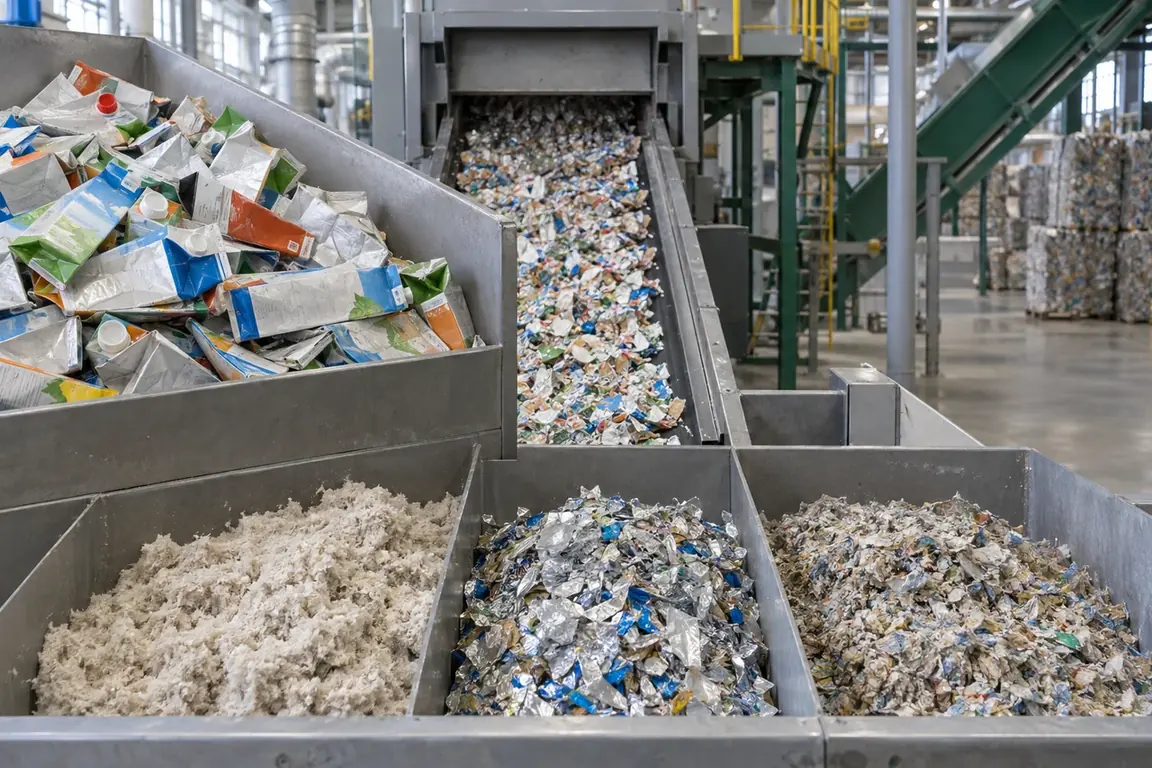
Where This Cutting Application Appears
Whole-carton preparation before pulping
Collected beverage cartons are reduced to support the defined fiber-recovery process.
Full-carton composite-board feed
Multilayer material is reduced before controlled pressing or another approved route.
Recovered PolyAl residue size reduction
Polymer-and-aluminum residue is prepared for agglomeration, granulation or further recycling.
Common Ways to Describe This Cutting Problem
- aseptic beverage carton recycling shredder knives
- post-consumer drink carton shredder blades
- paper plastic aluminum carton cutting knives
- PolyAl residue granulator blades
- milk and juice carton recycling cutter
- multilayer carton pre-shredder knife
- beverage carton film wrapping rotor problem
- replacement knives for carton recycling line
Define the Required Cut Result
- Reliable engagement of flattened, folded and nested cartons without bridging.
- Controlled reduction without long connected polymer-aluminum strips.
- Stable operation across documented moisture and contamination.
- Output matched to pulping, pressing or PolyAl recovery.
Problems to Diagnose Before Changing the Knife
Flattened cartons bridge above the rotor
- Document bulk density, flattening, moisture and hopper behavior.
- Review engagement, feeder and chamber opening from drawings.
- Compare loose, baled and pre-opened feed.
Polymer and aluminum form long wrapped strips
- Identify whether whole cartons or PolyAl initiates wrapping.
- Inspect stripper, counter-knife and rotor relationships.
- Record buildup direction and operating interval.
Contamination accelerates wear or damage
- Characterize permitted closures, dirt and sorting residues.
- Map wear and impacts against feed batches.
- Review upstream sorting and reject controls.
Output is unsuitable for the next stage
- Define downstream acceptance rather than a generic size.
- Sample paper-rich and PolyAl-rich fractions separately.
- Review knife condition, screen, recirculation and feed variation.
Knife Forms That May Be Considered
| Possible knife form | When it may be considered | What must be confirmed |
|---|---|---|
| Hooked rotor knife and counter-knife arrangement | For shredders pulling folded cartons into a controlled chamber. | Rotor pockets, counter-knife, stripper, feed system, contamination and output. |
| Intermeshing rotary-shear knife set | For primary reduction of bulky cartons or compacted feed. | Shaft interface, sequence, spacers, tooth profile, feed state and discharge. |
| Granulator rotor-and-stator knife set | For secondary reduction of cartons or PolyAl residue. | Material state, chamber, screen, speed range, target output and wear samples. |
Information to Send for Technical Review
You do not need to know the exact blade name. Send the available workpiece, machine, current-knife and cut-result information so the application can be reviewed against a drawing or sample.
- Feed definition: whole cartons, pre-shredded cartons or PolyAl.
- Carton constructions, closures and accepted contamination.
- Moisture, bale or loose-feed format and handling method.
- Downstream pulping, pressing, agglomeration or granulation.
- Machine model, hopper, feeder and chamber drawings.
- Existing rotor, stator, spacer and counter-knife information.
- Output sampling plus accepted and rejected material.
- Wear history, wrapping locations, cleaning and trial quantity.
Questions About This Cutting Application
How does this differ from corrugated-cardboard shredding?
Aseptic cartons combine paperboard with polymer and sometimes aluminum.
Should whole cartons and PolyAl use one review?
No; they are distinct feeds with different downstream objectives.
Why document caps and closures?
They change feed composition, impact exposure and flexible-material behavior.
What helps diagnose bridging?
Provide feed format, moisture, hopper and feeder details and bridge-location images.
Can one shred size suit every route?
No; output must follow the plant pulping, pressing or PolyAl process.
Request a Custom Cutting-Knife Review
Send the workpiece details, machine or holder information, current knife photos or sample, required quantity and examples of the present cut problem. Final dimensions, material, edge geometry and tolerances are confirmed from the approved requirements.