
Blade Application Guides / Application Guide / Aerospace composite manufacturing
Lightning-Strike Protection Mesh Sheet Slitting Blades
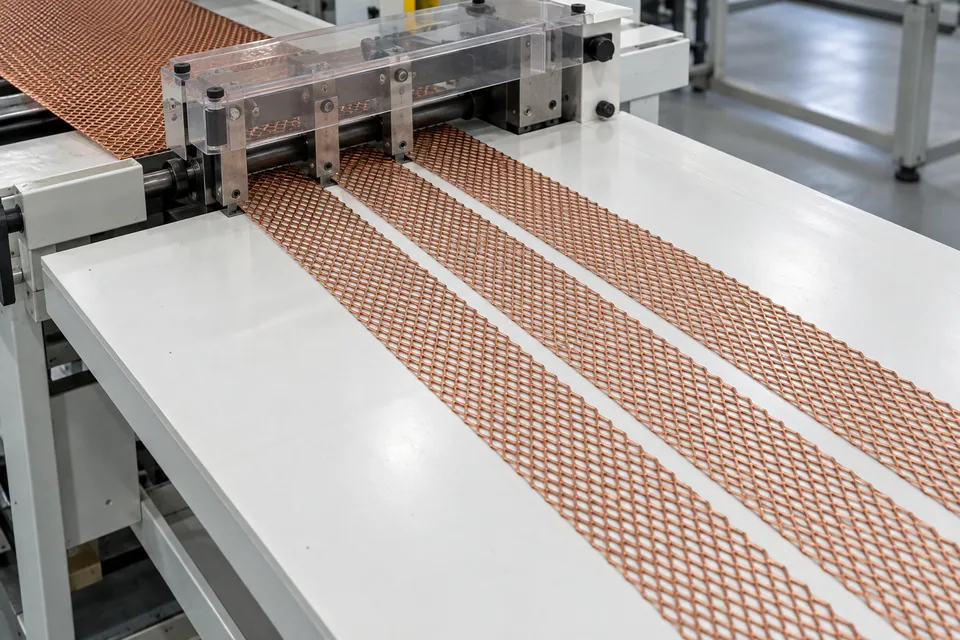
Expanded metal foil mesh is one material used in lightning-strike protection layers on composite structures. The Expanded Metal Company describes tailored conductive micromesh for that application and separately lists cutting and shearing among its metal-fabrication operations. This guide concerns an independent, unembedded mesh sheet or foil supplied for conversion. Sheet slitting means making long straight bands from that existing mesh; it is not the factory slitting-and-stretching step that creates expanded metal apertures. The buyer must define alloy, strand pattern, orientation, required overlap and the later resin or prepreg integration. A straight cut does not establish lightning-strike qualification of the final structure.
Updated
Where This Cutting Application Appears
Orient the open-cell pattern before cutting
Use the supplier drawing to mark long-way and short-way mesh pitch as well as the intended installation direction. A strip with correct width but rotated aperture geometry may not fit the layup or overlap plan. Identify raised versus flattened mesh and any carrier before choosing a support surface.
Support intermittent metal strands
Unlike continuous foil, the cutter meets metal only at each mesh strand. Trial a shearing or other controlled straight-cut geometry on the actual foil so strands do not lift into the blade gap or snag. Collect narrow scrap without dragging it across the retained network.
Inspect the edge as an open network
Measure band width from agreed strand or aperture datums. Look for projecting points, detached metal fragments, collapsed cells and local unraveling. Examine both edges; a favorable top view can hide a bent strand below the mesh plane.
Pass strips to layup evaluation
Position cut bands on the buyer’s composite tool with its specified overlap or joint. Verify flatness and orientation without claiming a prescribed electrical path. Conductivity, adhesion and lightning-strike behavior are qualified by the buyer in the final laminate.
Define the Required Cut Result
- Make straight mesh bands at the specified orientation.
- Keep adjacent apertures open and strands attached.
- Avoid metal splinters in the composite layup area.
- Provide geometry evidence for buyer laminate testing.
Problems to Diagnose Before Changing the Knife
Strands hook into the cutter
- Check edge support and shear clearance.
- Review mesh profile and strand angle.
- Inspect blade damage after a short trial.
Sharp protrusions remain at the retained edge
- Compare both sides of the cut.
- Check whether cutting passes through nodes or open cells.
- Review acceptable end geometry with the buyer.
Strip distorts after handling
- Measure with low repeatable tension.
- Inspect waste pull and stacking.
- Compare incoming mesh flatness.
Knife Forms That May Be Considered
| Possible knife form | When it may be considered | What must be confirmed |
|---|---|---|
| Supported straight shear edges | For thin expanded mesh sheet that can be restrained at the cut. | Confirm all strands part without bent cells or detached shards. |
| Guided guillotine sheet cut | For discrete long straight bands from a flat supplied panel. | Inspect blade clearance and mesh support on actual alloy and gauge. |
Information to Send for Technical Review
You do not need to know the exact blade name. Send the available workpiece, machine, current-knife and cut-result information so the application can be reviewed against a drawing or sample.
- Mesh supplier, alloy and foil grade
- Expanded pattern, pitch and orientation
- Raised/flattened and carrier state
- Sheet size and target band drawing
- Layup overlap and no-cut zones
- Allowed loose strands and sharp points
- Cut support and waste collection
- Buyer composite and lightning qualification plan
Questions About This Cutting Application
Is this cutting operation how expanded mesh is manufactured?
No. It divides an already expanded sheet; making the apertures uses a different slit-and-stretch process.
Can a continuous foil cutting rule be copied?
No. An open mesh needs strand and node inspection as well as width measurement.
Why record aperture direction?
The mesh pattern and intended placement direction must match the buyer’s layup drawing.
Does a clean mesh band prove lightning protection?
No. The buyer qualifies the integrated composite structure.
What should a sample include?
Send the exact mesh foil with alloy, pattern direction, support and acceptance drawing.
Public references and scope
These public sources provide material, cutting-method or safety context for this guide. Supplier pages describe their own materials or equipment; they do not establish a MEIRENTE blade specification or performance claim. Confirm the actual grade, machine setup and required cut with a drawing or sample.
Related product and service information
- Thermoplastic PEEK Composite Tape Contour Cutting Blades - thermoplastic PEEK composite tape · contour cutting
- Cyanate-Ester Prepreg Sheet Slitting Blades - cyanate-ester prepreg · sheet slitting
- Lightning-Strike Protection Mesh Cut-to-Size Blades - lightning-strike protection mesh · cut to size
Request a Custom Cutting-Knife Review
Send the workpiece details, machine or holder information, current knife photos or sample, required quantity and examples of the present cut problem. Final dimensions, material, edge geometry and tolerances are confirmed from the approved requirements.