
Blade Application Guides / Application Guide / Technical films
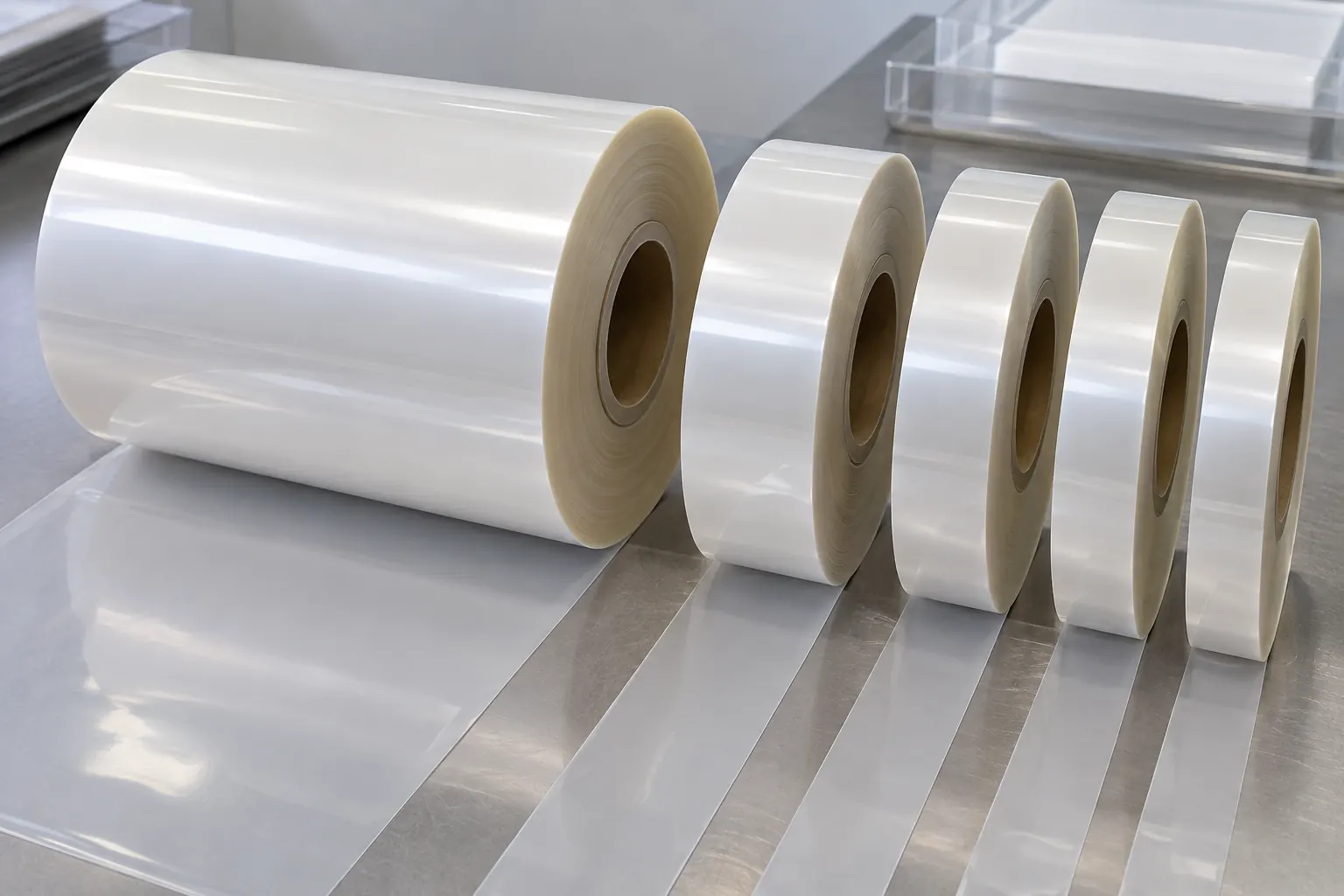
Laser-Printable Film Roll Slitting
Laser-printable film includes a heat-resistant carrier and a toner-receptive surface, sometimes with adhesive and release liner. Edge debris, coating scratches or curl can disturb printer feeding and toner fusion. A slitting review should identify the exact printable face and validate finished reels in the intended print process.
Updated
Where This Cutting Application Appears
Laser label face stock
Slit printable adhesive constructions into widths for label conversion or digital printing.
Synthetic document film
Prepare durable printable media reels with clean edges and controlled curl.
Laser imaging and transfer media
Convert coated film where surface cleanliness affects toner acceptance and feed reliability.
Roll Slitting process boundary
Roll slitting divides a master roll longitudinally into narrower rolls; it does not separate the web transversely into sheets or fixed lengths.
Roll Slitting setup checkpoint
Confirm unwind and rewind tension, slit widths, knife positions, core alignment, trim removal and the winding behavior of every daughter roll.
Roll Slitting acceptance checkpoint
Inspect roll width, edge condition, telescoping, interleaving, debris and whether each rewound roll remains stable at the required diameter.
Define the Required Cut Result
- Protect the toner-receptive surface from scratches and debris.
- Maintain width and film-to-liner alignment.
- Limit edge dust, coating chips and adhesive buildup.
- Produce reels that unwind and feed without curl or telescoping.
Problems to Diagnose Before Changing the Knife
Printable coating chips at the slit edge
- Identify coating chemistry and thickness.
- Inspect coated-face orientation and support.
- Compare edge debris under magnification.
Printer reports skew or feed jams
- Measure reel width and edge straightness.
- Review curl, roll hardness and core alignment.
- Test representative finished reels.
Adhesive transfers to reel edge
- Record adhesive type and temperature.
- Check liner registration and winding pressure.
- Inspect buildup location over time.
Finished media curls toward one face
- Review coating and liner stress balance.
- Mark winding orientation.
- Condition samples before measurement.
Knife Forms That May Be Considered
| Possible knife form | When it may be considered | What must be confirmed |
|---|---|---|
| Circular shear slitting arrangement | For supported coated or lined printable-film structures. | Confirm layer stack, overlap, side load, rotation, holder and printer-width tolerance. |
| Razor slitting arrangement | For compatible thin unlined films on purpose-designed clean razor stations. | Confirm coating sensitivity, support, holder, exposure, speed and debris extraction. |
Information to Send for Technical Review
You do not need to know the exact blade name. Send the available workpiece, machine, current-knife and cut-result information so the application can be reviewed against a drawing or sample.
- Carrier resin, gauge and toner-receptive coating construction
- Adhesive and release-liner details where present
- Printable-face orientation and allowed contact surfaces
- Master-roll size, target widths and dimensional tolerance
- Speed, tension, static, cleanliness and web temperature
- Existing slitting form, holder interface and used sample
- Limits for coating chips, dust, curl, adhesive and edge wave
- Printer model or process, feed direction, packing and production quantity
Questions About This Cutting Application
Why does a printable coating matter to slitting?
A brittle or filled receptor coating may chip differently from the carrier and create particles that affect printing.
Can printer feed problems come from winding?
Yes. Telescoping, curl, edge wave and core alignment can cause skew even when the cut edge looks clean.
Should print testing follow a slitting trial?
Yes. Toner adhesion, feed, registration and contamination should be checked on the intended process.
Can lined and unlined films use one assumption?
No. A liner changes thickness, stiffness, layer alignment and adhesive-edge behavior.
What marks the printable face?
Use supplier data and labelled samples; do not infer it only from gloss or surface feel.
Related product and service information
- Laser-Printable Film Edge Trimming - laser-printable film · width edge trimming
- Window Tint Film Roll Slitting - window tint film · roll slitting
- Holographic Transfer Film Roll Slitting - holographic transfer film · roll slitting
Request a Custom Cutting-Knife Review
Send the workpiece details, machine or holder information, current knife photos or sample, required quantity and examples of the present cut problem. Final dimensions, material, edge geometry and tolerances are confirmed from the approved requirements.