
Blade Application Guides / Application Guide / Technical films
Anti-Fog Packaging Film Edge Trimming
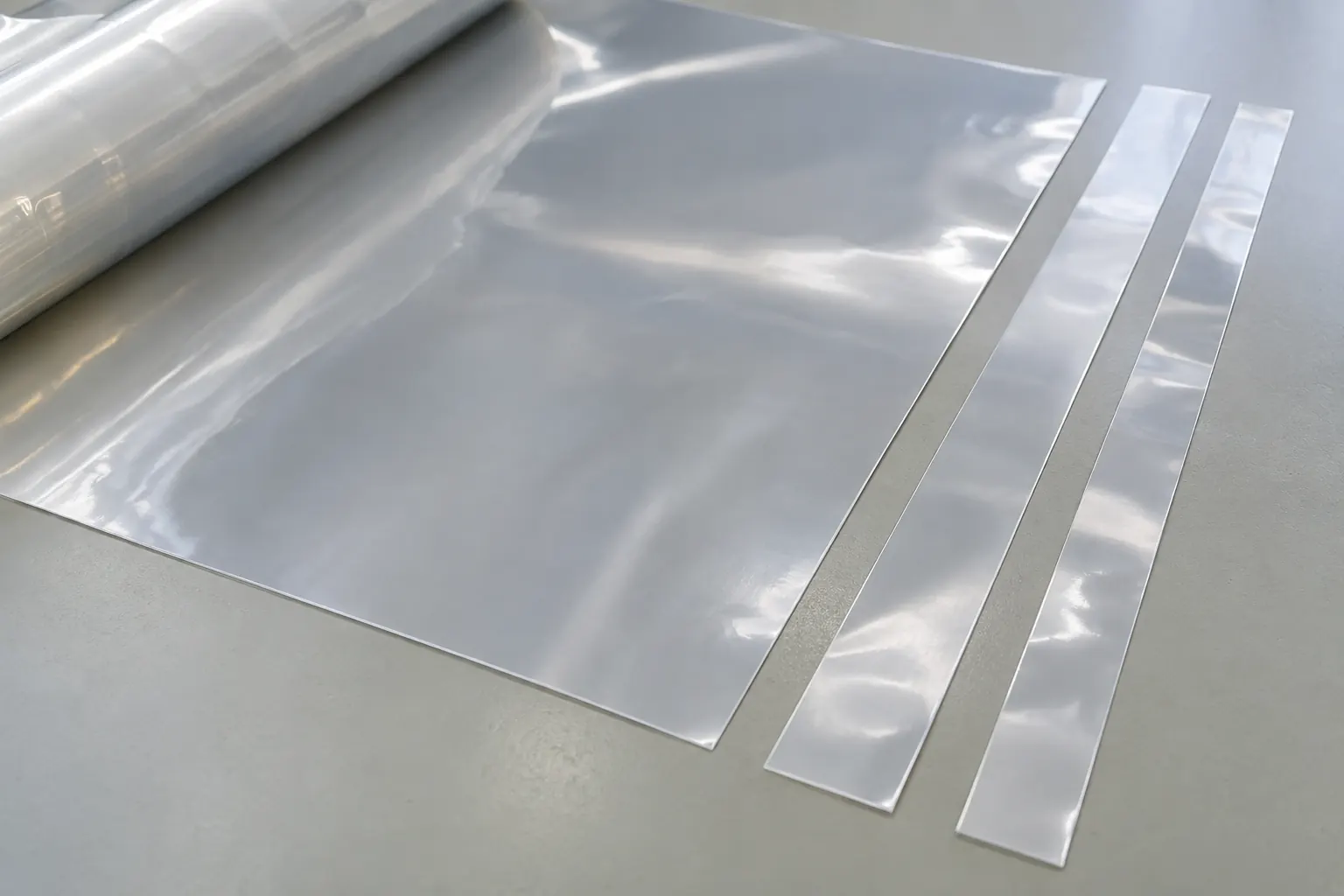
Anti-fog coating or additive distribution can differ near a cast, coated or laminated web margin. Edge trimming removes unstable edges and establishes usable width before sealing or rewinding. The review should map the active treatment boundary and prevent trim debris or transferred surface material from reaching the food-contact web.
Updated
Where This Cutting Application Appears
Treatment-margin removal
Remove edges with incomplete, heavy or contaminated anti-fog treatment.
Lidding-web final sizing
Establish the width used by tray-sealing and converting equipment.
Extrusion-edge cleanup
Trim thick or unstable cast-film margins before finished winding.
Width Edge Trimming process boundary
Width edge trimming removes controlled side margins to establish parallel finished edges and final web width; it is not a transverse length cut.
Width Edge Trimming setup checkpoint
Define both finished edge positions, centerline control, side guidance, trim width and reliable removal of the two continuous edge strips.
Width Edge Trimming acceptance checkpoint
Measure finished width across the run and inspect parallelism, camber, burr or fray, surface damage and trim-break frequency.
Define the Required Cut Result
- Remove defective margin while preserving full usable treated width.
- Maintain a continuous trim ribbon without transfer to the web.
- Limit particles, streaks and raised edge lips.
- Deliver clean edges compatible with downstream sealing.
Problems to Diagnose Before Changing the Knife
Treated margin smears during trimming
- Identify active face and treatment chemistry.
- Record temperature and storage age.
- Map contact and trim extraction surfaces.
Trim ribbon sticks to finished web
- Check static, surface tack and ribbon path.
- Review extraction tension and airflow.
- Inspect winding orientation.
Usable anti-fog width is inconsistent
- Map treatment boundary across the roll.
- Review guiding datum.
- Measure edge-to-active-area distance.
Finished edge curls into the seal zone
- Inspect gauge and treatment asymmetry.
- Review web tension and trim deformation.
- Measure after conditioning.
Knife Forms That May Be Considered
| Possible knife form | When it may be considered | What must be confirmed |
|---|---|---|
| Circular shear edge-trim arrangement | For supported final-width trimming of treated or multilayer food film. | Confirm resin stack, treatment face, overlap, side load, holder, trim path and hygiene controls. |
| Supported razor edge-trim arrangement | For compatible thin anti-fog web on a clean purpose-designed station. | Confirm support, blade exposure, speed, treatment sensitivity, holder and debris collection. |
Information to Send for Technical Review
You do not need to know the exact blade name. Send the available workpiece, machine, current-knife and cut-result information so the application can be reviewed against a drawing or sample.
- Film resin, gauge, layers and anti-fog treatment mechanism
- Treatment boundary and active-face orientation
- Incoming width, defective margin and required usable width
- Trim width, ribbon route and extraction method on each side
- Speed, tension, temperature, humidity and static control
- Existing trimming form, support, holder and used sample
- Limits for smear, debris, curl, lip and seal-area cleanliness
- Downstream sealing and cold-chain test, packing and production volume
Questions About This Cutting Application
Why map the anti-fog boundary before trimming?
Treatment coverage may not align perfectly with the physical web edge, so usable width can differ from total width.
Can trim ribbon contaminate finished film?
Yes. Static, tack or poor extraction can return ribbon or surface material to the product web.
What causes a curled trimmed edge?
Gauge asymmetry, treatment stress, web tension and local edge deformation are possible contributors.
Should food-packaging cleanliness be part of review?
Yes. Material handling, debris control and the customer's applicable hygiene requirements must be documented.
How is trimming linked to seal quality?
Particles, curl or treatment transfer at the edge can enter the seal area and should be checked in representative packs.
Related product and service information
- Anti-Static Protective Film Roll Slitting - anti-static protective film · roll slitting
- Window Tint Film Edge Trimming - window tint film · width edge trimming
- Holographic Transfer Film Edge Trimming - holographic transfer film · width edge trimming
Request a Custom Cutting-Knife Review
Send the workpiece details, machine or holder information, current knife photos or sample, required quantity and examples of the present cut problem. Final dimensions, material, edge geometry and tolerances are confirmed from the approved requirements.