
Blade Application Guides / Application Guide / flooring manufacturing
Cutting Laminate Flooring Planks
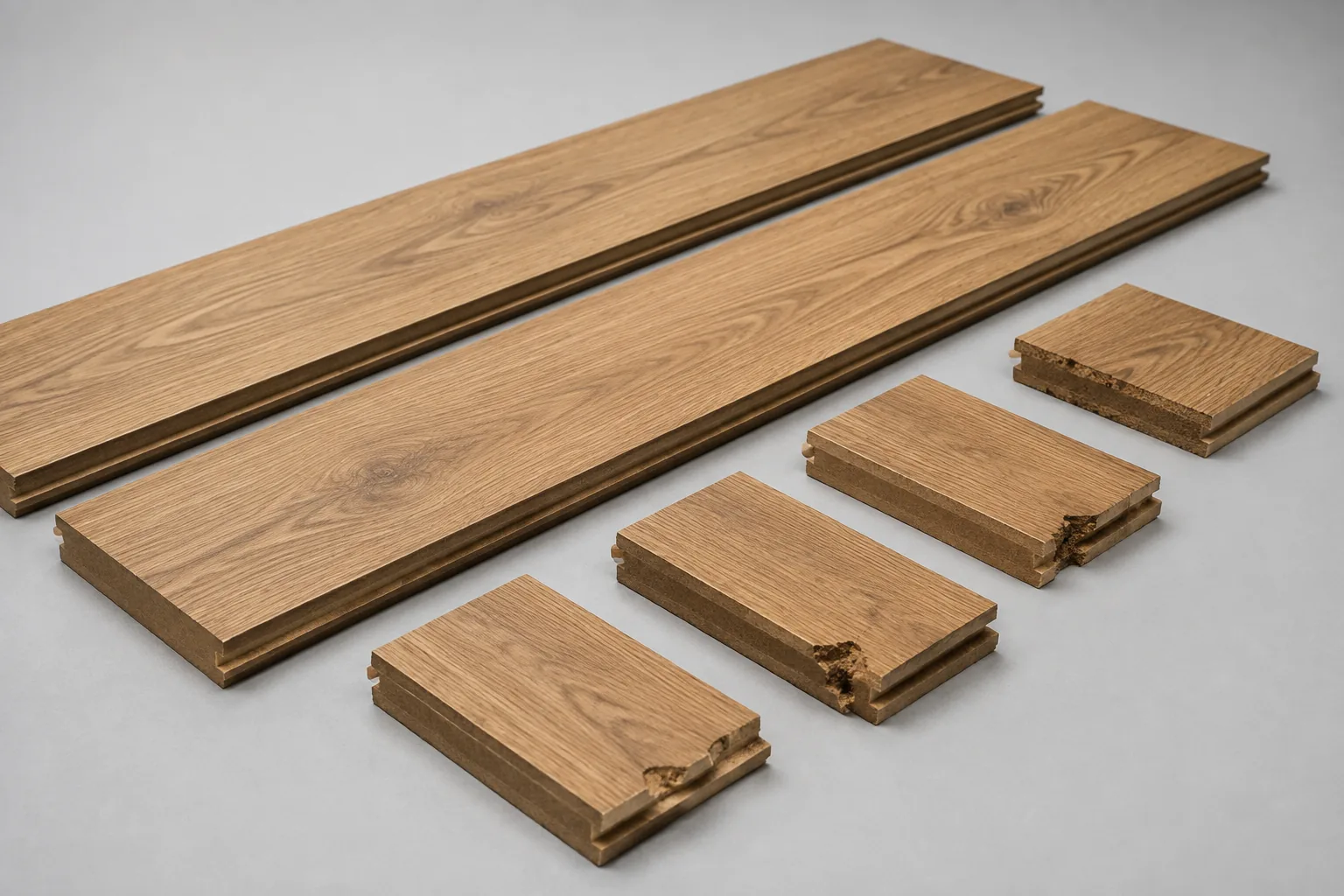
A laminate plank places an abrasion-resistant decorative surface over a dense fiberboard core, with profiled long edges that must remain undamaged. End cutting needs firm support beneath the plank and accurate registration from the tongue-and-groove datum so decorative chips do not become assembly gaps.
Updated
Where This Cutting Application Appears
Continuous-plank end sizing
Cuts profiled flooring boards to standard length after surface lamination and edge machining.
Random-length product conversion
Produces scheduled length mixes while the stop, feed and label data remain synchronized.
Sample and display-board cutting
Makes shorter presentation pieces without cracking the decorative surface or crushing the locking profile.
Cross-Cutting And End Sizing process boundary
cross-cutting and end sizing for laminate flooring planks is a linked sequence: the output condition and datum from each operation become the controlled input for the next. It should not be evaluated as one generic cut or accepted only by the final dimension.
Cross-Cutting And End Sizing setup checkpoint
For laminate flooring planks, define the operation order, intermediate dimensions, registration transfer, material support, web or part handling and waste route for every stage of cross-cutting and end sizing.
Cross-Cutting And End Sizing acceptance checkpoint
Verify both intermediate and final results from cross-cutting and end sizing, including dimensions, registration, edge or feature quality, material damage, waste separation and stable transfer between stages.
Define the Required Cut Result
- Square ends referenced to the plank profile
- Low top-surface and bottom-core chipping
- Stable finished length
- Unmarked tongue-and-groove edges
Problems to Diagnose Before Changing the Knife
Decorative layer chips at the end
- Confirm cutter rotation and entry face
- Inspect tooth sharpness and wear-layer abrasion
- Check scoring or backing support
HDF core breaks below the surface
- Support the exit edge
- Inspect core density and moisture
- Review feed rate and tooth spacing
End is not square to the locking edge
- Locate from the correct profile datum
- Check fence and spindle alignment
- Inspect plank bow and guide pressure
Length changes during the shift
- Calibrate stops and encoders
- Check feed slip from dust
- Monitor tool and bearing temperature
Knife Forms That May Be Considered
| Possible knife form | When it may be considered | What must be confirmed |
|---|---|---|
| wear-resistant toothed cutoff cutter | A rigid circular cutter with abrasion-resistant tips may suit high-volume cross-cutting when tooth geometry protects both laminate and HDF. | Confirm final geometry and mounting from the flooring-plank cutoff spindle, an unworn sample or an approved drawing before manufacture. |
| scoring and main cutter pair | A shallow scoring tool can protect a designated face where the production line maintains exact kerf alignment. | Confirm final geometry and mounting from the dual-tool flooring cutoff station, an unworn sample or an approved drawing before manufacture. |
| thin-kerf circular cutter | A thin kerf may reduce waste and load if the spindle and guides prevent deflection through the plank width. | Confirm final geometry and mounting from the rigid thin-kerf plank cutter, an unworn sample or an approved drawing before manufacture. |
Information to Send for Technical Review
You do not need to know the exact blade name. Send the available workpiece, machine, current-knife and cut-result information so the application can be reviewed against a drawing or sample.
- Flooring-line and cutoff-unit model
- Wear-layer type, overlay and surface texture
- Core material, density and plank thickness
- Locking-profile drawing and datum edge
- Target lengths, tolerance and line sequence
- Spindle speed, feed and scoring arrangement
- Marked chip, breakout and squareness samples
- Tool dimensions, quantity and expected change cycle
Questions About This Cutting Application
Why does the laminate chip while the HDF edge looks smooth?
The hard, brittle wear surface responds differently from the fiber core; inspect entry direction, support and tool wear at the top layer.
Can the tongue edge be used as the length datum?
Use whichever profile datum the product drawing controls, and ensure guides do not crush or deflect that feature.
What causes a visible gap at installed plank ends?
End angle, chipping, length error or profile damage can contribute; compare paired planks under the customer's assembly method.
Does a thinner kerf always improve the cut?
No. A thin tool can deflect if plate stiffness, guides, feed and spindle condition are inadequate.
How should trial planks be marked?
Record decorative face, feed direction, tongue side, production position and whether the sample came from startup or a warmed run.
Related product and service information
- Sizing MDF and HDF Panels - MDF and HDF panels · panel sizing
- Clipping Natural Wood Veneer Sheets - natural wood veneer sheets · clipping and edge joint preparation
- Trimming Plywood Panel Edges - plywood panels · panel edge trimming
Request a Custom Cutting-Knife Review
Send the workpiece details, machine or holder information, current knife photos or sample, required quantity and examples of the present cut problem. Final dimensions, material, edge geometry and tolerances are confirmed from the approved requirements.