
Blade Application Guides / Application Guide / Paper converting
Kraft Interleaving Paper Rotary Cutting: Protective Shapes With Low Fiber
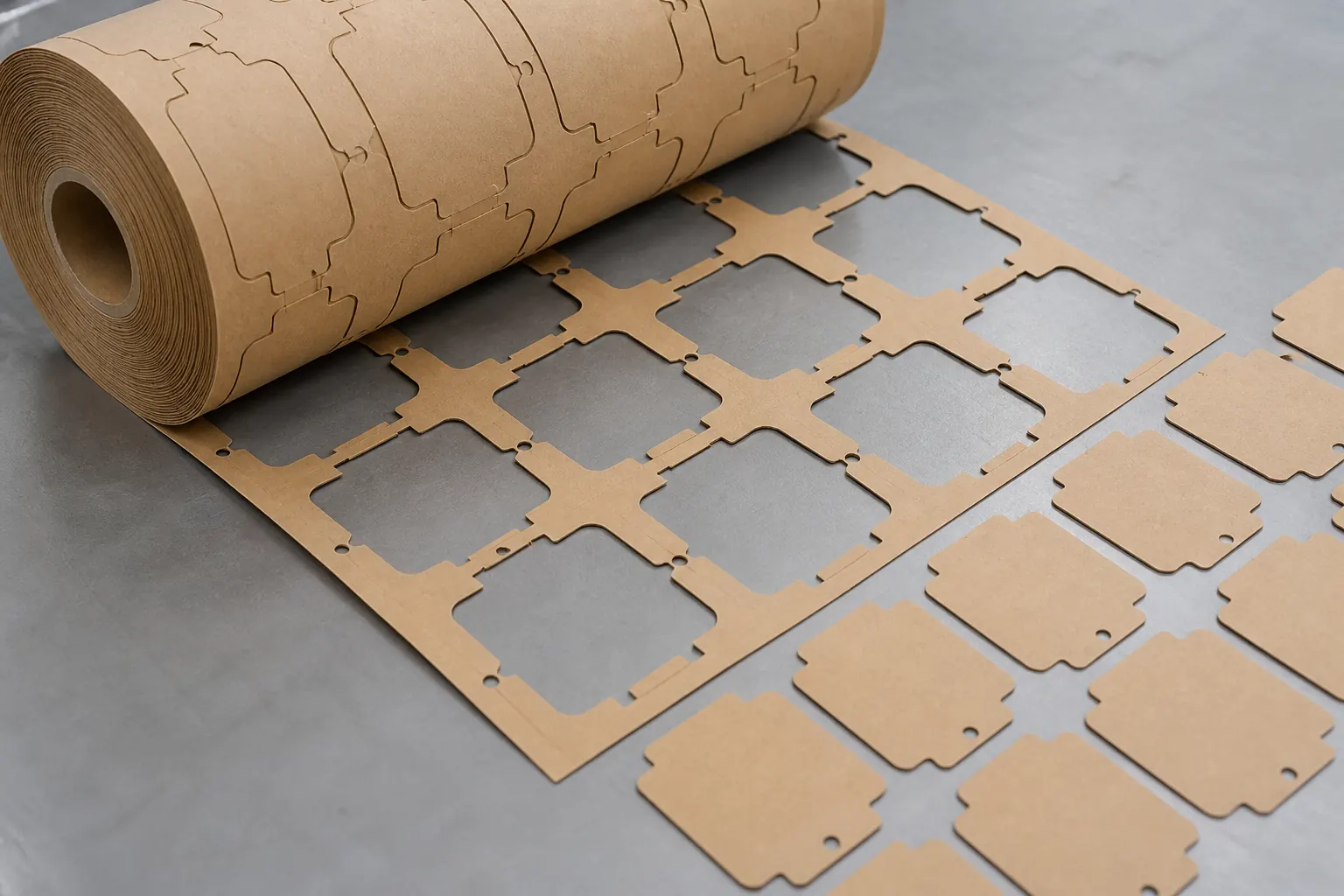
Rotary-cut kraft interleaves are used where rectangular sheets cannot follow a protected component's outline, holes or handling features. Profile completion must be achieved without creating fiber bundles, weak corners or debris that could remain between finished surfaces.
Updated
Where This Cutting Application Appears
Profiled metal-part interleaves
Kraft shapes follow stamped or machined component outlines so protected faces are separated without excessive overhang.
Glass and laminate separators
Rounded, notched or holed paper layers align with panels and handling fixtures during stacking.
Protective packing inserts
Repeated kraft forms are produced for kits, trays or bundled parts requiring clean removable separators.
Rotary Die Cutting process boundary
Rotary die cutting repeats registered profiles with a rotating tool across a moving web; it differs from straight slitting, cross cutting and simple edge trimming.
Rotary Die Cutting setup checkpoint
Confirm repeat pitch, registration marks, anvil condition, web tension, cutting depth and the waste path for every profile and internal feature.
Rotary Die Cutting acceptance checkpoint
Inspect registration, profile dimensions, corner quality, complete separation or controlled depth, liner condition and continuous waste removal.
Define the Required Cut Result
- Complete contours and holes without fiber bridges
- Hold protective coverage and alignment dimensions
- Avoid weak corners that tear during stacking
- Remove matrix waste without leaving particles on parts
Problems to Diagnose Before Changing the Knife
Fiber bridges remain inside small holes
Review furnish, hole size, support, pressure uniformity, profile geometry and whether incomplete areas repeat by position.
Narrow tabs tear during part removal
Check grain direction, tab width, corner radii, paper moisture, stripping direction and handling load.
Profiles shift relative to stacked components
Compare cut dimensions, paper conditioning, feed registration, stacking datum and movement during packing.
Waste fibers remain on finished pieces
Inspect fresh edges, waste stripping, static, vacuum cleaning, matrix breaks and packaging surfaces.
Knife Forms That May Be Considered
| Possible knife form | When it may be considered | What must be confirmed |
|---|---|---|
| Rotary profile-cutting form | Consider for repeated protective kraft outlines on suitable rotary converting equipment. | Confirm CAD profile, repeat, cylinder interface, support, dimensions and tolerances from approved drawings and trials. |
| Rotary perforating form | Consider for detachable areas or fold-and-tear protective sections. | Confirm tooth pattern, grain direction, residual strength and functional separation requirements through testing. |
Information to Send for Technical Review
You do not need to know the exact blade name. Send the available workpiece, machine, current-knife and cut-result information so the application can be reviewed against a drawing or sample.
- Kraft furnish, basis weight, caliper, moisture and grain
- Protected component drawing and critical coverage areas
- Profile CAD, hole sizes, radii, tolerances and repeat
- Web width, direction, speed and tension range
- Registration or stacking datum and allowable positional error
- Rotary interface, support surface and pressure method
- Incomplete cuts, torn tabs, debris and accepted part samples
- Waste stripping, cleaning, packing and end-use requirements
Questions About This Cutting Application
Why do small holes retain paper fibers?
Small closed profiles concentrate material and require uniform support and separation. Fiber furnish, moisture and debris removal also affect hole clearing.
Should grain direction follow a narrow protective tab?
Grain can influence tab strength and tearing, but the best orientation depends on profile geometry and handling. Test both where the load is uncertain.
How is protective coverage verified?
Overlay or stack the interleaf with the actual component and measure exposed areas, alignment, holes and movement under representative handling.
Can cut fibers damage polished parts?
Loose fibers may carry hard contaminants or create marks under pressure. Specify cleanliness and evaluate real stacked contact.
What prevents assuming an incorrect rotary specification?
Use the verified equipment interface, approved CAD, paper range, support, speed, tolerances and physical trial parts before final manufacture.
Related product and service information
- Kraft Interleaving Paper Edge Trimming: Smooth Protective Margins - kraft interleaving paper · width edge trimming
- Silicone Release Paper Rotary Die Cutting: Depth and Release-Surface Control - silicone release paper · rotary die cutting
- Glassine Liner Paper Rotary Die Cutting: Profiles Without Brittle Fracture - glassine liner paper · rotary die cutting
Request a Custom Cutting-Knife Review
Send the workpiece details, machine or holder information, current knife photos or sample, required quantity and examples of the present cut problem. Final dimensions, material, edge geometry and tolerances are confirmed from the approved requirements.