
Blade Application Guides / Application Guide / Paper converting
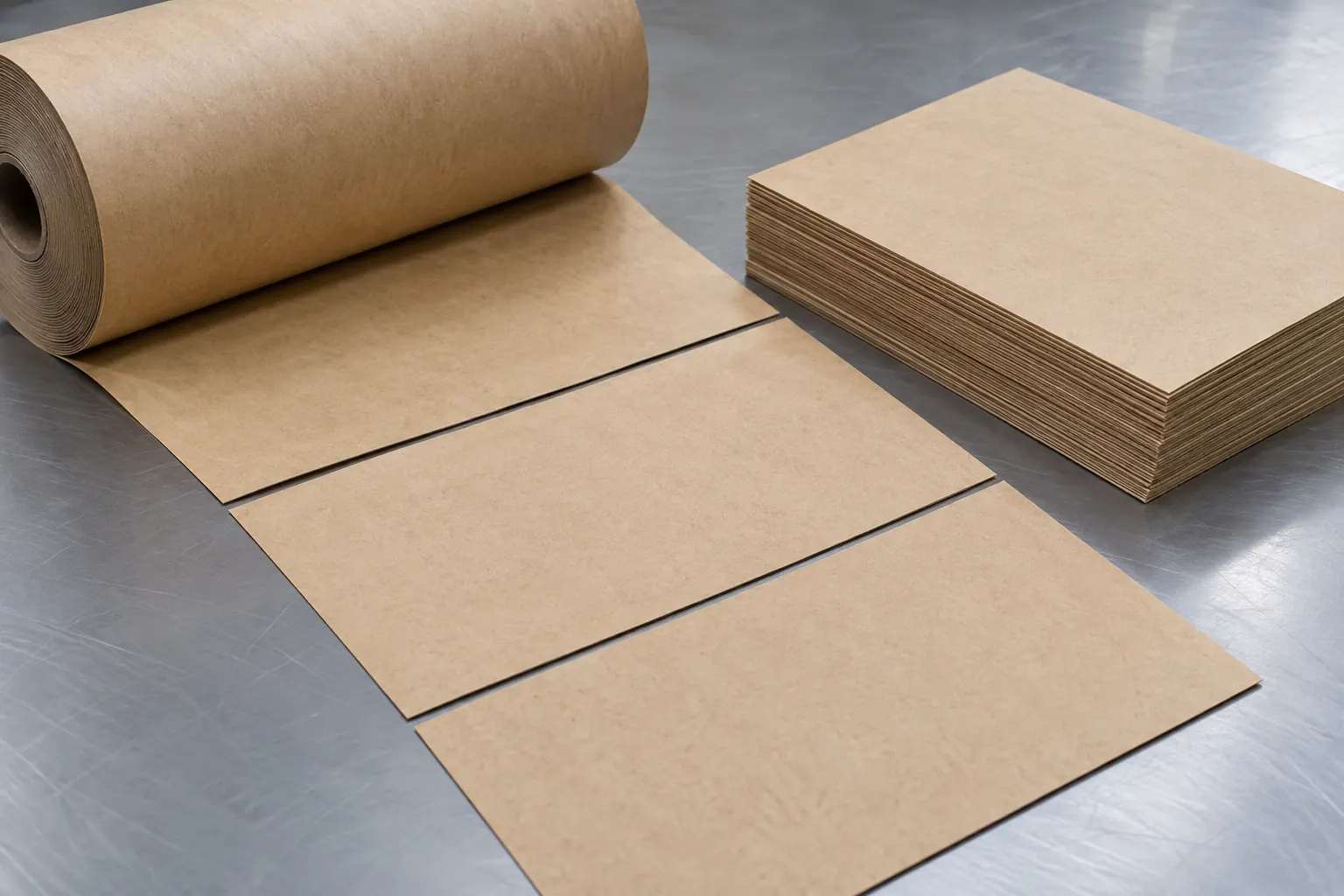
Kraft Interleaving Paper Cross Cutting: Clean Protective Sheets
Cross-cut kraft interleaves must cover the protected product without introducing fibers, folded corners or hard edge defects. Sheet size, squareness and flatness should be assessed with paper moisture, grain direction, feed control and delivery conditions, especially for thin grades handled at high speed.
Updated
Where This Cutting Application Appears
Sheet-metal separators
Kraft sheets are placed between finished metal plates or blanks to reduce abrasion, staining and direct contact.
Glass and laminate interleaves
Sized protective sheets separate fragile panels during stacking, transport and storage.
Rubber and molded-part protection
Paper separators are cut to stack dimensions for tacky sheets or finished components requiring clean release and handling.
Transverse Cross Cutting process boundary
Transverse cross cutting separates material across the web into sheets or repeated lengths; it is distinct from longitudinal roll slitting.
Transverse Cross Cutting setup checkpoint
Confirm repeat length, registration reference, web speed, cut timing, support across the width and sheet transfer immediately after separation.
Transverse Cross Cutting acceptance checkpoint
Measure repeat length and squareness, then inspect leading and trailing edges, registration error, sheet curl and stacking consistency.
Define the Required Cut Result
- Hold sheet size and squareness for full product coverage
- Minimize loose fibers at transverse edges
- Prevent folded corners, curl and stack misalignment
- Keep hard particles away from protected surfaces
Problems to Diagnose Before Changing the Knife
Trailing edge tears instead of separating cleanly
Review sheet support, grain direction, paper moisture, cutoff synchronization, contact progression and web tension.
Thin sheets fold at delivery
Check airflow, static, conveyor speed, deceleration, edge curl, delivery stops and sheet-to-sheet friction.
Sheet size does not match metal blanks
Verify feed calibration, slip, dimensional tolerance, paper conditioning and the datum used to compare paper with protected parts.
Fibers transfer onto the protected stack
Inspect fresh cutoff edges, transport surfaces, static, dust removal, stack movement and packaging cleanliness.
Knife Forms That May Be Considered
| Possible knife form | When it may be considered | What must be confirmed |
|---|---|---|
| Straight cutoff knife | Consider on sheeters using a transverse straight-edge separation for kraft interleaves. | Confirm dimensions, mounting, bevel, motion, support and counterface from verified equipment records. |
| Rotary cutoff knife | Consider where continuous roll-to-sheet production uses synchronized rotating cutoff elements. | Confirm cutting diameter, interface, timing, support and speed from the actual line and accepted trials. |
Information to Send for Technical Review
You do not need to know the exact blade name. Send the available workpiece, machine, current-knife and cut-result information so the application can be reviewed against a drawing or sample.
- Kraft furnish, basis weight, thickness, moisture and grain
- Surface treatment and particle-cleanliness requirement
- Roll width, target sheet dimensions and tolerances
- Protected-product dimensions, surface finish and stacking method
- Line speed, feed control, web tension and cutoff frequency
- Existing cutoff motion, mounting, support and counterface
- Torn edges, folded sheets and contaminated stack samples
- Packing, storage humidity and downstream handling procedure
Questions About This Cutting Application
Should interleaving sheets be larger than the protected part?
The required overhang depends on handling and contact risk. Define target dimensions and tolerances from the actual stack rather than using a generic allowance.
Why do thin kraft sheets fold during delivery?
Low stiffness, static, airflow, curl, high delivery speed and impact against stops can fold corners even when the cutoff edge is clean.
How are loose fibers evaluated?
Inspect fresh edges and protected surfaces after representative stacking or transport, using a defined area, lighting and cleanliness criterion.
Can grain direction influence cross cutting?
Yes. Tear propagation, stiffness, curl and dimensional response differ with grain orientation. Mark the machine direction on submitted samples.
What is needed before quoting the cutoff part?
Provide the actual machine interface and motion, current part or drawing, paper range, sheet sizes, speed and accepted edge sample.
Related product and service information
- Silicone Release Paper Cross Cutting: Flat Sheets Without Edge Damage - silicone release paper · transverse cross cutting
- Glassine Liner Paper Cross Cutting: Accurate, Flat Release Sheets - glassine liner paper · transverse cross cutting
- Clay-Coated Label Paper Cross Cutting: Clean Printed Sheets - clay-coated label paper · transverse cross cutting
Request a Custom Cutting-Knife Review
Send the workpiece details, machine or holder information, current knife photos or sample, required quantity and examples of the present cut problem. Final dimensions, material, edge geometry and tolerances are confirmed from the approved requirements.