
Blade Application Guides / Application Guide / Air filtration manufacturing
HVAC Pocket-Filter Media Shear Slitting Blades
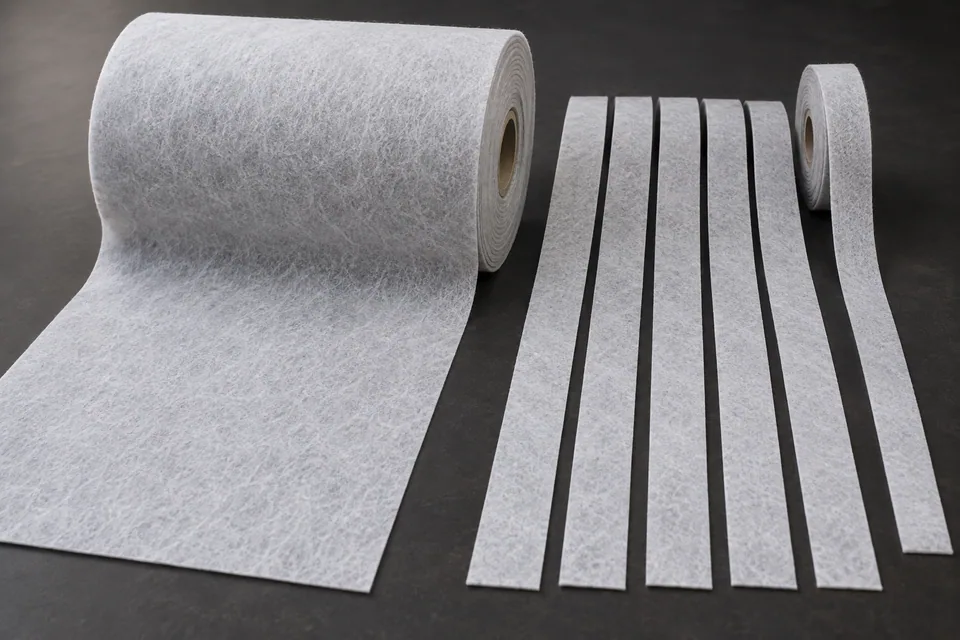
HVAC pocket filters use nonwoven media formed into sewn or welded pockets, but the buyer’s actual fiber stack and seam method determine conversion. Shear slitting divides a parent roll lengthwise into strips that later become pockets or panel components. Rotary knife fit must be trialed on the supplied loft and basis weight so edge fibers do not detach or bunch. Set each width from the pocket layout, including seam allowance. Inspect the edges after folding or welding, because a strip that measures correctly at the slitter may fail in assembly. Filtration class and efficiency are established by the finished filter’s tests.
Updated
Where This Cutting Application Appears
Map lanes to the pocket layout
Set strip widths from the pocket depth, fold line and seam allowance rather than only the nominal filter frame. Mark air-entry orientation or graded face when the supplied medium has one, and identify outside waste lanes.
Trial paired edges on the actual loft
Record rotary knife condition, overlap, clearance, backing and web tension. A bulky synthetic nonwoven may compress at the knife and rebound afterward; measure finished lane width only after a stated recovery interval.
Grade the fiber edge
Inspect both slit sides for fiber tails, clumps, partial separation and flattened zones. Check whether an inner layer remains connected even when the outer faces part. Collect loose fibers from knife exit and after the first guide.
Test a representative pocket seam
Fold or weld trial strips by the buyer’s usual method. Compare seam width, edge alignment and visible fiber escape; keep a slitter sample and an assembled pocket sample so later seam defects are not assumed to be knife defects.
Define the Required Cut Result
- Produce widths that leave the specified seam allowance.
- Fully separate every nonwoven layer.
- Limit loose fibers and edge compaction.
- Deliver strips suitable for buyer pocket assembly tests.
Problems to Diagnose Before Changing the Knife
One layer bridges across a slit
- Inspect rotary edge engagement and overlap.
- Check thick spots in the incoming roll.
- Review support at the cut.
Width narrows after winding
- Measure after material recovery.
- Review knife pressure and web tension.
- Check guide contact and fold history.
Pocket seam sheds fibers
- Compare knife-exit and post-seam samples.
- Inspect the cut edge and weld zone separately.
- Confirm the seam allowance remains in the finished strip.
Knife Forms That May Be Considered
| Possible knife form | When it may be considered | What must be confirmed |
|---|---|---|
| Matched rotary shear knives | For a compatible line slitting the supplied synthetic pocket medium. | Confirm full-layer separation, lane width after recovery and accepted fiber edge. |
| Outside-lane trim pair | Where a sacrificial selvage is removed before useful pocket lanes. | Confirm waste takeoff does not pull fibers from adjacent useful strip. |
Information to Send for Technical Review
You do not need to know the exact blade name. Send the available workpiece, machine, current-knife and cut-result information so the application can be reviewed against a drawing or sample.
- Filter-media grade and layer construction
- Parent width and pocket-panel lane schedule
- Airflow-face orientation if relevant
- Pocket fold and seam allowance
- Accepted fiber-shedding and edge-compaction criteria
- Rotary knife and arbor drawings
- Web tension and winding method
- Buyer pocket assembly and filtration test plan
Questions About This Cutting Application
Why is seam allowance part of slitting?
The useful strip must leave enough material for the specified pocket fold or weld after the final width is measured.
Does a clean slit establish filter class?
No. The complete pocket filter and its media are tested under the buyer’s applicable filtration method.
When should a lofty nonwoven width be read?
Use a defined recovery interval after knife pressure and winding, not a compressed in-line reading alone.
Which edge defect matters most?
Check loose fibers, connected layers and flattened areas that can affect later seams or cleanliness.
What is needed for trial?
Send actual media, pocket layout, seam method, machine drawings and accepted assembled samples.
Public references and scope
These public sources provide material, cutting-method or safety context for this guide. Supplier pages describe their own materials or equipment; they do not establish a MEIRENTE blade specification or performance claim. Confirm the actual grade, machine setup and required cut with a drawing or sample.
Related product and service information
- Paint-Booth Filter Roll Shear Slitting Blades - paint-booth filter roll · shear slitting
- Vacuum-Cleaner Filter Media Shear Slitting Blades - vacuum-cleaner filter media · shear slitting
- Automotive Cabin Filter Media Shear Slitting Blades - automotive cabin filter media · shear slitting
Request a Custom Cutting-Knife Review
Send the workpiece details, machine or holder information, current knife photos or sample, required quantity and examples of the present cut problem. Final dimensions, material, edge geometry and tolerances are confirmed from the approved requirements.