
Blade Application Guides / Application Guide / Air filtration manufacturing
Vacuum-Cleaner Filter Media Shear Slitting Blades
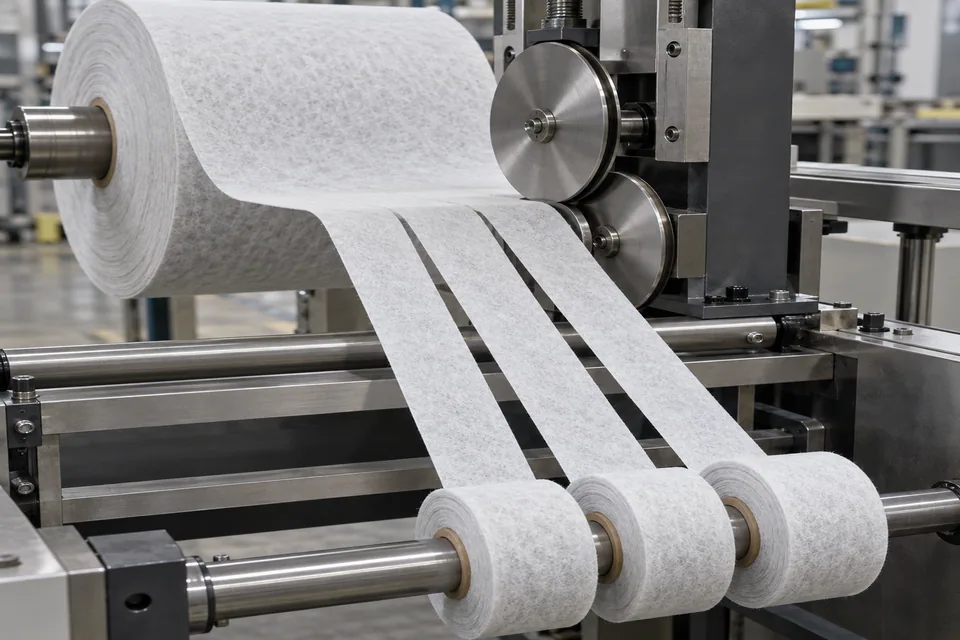
Vacuum cleaner filters may use very different media: meltblown or SMS nonwovens for bags, synthetic composites for prefilters, or microfiberglass for exhaust filters. The buyer must identify the actual grade and destination before specifying shear knives. Paired rotary shear edges divide a parent roll into lanes; a trial should inspect all plies and any charged or coated surface without presuming that cutting preserves filtration behavior. Width and edge cleanliness must be measured again after the normal winding and assembly steps. Finished filtration efficiency remains a separate test.
Updated
Where This Cutting Application Appears
Separate the media route by filter type
Record whether the slit lane will become a bag wall, premotor layer or exhaust element. Set width from that part’s seam, pleat or support drawing, and mark any face orientation that affects later assembly.
Check the knife pair against the actual composite
Measure clearance, overlap and edge condition on the installed rotary shear. A fibrous or layered web may show a clean outer face while a fine inner layer pulls or bridges; inspect the full cross-section under the buyer method.
Watch fine debris and surface disturbance
Collect representative samples from each lane at knife exit. Examine fiber tails, glass particles where relevant, coating lift and scuffing on any delicate fine-fiber face; avoid treating all vacuum media as the same material.
Follow the lane through winding
Inspect the slit strip after normal winding and any preliminary pleating or sealing. If a fragile edge sheds later, compare against an untouched control and the first knife-exit sample before changing a blade setting.
Define the Required Cut Result
- Meet lane widths for the designated filter component.
- Separate all plies without long fiber bridges.
- Limit loose fibers or glass particles.
- Preserve orientation and integrity for downstream tests.
Problems to Diagnose Before Changing the Knife
A fine layer pulls behind the cut
- Inspect blade condition and side clearance.
- Compare actual layer stack and tension.
- Check support close to the rotary nip.
Glass or synthetic fiber debris rises
- Map debris by media grade and slit lane.
- Inspect knife wear and guide abrasion.
- Compare with incoming roll contamination.
Later sealing exposes an uneven edge
- Compare knife-exit and assembled samples.
- Check whether the lane width included seam allowance.
- Review winding deformation.
Knife Forms That May Be Considered
| Possible knife form | When it may be considered | What must be confirmed |
|---|---|---|
| Matched rotary shear pair | For a compatible vacuum-media roll requiring continuous narrow lanes. | Confirm each layer separates and meets particle criteria on actual stock. |
| Dedicated selvage trim pair | When the outer roll edge must be discarded before useful media lanes. | Confirm trimmed waste does not contaminate fine-filter faces. |
Information to Send for Technical Review
You do not need to know the exact blade name. Send the available workpiece, machine, current-knife and cut-result information so the application can be reviewed against a drawing or sample.
- Vacuum-media supplier and exact grade
- Bag, premotor or exhaust-filter destination
- Full layer, coating and fine-fiber construction
- Parent width and lane schedule
- Accepted fiber and particle limit
- Rotary knives, spacers and support drawings
- Winding, pleating or seam method
- Buyer final filter test plan
Questions About This Cutting Application
Why identify the vacuum-filter location?
Bag, premotor and exhaust media use different constructions and downstream geometries.
Can a rotary shear be chosen from basis weight alone?
No. Layer stack, surface treatment, support and accepted particle level matter.
What should be checked on both slit sides?
Look for long fiber bridges, loose particles, layer pullback and face scuffs.
Does an acceptable lane mean the filter passes HEPA testing?
No. Any efficiency classification belongs to the tested finished filter, not the slit edge.
What sample is required?
Use the actual media grade and downstream construction, including any charged, coated or fiberglass layer.
Public references and scope
These public sources provide material, cutting-method or safety context for this guide. Supplier pages describe their own materials or equipment; they do not establish a MEIRENTE blade specification or performance claim. Confirm the actual grade, machine setup and required cut with a drawing or sample.
Related product and service information
- Acoustic Dash Insulator Cut To Size Blades - acoustic dash insulator · cut to size
- HVAC Pocket-Filter Media Shear Slitting Blades - HVAC pocket-filter media · shear slitting
- Paint-Booth Filter Roll Shear Slitting Blades - paint-booth filter roll · shear slitting
Request a Custom Cutting-Knife Review
Send the workpiece details, machine or holder information, current knife photos or sample, required quantity and examples of the present cut problem. Final dimensions, material, edge geometry and tolerances are confirmed from the approved requirements.