
Blade Application Guides / Application Guide / Air filtration manufacturing
Automotive Cabin Filter Media Shear Slitting Blades
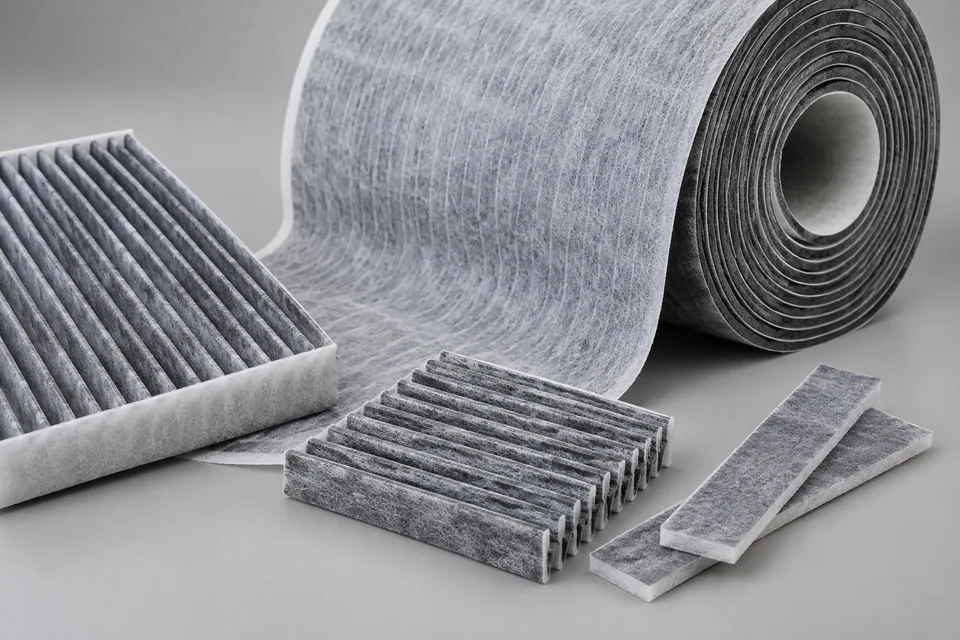
Automotive cabin filter media can be a single fiber web or a multilayer construction with a carbon layer and other functional treatments. Shear slitting makes longitudinal lanes for later pleating or element assembly. The accepted edge must preserve the supplied media layers and avoid loose fibers or carbon dust; the final filter’s efficiency and pressure drop are separate tests.
Updated
Where This Cutting Application Appears
Set lanes for the pleater
Shear slitting makes continuous widths from cabin-media web before pleating. Calculate lane width from pleat pack and frame drawings, including edge allowance. Ahlstrom identifies carbon-bearing and particle-capture layer options, so mark the intended airflow face and lane orientation.
Inspect the carbon-containing edge
For a three-layer adsorbent grade, check whether the cut exposes loose carbon granules or splits the outer support layers. Compare the slit lane with an untouched strip from the same roll. Do not generalize the result to a different carbon loading or charged particle layer.
Review paired-knife geometry
Record the actual rotary knife pair, overlap, side clearance, spacer stack and edge support used in the trial. Ahlstrom emphasizes media cohesion and pleatability, but it does not prescribe a knife setting. Trial the precise layer stack and thickness bought by the filter maker.
Watch lane winding and dust
Route narrow outside trim away from finished lanes and inspect after rewinding. Carbon dust or loose fibers caught between wraps can mark the surface or migrate to the next pleating station even when the cut edge first appears clean.
Check downstream pleating
Pleat representative slit lanes and inspect whether the edge frays, carbon escapes or the web tracks poorly. Final cabin-air filtration and gas-adsorption performance are evaluated by the filter manufacturer, not inferred from the slit.
Define the Required Cut Result
- Hold lane widths and straightness to the supplied layout.
- Meet the agreed edge-fiber and particle limits.
- Retain media layers and coatings through the cut and winding path.
- Separate trim without contaminating accepted lanes.
- Apply the buyer’s material-specific acceptance plan for automotive cabin filter media.
Problems to Diagnose Before Changing the Knife
Width varies between lanes
- Check spacer stack, arbor seating and knife position.
- Measure parent-web movement and edge guide stability.
- Sample every lane at several run positions.
One edge sheds more than its mate
- Inspect both knife edges and actual side clearance.
- Check support and media direction at the nip.
- Compare the same material lot across knife positions.
A slit lane curls or wrinkles
- Locate the first point of distortion.
- Review tension, guide contact and winding separation.
- Compare with an uncut control sample.
Trim breaks or wraps
- Record trim width and break location.
- Inspect scrap takeoff, knife condition and tension.
- Check whether broken trim transfers debris to accepted media.
Carbon or fine fibers shed from one slit edge
- Confirm whether the grade actually contains a carbon layer.
- Inspect knife-pair engagement and support through the full stack.
- Apply the buyer’s particle test after winding and pleating simulation.
Knife Forms That May Be Considered
| Possible knife form | When it may be considered | What must be confirmed |
|---|---|---|
| Matched circular shear slitter knives | For continuous longitudinal separation on a compatible paired-knife line. | Confirm arbor, edge geometry, side clearance, overlap and machine limits from drawings. |
| Circular edge-trim pair | When only the outside allowance is removed before or during lane conversion. | Confirm trim width, scrap route and retained-edge criteria. |
Information to Send for Technical Review
You do not need to know the exact blade name. Send the available workpiece, machine, current-knife and cut-result information so the application can be reviewed against a drawing or sample.
- Cabin media grade and layer order
- Pleat direction and lane-width layout
- Carbon or fiber shedding limit
- Approved wound-roll edge sample
- Parent-web width, finished lane layout and trim width
- Media layer construction and thickness range
- Slitter knife, arbor and spacer drawings
- Side clearance, overlap and runout records
- Edge-fiber, particle and coating acceptance samples
- Web tension, line speed and rewinding arrangement
Questions About This Cutting Application
What is shear slitting?
Paired rotary shear edges divide the cabin-media web longitudinally into usable pleater lanes; a transverse guillotine makes discrete lengths.
Does a nominal media thickness fix the knife clearance?
No. A carbon middle layer, charged layer or other laminate changes the cut. Establish clearance with the actual Ahlstrom grade and machine.
Should every lane be inspected?
Sample each knife station because outer trim, middle lanes and support conditions can produce different amounts of carbon or fiber release.
Can cut quality be judged before rewinding?
Check immediately at the cut and after rewinding and pleating; debris and delamination may appear only after bending.
Does a clean edge guarantee filtration or membrane performance?
No. The filter maker separately measures particle removal, gas adsorption and pressure drop on its assembled element.
Does slitting establish cabin filtration performance?
No. The assembled filter requires its own efficiency and pressure-drop tests.
Public references and scope
These public sources provide material, cutting-method or safety context for this guide. Supplier pages describe their own materials or equipment; they do not establish a MEIRENTE blade specification or performance claim. Confirm the actual grade, machine setup and required cut with a drawing or sample.
Related product and service information
- Gas-Turbine Intake Filter Media Shear Slitting Blades - gas-turbine intake filter media · shear slitting
- HVAC Pocket-Filter Media Shear Slitting Blades - HVAC pocket-filter media · shear slitting
- Vacuum-Cleaner Filter Media Shear Slitting Blades - vacuum-cleaner filter media · shear slitting
Request a Custom Cutting-Knife Review
Send the workpiece details, machine or holder information, current knife photos or sample, required quantity and examples of the present cut problem. Final dimensions, material, edge geometry and tolerances are confirmed from the approved requirements.