
Blade Application Guides / Application Guide / Paperboard converting
Honeycomb Paper Panel Cut-to-Size Blades
Cut-to-size honeycomb panels must retain their designed length and squareness without turning the unsupported cellular edge into a compressed wedge. Panel thickness, cell direction, facing adhesion and the way the workpiece is supported all influence the final end condition.
Updated
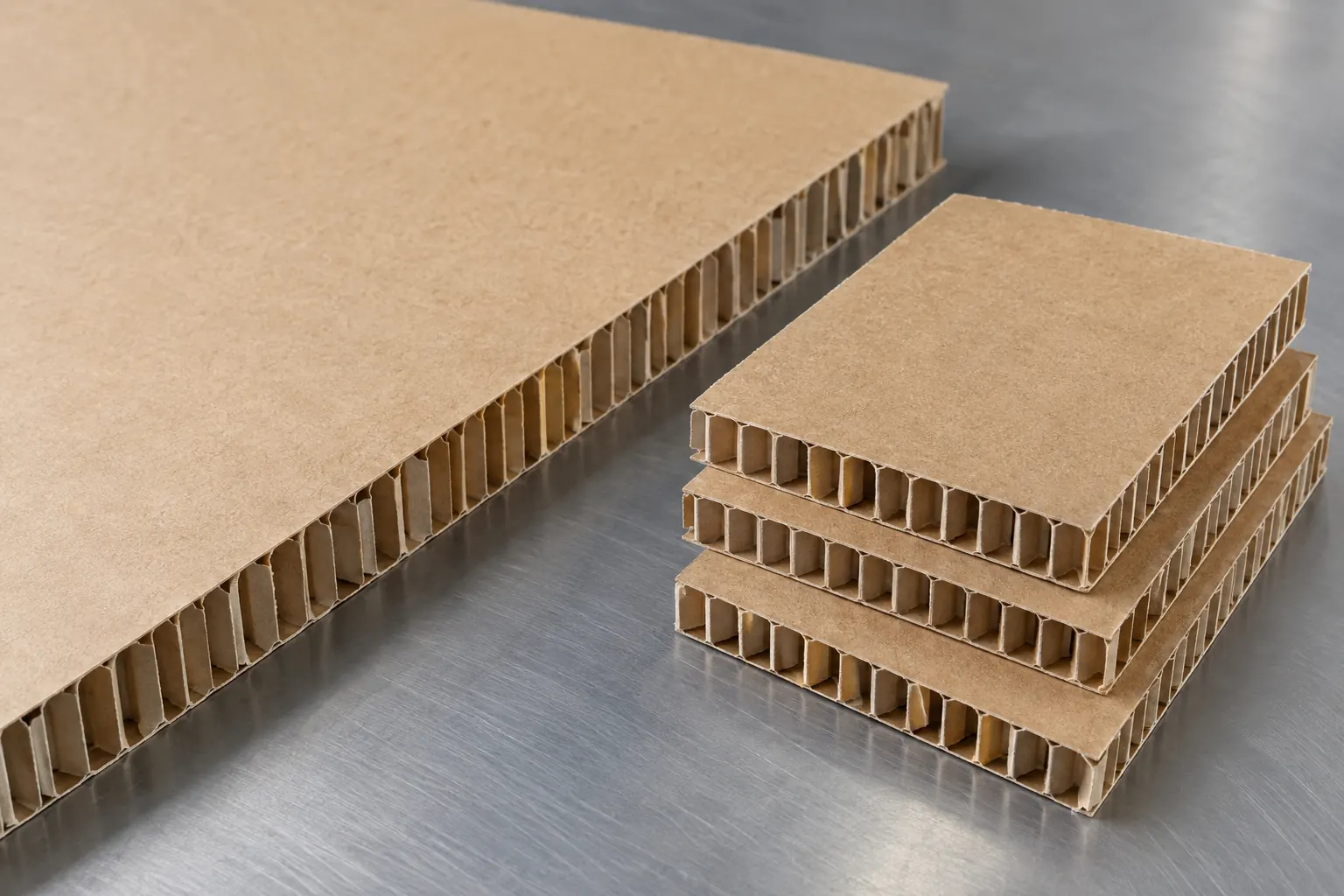
Where This Cutting Application Appears
Packaging panel sizing
Cuts protective faces, pads and dividers to the dimensions required by a pack design.
Paper-pallet deck preparation
Produces square cellular panels for laminated transport structures.
Door and furniture infill blanks
Sizes lightweight core panels before skins or edge members are assembled.
Cut To Size process boundary
Cut to size establishes final straight-sided length and width dimensions; it is different from following a shaped profile or removing only a narrow edge allowance.
Cut To Size setup checkpoint
Confirm both finished dimensions, datum edges, squareness method, hold-down arrangement and the sequence used when length and width require separate cuts.
Cut To Size acceptance checkpoint
Measure length, width, diagonal or squareness as applicable, then inspect corner damage, edge compression and post-cut dimensional recovery.
Define the Required Cut Result
- Accurate length and square panel corners
- Facing and core terminate at a flush end
- Minimal cell-wall buckling or adhesive-node failure
- Flat workpieces ready for lamination or assembly
Problems to Diagnose Before Changing the Knife
Panel end becomes wedge-shaped
- Measure top and bottom cut positions
- Review support through panel thickness
- Inspect compression and cutting-path deflection
Bottom facing stays connected
- Check full-depth completion and backing
- Inspect facing strength and adhesive
- Map incomplete areas across panel width
Cells collapse several rows inward
- Compare cell size, orientation and density
- Review hold-down contact and pressure
- Separate cutting damage from stacking damage
Finished panel is out of square
- Confirm reference edge and feed alignment
- Measure panel bow before cutting
- Check lateral movement during restraint
Knife Forms That May Be Considered
| Possible knife form | When it may be considered | What must be confirmed |
|---|---|---|
| guided straight cutoff arrangement | May suit panel sizing where a full-width supported linear cut is available. | Confirm stroke, cutting width, panel support, hold-down, interface and backing from equipment data. |
| serrated cutoff arrangement | May be trialed for thick cellular constructions where progressive engagement is compatible with the required edge. | Confirm any tooth geometry only through representative materials, holder information and approved trials. |
| rotary cutoff arrangement | May suit continuous panel lines designed to synchronize feed and transverse cutting. | Confirm rotation, cylinder interface, timing, support and allowable panel thickness before selection. |
Information to Send for Technical Review
You do not need to know the exact blade name. Send the available workpiece, machine, current-knife and cut-result information so the application can be reviewed against a drawing or sample.
- Facing and core paper specifications
- Cell size, orientation, density and adhesive pattern
- Panel thickness, length, width and flatness
- Finished dimensions and squareness tolerance
- Feed direction, speed, support and hold-down
- Current cutoff motion, backing and mounting
- Samples showing wedge ends, crush and incomplete facing cuts
- Downstream lamination, assembly and load expectations
Questions About This Cutting Application
Why can a panel cut be square on one face only?
Deflection or uneven support through the hollow core can shift the cut path between facings.
Should dimensions be checked under compression?
Use the customer's final inspection condition and also record any temporary compression at cutting.
What causes bottom-facing tails?
Incomplete depth, weak backing support, facing toughness or panel bow can leave the exit layer connected.
Can cell crush be hidden by edge tape?
Covering may conceal appearance but not necessarily restore bond area or structural function.
What panel samples are needed?
Provide full-build uncut material plus accepted and rejected cut ends from representative thicknesses and cell directions.
Related product and service information
- Honeycomb Paper Panel Sheet-Slitting Blades - honeycomb paper panel · sheet slitting
- Liquid Packaging Board Cut-to-Size Blades - liquid packaging board · cut to size
- Recycled Grey Chipboard Cut-to-Size Blades - recycled grey chipboard · cut to size
Request a Custom Cutting-Knife Review
Send the workpiece details, machine or holder information, current knife photos or sample, required quantity and examples of the present cut problem. Final dimensions, material, edge geometry and tolerances are confirmed from the approved requirements.