
Blade Application Guides / Application Guide / civil engineering textiles
Slitting Geotextile Rolls
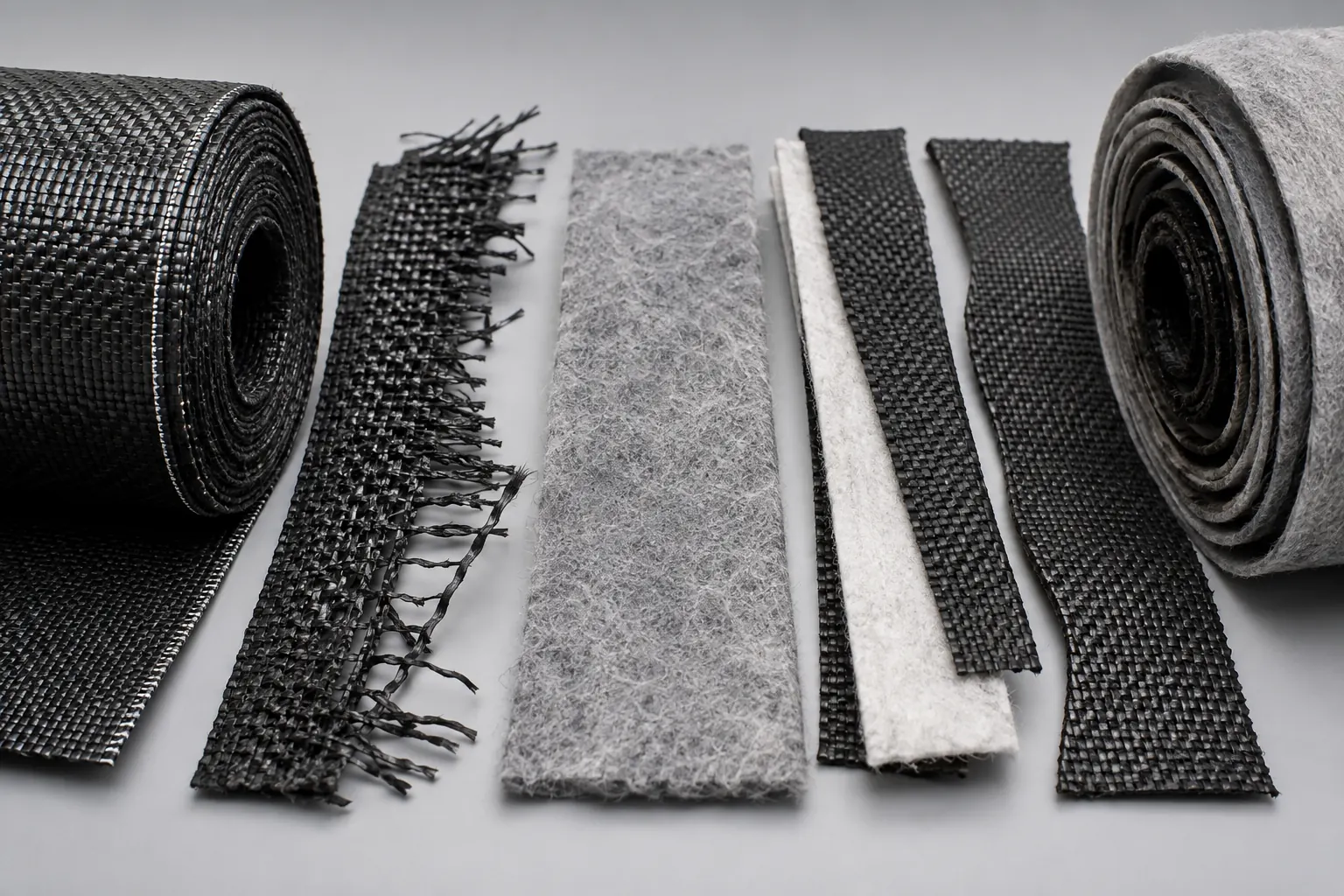
Geotextiles range from open woven grids to bulky needle-punched webs, so the same slitting setup cannot be assumed across grades. Roll tension, mass per area, reinforcement direction and the way the cut edge will be handled in the field all influence the acceptable separation method.
Updated
Where This Cutting Application Appears
Master-roll width conversion
Divides wide geotextile into shipment or installation widths while maintaining a straight wound edge.
Deckle-edge removal
Trims unstable margins after weaving, needling or coating before inspection and roll packaging.
Reinforced geotextile processing
Cuts grids or composite layers where yarn direction and interlayer slip can change edge integrity.
Roll Slitting And Width Conversion process boundary
roll slitting and width conversion for woven and nonwoven geotextile rolls is a linked sequence: the output condition and datum from each operation become the controlled input for the next. It should not be evaluated as one generic cut or accepted only by the final dimension.
Roll Slitting And Width Conversion setup checkpoint
For woven and nonwoven geotextile rolls, define the operation order, intermediate dimensions, registration transfer, material support, web or part handling and waste route for every stage of roll slitting and width conversion.
Roll Slitting And Width Conversion acceptance checkpoint
Verify both intermediate and final results from roll slitting and width conversion, including dimensions, registration, edge or feature quality, material damage, waste separation and stable transfer between stages.
Define the Required Cut Result
- Specified roll width from core to outer diameter
- Limited yarn pullout or loose fiber at the edge
- No telescoping or layer displacement during winding
- Controlled blade temperature on long production runs
Problems to Diagnose Before Changing the Knife
Frayed or open edge
- Identify woven, nonwoven or grid construction
- Compare cut direction with principal yarn orientation
- Inspect edge sharpness and support immediately at the slit
Layer shifting
- Check tension balance across composite layers
- Inspect nip pressure before the cutting station
- Mark relative layer position before and after slitting
Width variation
- Verify edge guiding and holder locking
- Measure web stretch under operating tension
- Check slitter runout across the working diameter
Blade heating
- Record line speed and uninterrupted run length
- Inspect friction marks and polymer transfer
- Check side load, overlap and cooling policy
Knife Forms That May Be Considered
| Possible knife form | When it may be considered | What must be confirmed |
|---|---|---|
| circular shear slitter | Suitable to assess for continuous web conversion when the machine can control overlap, side load and support through tough woven reinforcement. | Confirm dimensions and edge details from the geotextile slitter equipment, an unworn sample or an approved drawing before manufacture. |
| powered rotary cutter | May match thick or multi-layer material where driven surface speed reduces dragging at the cut. | Confirm dimensions and edge details from the geotextile rotary cutter equipment, an unworn sample or an approved drawing before manufacture. |
| serrated knife | May assist progressive separation of bulky nonwoven grades, provided tooth marks and fiber pullout remain acceptable. | Confirm dimensions and edge details from the geotextile cutting station equipment, an unworn sample or an approved drawing before manufacture. |
Information to Send for Technical Review
You do not need to know the exact blade name. Send the available workpiece, machine, current-knife and cut-result information so the application can be reviewed against a drawing or sample.
- Geotextile slitter and rewinder model
- Woven, nonwoven, grid or composite construction
- Polymer, mass per area and nominal thickness
- Master width, slit plan and roll diameter
- Web tension, speed and guiding arrangement
- Current knife dimensions, overlap and side load
- Accepted and frayed edge samples with machine direction
- Number of knives, delivery date and destination
Questions About This Cutting Application
Why does a woven geotextile open at the slit edge?
The edge may pull load-bearing yarns instead of severing them. Review yarn direction, local support and shear condition.
Can woven and needle-punched grades share one setup?
Not without review. Their thickness, tensile behavior and failure modes differ, even when finished width is identical.
What causes width to change after winding?
Web stretch, guiding correction and uneven roll tension can change the apparent width. Define the inspection condition.
How should blade heating be investigated?
Log temperature against speed, run time, polymer transfer, overlap and side load rather than assessing only at shutdown.
Is a field-cut sample enough for a replacement knife?
It helps document the material, but machine mounting and an unworn knife or approved drawing are still required.
Related product and service information
- Cross-Cutting Woven Industrial Fabric - woven industrial fabric · cross-cutting to length
- Slitting Spunbond Nonwoven Rolls - spunbond nonwoven rolls · longitudinal roll slitting
- Slitting Meltblown Nonwoven Web - meltblown nonwoven web · precision web slitting
Request a Custom Cutting-Knife Review
Send the workpiece details, machine or holder information, current knife photos or sample, required quantity and examples of the present cut problem. Final dimensions, material, edge geometry and tolerances are confirmed from the approved requirements.