
Blade Application Guides / Application Guide / Flexible food packaging
CPP Heat-Seal Film Shear Slitting Blades
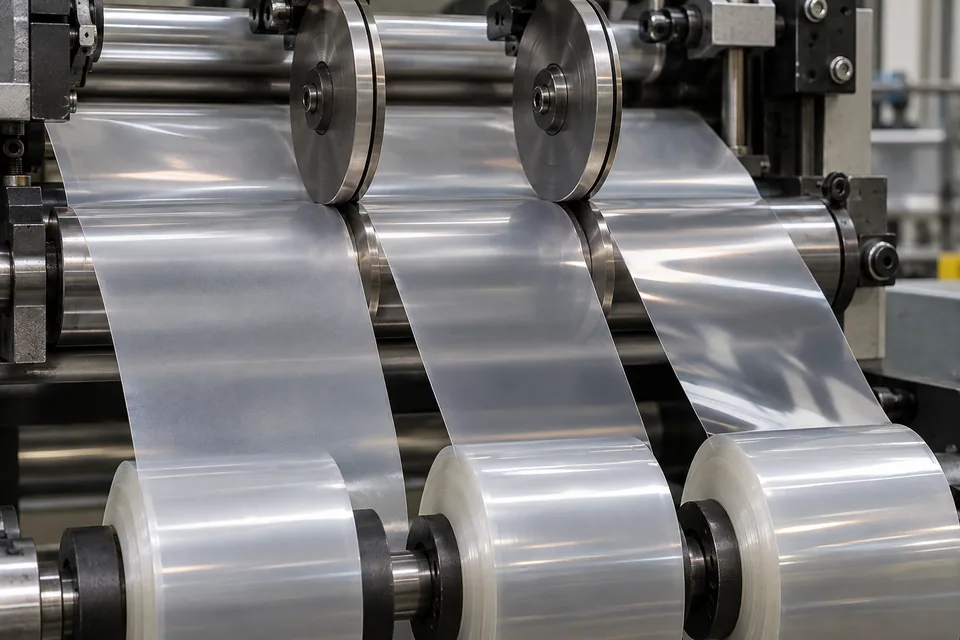
CPP film can be supplied with a heat-sealable side and a differently treated side, as Cosmo Films describes for a retort-lidding construction. Kampf lists CPP with a shear-slitting option, which uses two circular knife edges meeting through a moving web. This operation creates narrow raw-film reels before printing, laminating or lid making. The pair geometry, side force and web handling must be set through an actual-grade trial: a smooth-looking roll edge can conceal a compressed seal surface or a curled lip. Final heat-seal and package-integrity claims remain with the buyer’s completed lid or pouch testing.
Updated
Where This Cutting Application Appears
Place knife pairs around the lid layout
Set cut positions from the customer’s sealing flange, graphics and nesting plan. A shear pair should not touch a functional seal area beyond the specified edge allowance. Record which face contacts the upper knife, lower knife and web guides.
Inspect both products of each shear
The left and right edges of a paired cut can differ. Examine the seal face and treated face for rolled lips, scratch marks and transferred particles. Track each knife pair separately so a single worn position does not appear to be a whole-roll material problem.
Check continuous separation at operating tension
A low-force setting can leave thin web tags, while heavy engagement can deform an edge. Compare samples at startup, steady run and after a stop. Measure widths at a stated tension; a soft CPP web can show apparent width change if gauges and rewind tension differ.
Return trial reels for sealing evaluation
Reinspect after winding and storage, especially where reel contact could mark the heat-seal side. The buyer should test its intended sealing, peel, retort or sterilization cycle only when those uses actually apply to the supplied CPP grade.
Define the Required Cut Result
- Make complete, repeatable CPP lane cuts.
- Avoid curled lips and seal-face damage at paired knives.
- Preserve specified winding direction and width.
- Leave package testing to the buyer’s actual end use.
Problems to Diagnose Before Changing the Knife
One edge has a rolled lip
- Inspect upper/lower knife side loading.
- Check the affected knife pair for wear.
- Compare both film faces.
Intermittent web bridges persist
- Review overlap across the full web width.
- Check web flutter and knife runout.
- Examine tags on left and right edges.
Seal surface marks appear after winding
- Locate first mark before or after rewind.
- Review face-out winding and reel pressure.
- Inspect guides for particle buildup.
Knife Forms That May Be Considered
| Possible knife form | When it may be considered | What must be confirmed |
|---|---|---|
| Opposed rotary shear knives | For CPP supplied as a stable continuous web. | Validate complete separation without seal-face compression. |
| Stationary razor alternative | Where a shear pair produces unacceptable lips or scuffs. | Compare edge and sealing-trial samples under equivalent winding conditions. |
Information to Send for Technical Review
You do not need to know the exact blade name. Send the available workpiece, machine, current-knife and cut-result information so the application can be reviewed against a drawing or sample.
- Supplier CPP grade and treatment map
- Heat-seal and nonseal face orientation
- Web and finished-lane drawings
- Shear-pair blade and anvil details
- Expected line tension and winding settings
- Accepted lip, tag and scratch examples
- Storage/conditioning method
- Buyer lid or pouch validation test
Questions About This Cutting Application
Why inspect left and right slit edges separately?
The paired knife can leave different edge shapes on opposite lanes.
Can heavy overlap improve every cut?
No. Too much loading may roll a lip or compress a seal surface.
Are CPP retort properties implied by a shear slit?
No. The supplied grade and buyer’s completed-pack tests determine those properties.
Why measure width at stated tension?
Film stretch and winding tension can change the apparent lane width.
What trial samples matter?
Keep startup, steady-run and rewound strips from both faces and both sides of a knife pair.
Public references and scope
These public sources provide material, cutting-method or safety context for this guide. Supplier pages describe their own materials or equipment; they do not establish a MEIRENTE blade specification or performance claim. Confirm the actual grade, machine setup and required cut with a drawing or sample.
Related product and service information
- Confectionery Slab and Bar Cutting - confectionery slabs and bars · guillotine cutting and scoring
- BOPP Snack Packaging Film Shear Slitting Blades - BOPP snack packaging film · shear slitting
- CPP Heat-Seal Film Razor Slitting Blades - CPP heat-seal film · razor slitting
Request a Custom Cutting-Knife Review
Send the workpiece details, machine or holder information, current knife photos or sample, required quantity and examples of the present cut problem. Final dimensions, material, edge geometry and tolerances are confirmed from the approved requirements.