
Blade Application Guides / Application Guide / Flexible food packaging
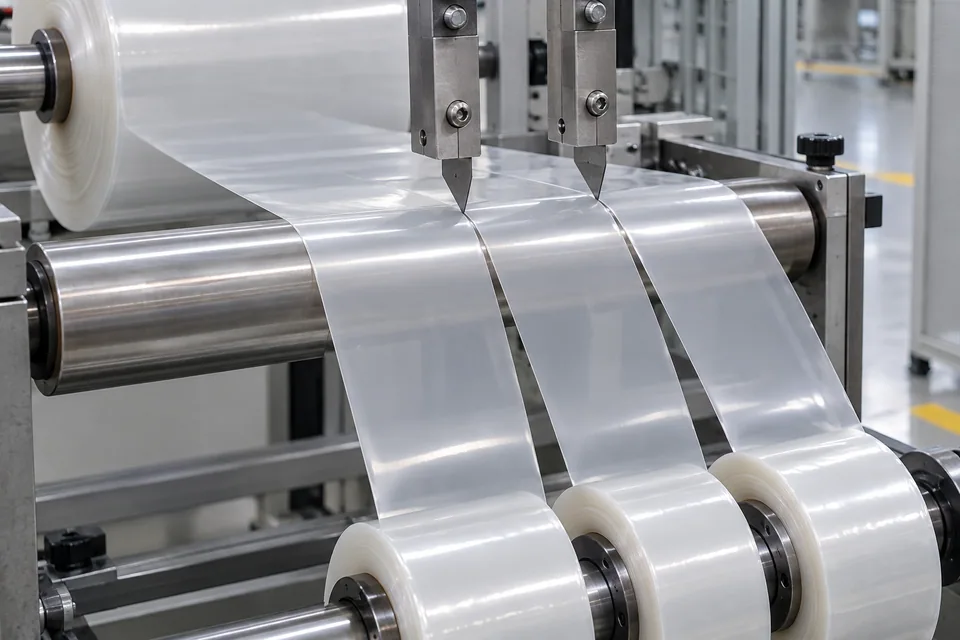
CPP Heat-Seal Film Razor Slitting Blades
Cast polypropylene (CPP) heat-seal film is a flexible packaging material whose two faces can have different roles. A Cosmo Films retort-lidding grade, for example, has an untreated heat-sealable layer and a treated opposite side. Kampf lists CPP in its film-slitter materials and names razor cutting among the available systems. The cutting workpiece is a raw or converter-supplied film web, not a finished lid or sealed tray. Any blade trial must record which face contacts guides, the exact supplier grade and the later sealing geometry. A clean cut supports conversion but does not prove peel force or retort performance.
Updated
Where This Cutting Application Appears
Identify the functional film faces
Read the supplier construction for the exact CPP grade. Mark the seal side and any printable or laminating side on the roll core and sample strips. Set the lane map around the buyer’s lid or pouch layout, preserving any treated surface from unnecessary contact.
Trial blade drag at the slit
Feed a short length through a stationary razor position and inspect both edges for dragged film, raised lips or stringing. Compare samples taken immediately at the blade with wound samples; any thermal or frictional change at the edge needs investigation rather than a claimed universal razor setting.
Control winding and blocking
CPP lanes may stick or shift depending on surface treatment and winding conditions. Check whether fine trim clings to the seal face and whether reel pressure creates contact marks after storage. Preserve the specified face-out orientation for the customer’s packaging line.
Qualify the lid or pouch later
The buyer may laminate, print, die cut or seal the slit lanes. Provide traceable samples and edge observations, then have the buyer test seal initiation, peel and package integrity using its actual process.
Define the Required Cut Result
- Hold CPP lanes to the buyer’s lid or pouch layout.
- Keep the heat-seal face free of dragged edges and debris.
- Avoid winding marks that obscure surface condition.
- Provide traceable strips for sealing tests.
Problems to Diagnose Before Changing the Knife
Seal face picks up slit fragments
- Check trim extraction and static behavior.
- Inspect blade condition and support.
- Look at rewound and immediate-cut samples.
A lip forms along one lane edge
- Review razor angle and web support.
- Compare both faces at the slit.
- Check localized tension or blade wear.
Finished reels block or telescope
- Record surface orientation and winding pressure.
- Review storage condition and roll age.
- Compare with an uncut wound control.
Knife Forms That May Be Considered
| Possible knife form | When it may be considered | What must be confirmed |
|---|---|---|
| Stationary razor holder | For a CPP grade that passes edge and surface trials under the actual web path. | Confirm low drag, clean seal face and stable winding. |
| Rotary shear comparison | If a razor leaves a pulled lip or loose slivers. | Compare seal-face condition and finished-reel quality on the same film. |
Information to Send for Technical Review
You do not need to know the exact blade name. Send the available workpiece, machine, current-knife and cut-result information so the application can be reviewed against a drawing or sample.
- CPP maker, grade and face-treatment data
- Seal side and printable side marking
- Retort or nonretort end use
- Web width and lane or lid layout
- Blade and guide contact surfaces
- Accepted lip, stringing and particle criteria
- Winding and storage specification
- Buyer seal and package-integrity test
Questions About This Cutting Application
Are both faces of CPP film equivalent?
Not necessarily. A grade may pair an untreated seal face with a treated opposite face.
Can a razor mark affect sealing?
Visible debris or drag near the seal area should be evaluated in the buyer’s sealing trial.
Is every CPP grade a retort film?
No. Obtain the exact supplier construction and intended end use.
What should be checked after winding?
Reinspect edge lip, surface marks, blocking and reel stability.
Does a clean edge prove package integrity?
No. The buyer validates the formed and sealed package.
Public references and scope
These public sources provide material, cutting-method or safety context for this guide. Supplier pages describe their own materials or equipment; they do not establish a MEIRENTE blade specification or performance claim. Confirm the actual grade, machine setup and required cut with a drawing or sample.
Related product and service information
- CPP Heat-Seal Film Shear Slitting Blades - CPP heat-seal film · shear slitting
- BOPP Snack Packaging Film Razor Slitting Blades - BOPP snack packaging film · razor slitting
- Effervescent Tablet Sachet Laminate Razor Slitting Blades - effervescent tablet sachet laminate · razor slitting
Request a Custom Cutting-Knife Review
Send the workpiece details, machine or holder information, current knife photos or sample, required quantity and examples of the present cut problem. Final dimensions, material, edge geometry and tolerances are confirmed from the approved requirements.