
Blade Application Guides / Application Guide / Flexible food packaging
BOPP Snack Packaging Film Shear Slitting Blades
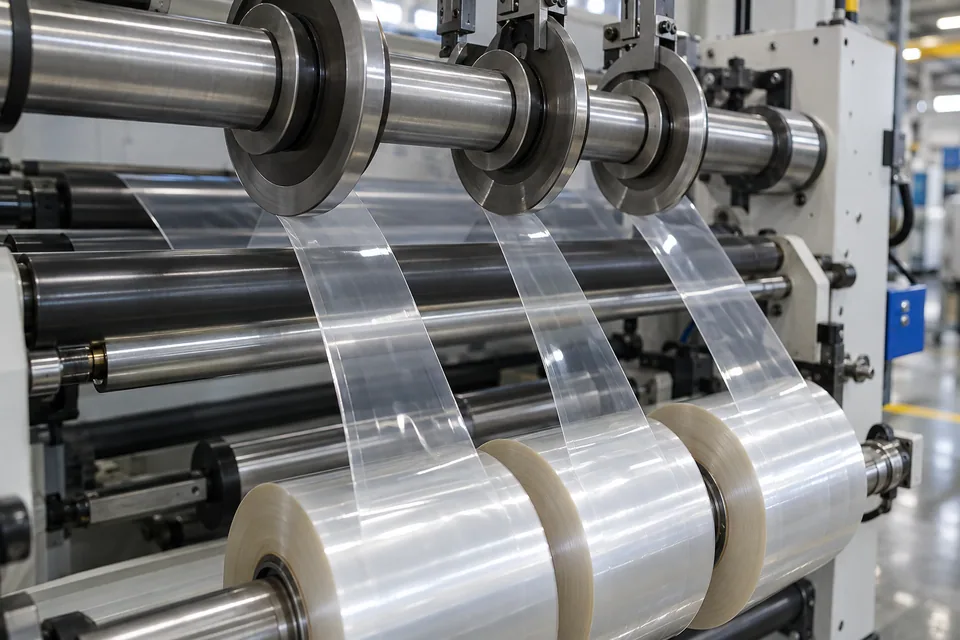
BOPP film is widely used as a flexible packaging web, and Jindal Films identifies grades for horizontal and vertical form-fill-seal applications. Kampf explicitly lists BOPP with a shear-cut option on film slitters. In this method, opposed circular knives separate a continuously moving web at a controlled intersection. It is distinct from a stationary razor even when both produce narrow reels. A shear trial should compare edge shape, print-face contact and winding behavior on the buyer’s exact coated, uncoated or metallized grade. No knife choice alone establishes the finished snack pack’s seal or barrier performance.
Updated
Where This Cutting Application Appears
Place the shear relative to printed lanes
Use the packaging artwork and repeat to locate each knife pair. Check that outer trim and inner cuts leave the specified sealing margins. Retain the machine-direction reference on every roll so the converter does not reverse face or web travel in a later run.
Qualify paired-knife engagement
Observe upper and lower edges at the actual line speed range during a controlled trial. Insufficient overlap may leave intermittent tags; excessive side loading can roll the BOPP edge or transfer debris. Photograph both faces of each slit rather than judging only the top view.
Separate shear marks from winding marks
Measure lane width close to the cut and again on the finished reel. A curled edge can form at the knife while a stepped roll edge can arise during rewind. Record knife alignment, web guide drift and reel tension before adjusting a blade.
Test the buyer’s conversion handoff
Run sample reels through printing, lamination or packing equipment as appropriate. Watch for edge flutter and web tracking at registration. The buyer evaluates package seal and barrier tests on the actual laminate or pack, after all downstream operations.
Define the Required Cut Result
- Produce stable BOPP lanes with intact printed margins.
- Avoid intermittent tags or rolled edges from the shear pair.
- Hold repeat registration through rewinding.
- Keep final pack testing separate from blade qualification.
Problems to Diagnose Before Changing the Knife
Tiny tags remain between lanes
- Inspect upper/lower overlap along the cut.
- Check both knife edges for wear.
- Observe web support at the nip.
One edge curls more than the other
- Compare side pressure and blade geometry.
- Check film face orientation.
- Review tension into and out of the nip.
Artwork shifts at the reel edge
- Check guide reference to the printed repeat.
- Measure lane width near the knife.
- Inspect differential rewind tension.
Knife Forms That May Be Considered
| Possible knife form | When it may be considered | What must be confirmed |
|---|---|---|
| Matched rotary shear pair | For a BOPP grade and web path that tolerate paired-edge engagement. | Confirm separation, low debris and roll build on the buyer’s film. |
| Alternative stationary razor | If shear loading produces a rolled edge or unacceptable curl. | Compare identical wound-roll and print-registration criteria. |
Information to Send for Technical Review
You do not need to know the exact blade name. Send the available workpiece, machine, current-knife and cut-result information so the application can be reviewed against a drawing or sample.
- Actual BOPP grade and supplier handling sheet
- Coating or metallized side identification
- Print and seal-zone lane drawing
- Upper/lower knife configuration
- Expected cut and rewind speed range
- Allowed edge curl and tag criteria
- Parent and finished roll specifications
- Buyer packaging-line validation plan
Questions About This Cutting Application
How does a shear cut differ from a razor cut?
Two rotary edges meet at the web; a razor uses a stationary sharp edge.
Can overlap be selected from film thickness alone?
No. Pair geometry, support and actual grade govern a qualified setting.
Why check both slit faces?
A rolled lip or coating mark may appear on one side only.
What causes a good cut to wind badly?
Guide drift, lane separation and winding tension can alter reel quality after the knife.
Does shear slitting approve the final food pack?
No. The buyer tests seal, barrier and machinability of completed packaging.
Public references and scope
These public sources provide material, cutting-method or safety context for this guide. Supplier pages describe their own materials or equipment; they do not establish a MEIRENTE blade specification or performance claim. Confirm the actual grade, machine setup and required cut with a drawing or sample.
Related product and service information
- CPP Heat-Seal Film Razor Slitting Blades - CPP heat-seal film · razor slitting
- BOPP Snack Packaging Film Razor Slitting Blades - BOPP snack packaging film · razor slitting
- Effervescent Tablet Sachet Laminate Shear Slitting Blades - effervescent tablet sachet laminate · shear slitting
Request a Custom Cutting-Knife Review
Send the workpiece details, machine or holder information, current knife photos or sample, required quantity and examples of the present cut problem. Final dimensions, material, edge geometry and tolerances are confirmed from the approved requirements.