
Blade Application Guides / Application Guide / industrial fabric converting
Slitting Coated Technical Fabrics
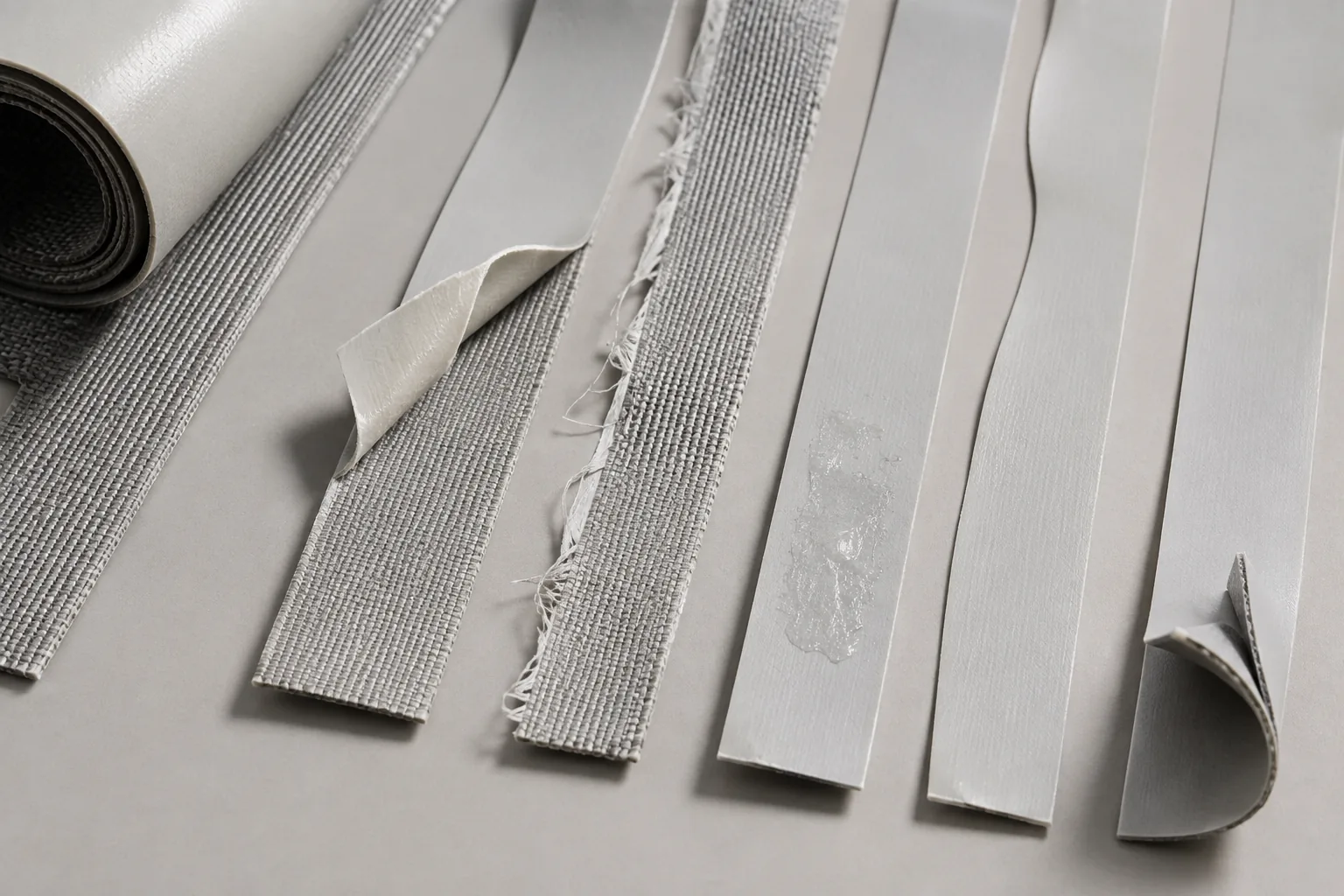
Coated fabric behaves as a bonded laminate: the textile carries tensile load while the polymer coating may be soft, brittle or tacky. The slitting decision must preserve adhesion at the edge and manage web tension without cracking or peeling the coating.
Updated
Where This Cutting Application Appears
Coating-line edge trim
Removes irregular margins after coating or curing before inspection and winding.
Finished-roll width conversion
Slits coated fabric into customer widths for tarpaulin, membrane, belting or protective products.
Multi-layer laminate conversion
Separates textile-reinforced laminates where interlayer adhesion and curl must remain controlled.
Longitudinal Slitting process boundary
longitudinal slitting for coated technical fabric is planned around longitudinal width conversion of a moving roll, web, sheet or strip into controlled lanes or daughter rolls; it is not transverse length cutting, profile formation or removal of only a narrow damaged margin.
Longitudinal Slitting setup checkpoint
For coated technical fabric, confirm unwind and rewind tension, lane widths, knife positions, edge guidance, core alignment, trim removal and discharge behavior.
Longitudinal Slitting acceptance checkpoint
For coated technical fabric, evaluate lane width, edge condition, camber or wandering, debris, telescoping, interleaving and stable winding or downstream transfer.
Define the Required Cut Result
- Coating remains bonded to the textile edge
- Low yarn fray through the reinforcement
- Stable width without web skew or curl
- Predictable control of tacky residue
Problems to Diagnose Before Changing the Knife
Coating peel
- Identify coating polymer and cure condition
- Inspect adhesion before the slitter
- Compare compression and cutting direction
Fabric fray
- Record weave, yarn and bias direction
- Inspect full separation of reinforcement
- Check local support and edge damage
Sticky residue
- Measure web and edge temperature
- Map deposits against coating side
- Review approved cleaning or release treatment
Slit-line drift
- Verify web guide response
- Check differential tension and curl
- Measure holder runout and axial movement
Knife Forms That May Be Considered
| Possible knife form | When it may be considered | What must be confirmed |
|---|---|---|
| circular shear slitter | Can support both coating and textile between matched edges when overlap and side load are controlled. | Confirm dimensions and edge details from the coated-fabric slitter equipment, an unworn sample or an approved drawing before manufacture. |
| razor slitter | May suit thin, well-supported laminates where coating does not close around or contaminate the exposed edge. | Confirm dimensions and edge details from the coated-fabric razor station equipment, an unworn sample or an approved drawing before manufacture. |
| heated knife when process-approved | May seal selected thermoplastic textile edges, but only where heat effects, fumes and finished-edge requirements are approved. | Confirm dimensions and edge details from the heated coated-fabric cutter equipment, an unworn sample or an approved drawing before manufacture. |
Information to Send for Technical Review
You do not need to know the exact blade name. Send the available workpiece, machine, current-knife and cut-result information so the application can be reviewed against a drawing or sample.
- Coating and slitting line model
- Base textile, weave and mass per area
- Coating polymer, side, gauge and cure
- Total thickness and laminate layers
- Web speed, tension, temperature and support
- Finished widths and edge requirements
- Photos of peel, fray, residue and curl
- Knife sample, quantity and destination
Questions About This Cutting Application
Why does coating peel only after slitting?
The cut can expose weak adhesion or introduce compressive stress. Check cure and peel strength beside an uncut control.
Can heat prevent textile fray?
Only for compatible thermoplastics and approved processes. Heat can damage coatings, change dimensions or create emissions.
Which side should face the slitter?
That depends on coating location, support and edge geometry. Identify the working side in samples and drawings.
How is tacky residue evaluated?
Record temperature, run length and deposit location before and after cleaning, not simply whether residue exists.
Can an uncoated-fabric knife be reused?
Do not assume so. Coating adds thickness, friction, adhesion and contamination behavior that require a new review.
Related product and service information
- Slitting Meltblown Nonwoven Web - meltblown nonwoven web · precision web slitting
- Slitting Spunbond Nonwoven Rolls - spunbond nonwoven rolls · longitudinal roll slitting
- Cutting Needle-Punched Felt - needle-punched felt · sheet and roll cutting
Request a Custom Cutting-Knife Review
Send the workpiece details, machine or holder information, current knife photos or sample, required quantity and examples of the present cut problem. Final dimensions, material, edge geometry and tolerances are confirmed from the approved requirements.