
Blade Application Guides / Application Guide / Paper converting
Clay-Coated Label Paper Rotary Die Cutting: Profiles With Intact Print
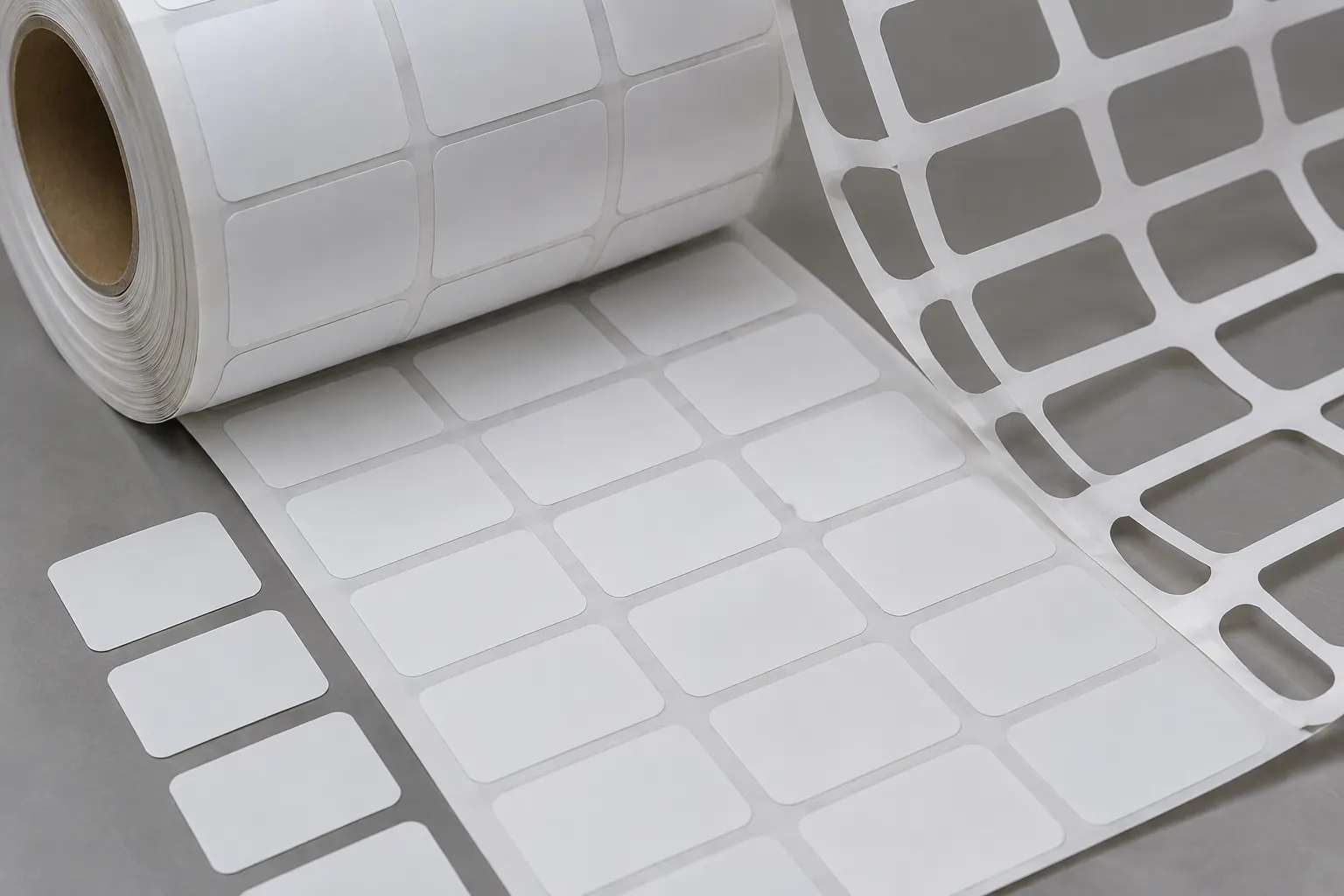
Rotary die cutting clay-coated label paper places concentrated stress into a brittle coated surface, often close to printed graphics or varnished borders. Profile geometry, print registration, coating strength and matrix layout must be reviewed together to avoid edge whitening, lifted fibers and waste breaks.
Updated
Where This Cutting Application Appears
Wet-glue bottle labels
Printed coated paper is cut into registered label profiles while preserving graphics, varnish and stack separation.
Promotional and decorative labels
Repeated shapes with curves, notches or tabs are produced from mineral-coated printed webs.
Coated paper components
Functional paper shapes are rotary cut before stacking, collating or attachment to packaging.
Rotary Die Cutting process boundary
Rotary die cutting repeats registered profiles with a rotating tool across a moving web; it differs from straight slitting, cross cutting and simple edge trimming.
Rotary Die Cutting setup checkpoint
Confirm repeat pitch, registration marks, anvil condition, web tension, cutting depth and the waste path for every profile and internal feature.
Rotary Die Cutting acceptance checkpoint
Inspect registration, profile dimensions, corner quality, complete separation or controlled depth, liner condition and continuous waste removal.
Define the Required Cut Result
- Create complete profiles with minimal edge whitening
- Keep cut-to-print registration within the approved window
- Prevent coating cracks and fiber lift at corners
- Strip surrounding waste without damaging finished labels
Problems to Diagnose Before Changing the Knife
White fracture band appears around profiles
Review coating brittleness, print and varnish layers, pressure, support, edge progression, profile curvature and inspection lighting.
Small corners lift or split
Check corner radii, grain direction, coating strength, narrow necks, material moisture and pressure distribution.
Cut line moves relative to graphics
Evaluate print-mark quality, sensor setup, web tension, feed slip, cylinder synchronization and artwork repeat variation.
Waste matrix breaks around narrow gaps
Review matrix geometry, bridge width, stripping direction, speed, tension, static and coating debris accumulation.
Knife Forms That May Be Considered
| Possible knife form | When it may be considered | What must be confirmed |
|---|---|---|
| Rotary profile-cutting form | Consider for repeated printed label profiles on compatible rotary equipment. | Confirm artwork datum, profile drawing, repeat, cylinder interface, support and tolerances through approved line data and trials. |
| Rotary perforating form | Consider when coated labels or coupons require a controlled tear feature. | Confirm tooth pattern, residual strength, print clearance and functional tear direction from testing rather than assumption. |
Information to Send for Technical Review
You do not need to know the exact blade name. Send the available workpiece, machine, current-knife and cut-result information so the application can be reviewed against a drawing or sample.
- Base-paper and clay-coating specifications with moisture range
- Ink, varnish, coating cure and surface-strength information
- Profile drawing, radii, tolerances, repeat and nesting layout
- Print registration datum and allowable cut-to-print deviation
- Web direction, speed, tension and feed-control arrangement
- Rotary interface, support surface and pressure-adjustment method
- Accepted labels, whitening samples and broken waste matrix
- Stacking, counting, downstream application and inspection plan
Questions About This Cutting Application
What causes a white edge on coated paper labels?
The mineral coating may fracture or separate from the base sheet under concentrated stress. Coating strength, moisture, support and profile geometry all contribute.
Can registration error originate in printing?
Yes. Artwork repeat and web distortion should be measured before attributing all cut-to-print variation to the rotary process.
Why do narrow matrix bridges keep breaking?
They carry high stripping stress and may be weakened by sharp corners, coating cracks, debris, excessive tension or an unfavorable stripping angle.
How should edge whitening be accepted?
Define maximum visible band, inspection lighting, magnification, color background and clearance from graphics rather than using a subjective description.
Does the label profile determine the final rotary form?
It is one input. Equipment interface, repeat, support, material layers, print reference, pressure control and trial approval are also required.
Related product and service information
- Clay-Coated Label Paper Edge Trimming: Clean Margins and Stable Width - clay-coated label paper · width edge trimming
- Water-Based Coated Poster Paper Rotary Cutting: Clean Display Shapes - water-based coated poster paper · rotary die cutting
- Silicone Release Paper Rotary Die Cutting: Depth and Release-Surface Control - silicone release paper · rotary die cutting
Request a Custom Cutting-Knife Review
Send the workpiece details, machine or holder information, current knife photos or sample, required quantity and examples of the present cut problem. Final dimensions, material, edge geometry and tolerances are confirmed from the approved requirements.