
Blade Application Guides / Application Guide / Electrical equipment manufacturing
Ceramic-Fiber Electrical Insulation Paper Contour-Cutting Blades
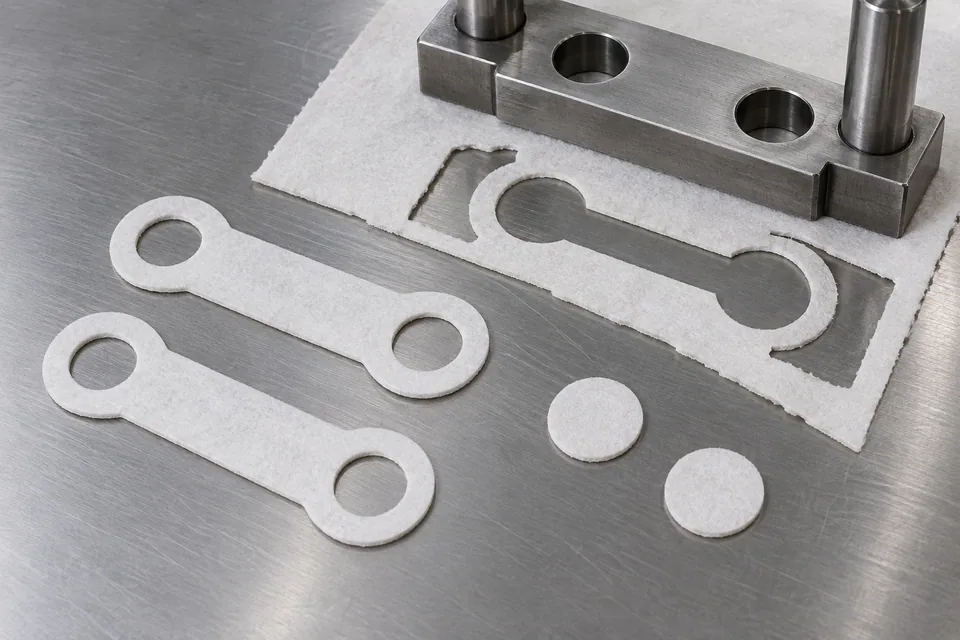
ETERNIFIBER describes ceramic-fiber paper as die-cuttable and suitable for electrical insulation, and Kairo reports custom die-cut paper shapes for high-temperature equipment. These first-party descriptions support a shaped cut in a selected grade, while the customer must still verify that this grade is suitable for its electrical location. This guide covers a flat barrier with an aperture, slot or curved clearance path, cut before device installation. It is not a claim about a finished transformer insulation system or a generic gasket. Narrow bridges and small holes can crumble or shed fibers even when straight outer edges look sound. A die or guided profile knife must therefore be trialed on the actual thickness and binder state, with careful scrap removal.
Updated
Where This Cutting Application Appears
Map every feature to the electrical assembly
Receive the released aperture, edge radius and conductor-clearance drawing. Mark the part face and any support area needed during installation. Avoid treating a seal-gasket template as an electrical barrier design without the owner’s approval.
Pilot the smallest aperture
Cut a limited set using the intended die or guided contour method. Inspect hole walls, narrow bridges and inside corners for fiber fracture or compression. Compare first and later impressions for tool buildup and paper damage.
Control slugs and free fibers
Remove internal slugs and skeleton scrap separately from accepted parts. Measure aperture location and bridge width on a supported fixture. Examine both faces for particles retained in openings, because a dimensional pass cannot excuse loose material near energized features.
Qualify the installed barrier
Pack shaped pieces flat and protect fragile bridges. The device maker should fit them around the actual conductor or heater and test electrical isolation and temperature behavior on the completed assembly.
Define the Required Cut Result
- Produce released barrier contour and apertures.
- Maintain narrow bridges and edge thickness.
- Keep slugs and ceramic fibers away from installed parts.
- Preserve orientation and grade traceability.
Problems to Diagnose Before Changing the Knife
Hole wall crumbles
- Review die support and paper grade.
- Check feature size against actual material.
A narrow bridge cracks during ejection
- Inspect stripper pressure and handling.
- Compare die-cut versus guided-cut trials.
Loose slug remains in the aperture
- Review ejection and scrap collection.
- Inspect both faces before packing.
Knife Forms That May Be Considered
| Possible knife form | When it may be considered | What must be confirmed |
|---|---|---|
| Matched profile punch and die | For a repeatable released contour on tested ceramic-fiber paper. | Check aperture, narrow bridges, edge shedding and slug release. |
| Guided contour knife | For prototypes or profiles needing a different support method. | Compare fiber damage and installed fit. |
Information to Send for Technical Review
You do not need to know the exact blade name. Send the available workpiece, machine, current-knife and cut-result information so the application can be reviewed against a drawing or sample.
- Named paper grade and fiber/binder data
- Contour and aperture drawing
- Sheet thickness and part orientation
- Minimum bridge and clearance requirements
- Allowed fiber shedding and edge crush
- Profile tool and backing method
- Slug/dust collection and packing
- Device electrical test owner
Questions About This Cutting Application
Can a thermal gasket pattern be reused directly?
Only if the electrical equipment owner approves the same geometry and grade.
Why pilot a small aperture?
It exposes fragile fiber walls and difficult slug removal.
Does a die-cut paper part prove electrical isolation?
No. Test the installed device under actual conditions.
What happens to loose fibers?
Collect and inspect them according to the site’s material handling procedure.
What belongs in an RFQ?
Send the exact paper sample, drawing and feature-edge acceptance.
Public references and scope
These public sources provide material, cutting-method or safety context for this guide. Supplier pages describe their own materials or equipment; they do not establish a MEIRENTE blade specification or performance claim. Confirm the actual grade, machine setup and required cut with a drawing or sample.
Related product and service information
- Ceramic-Fiber Electrical Insulation Paper Cut-to-Size Blades - ceramic-fiber electrical insulation paper · cut to size
- NMN Motor-Insulation Laminate Contour-Cutting Blades - NMN motor-insulation laminate · contour cutting
- Polyimide-Mica Insulation Laminate Contour-Cutting Blades - polyimide-mica insulation laminate · contour cutting
Request a Custom Cutting-Knife Review
Send the workpiece details, machine or holder information, current knife photos or sample, required quantity and examples of the present cut problem. Final dimensions, material, edge geometry and tolerances are confirmed from the approved requirements.