
Blade Application Guides / Application Guide / Electrical equipment manufacturing
Ceramic-Fiber Electrical Insulation Paper Cut-to-Size Blades
ETERNIFIBER states that its ceramic-fiber paper can be supplied as sheets cut to various sizes and shapes for applications including electrical insulation. Divine Cera lists both roll and sheet forms of ceramic-fiber paper and notes electrical insulation properties. This guide makes plain rectangular panels from a verified paper sheet for a buyer-designed hot electrical barrier, not a finished gasket with a curved perimeter. A supported straight blade can be tested, but the exact fiber type, organic binder and paper density must come from the material owner. Cut corners and free edges may shed fibers or crush under handling. The installed apparatus, not the blade trial, determines whether the insulation system meets its electrical and temperature requirements.
Updated
Where This Cutting Application Appears
Convert apparatus dimensions into a flat panel
List the required rectangle width, length and thickness, plus any installation overlap or later hole allowance. Identify which side of the paper will face a heating element or conductor. Do not borrow dimensions from a thermal-only gasket if the customer’s electrical clearances differ.
Support each straight cut
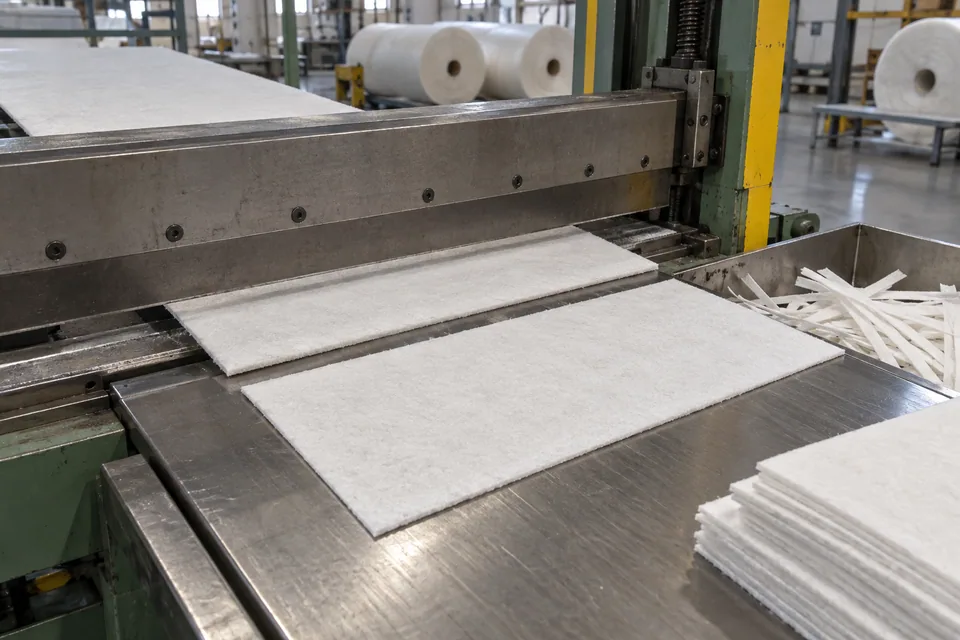
Trial a sheet shear or guided knife with the paper backed across its width. Check whether the blade produces a sharp rectangular end or pulls out fibers at the exit corner. Inspect the outgoing panel and the sheet edge left for the next cut.
Measure without crushing the sample
Check panel length, width, squareness and thickness under the buyer’s low-load measuring method. Inspect all four edges for crumbling, loose fiber and crushed corners. Keep first and later pieces so changing blade or support condition is visible.
Pack for apparatus assembly
Store panels flat in protective packaging and keep grade and lot information with each stack. The owner should test fit against real conductors or heating elements and perform dielectric and thermal verification under its system conditions.
Define the Required Cut Result
- Deliver released rectangular ceramic-paper panels.
- Keep corners and edges intact during cutting and transfer.
- Maintain nominal panel thickness near cut lines.
- Provide traceable samples for device qualification.
Problems to Diagnose Before Changing the Knife
Exit corner crumbles
- Review blade support and direction.
- Inspect the original sheet for weak areas.
Panels vary in length
- Check guide reference and material movement.
- Measure consecutive pieces.
Thickness falls near the cut edge
- Review compression by blade or hold-down.
- Compare to undisturbed central paper.
Knife Forms That May Be Considered
| Possible knife form | When it may be considered | What must be confirmed |
|---|---|---|
| Supported straight sheet shear | For a released rectangle in a specific ceramic-fiber paper grade. | Check four-edge integrity, dimensions and thickness. |
Information to Send for Technical Review
You do not need to know the exact blade name. Send the available workpiece, machine, current-knife and cut-result information so the application can be reviewed against a drawing or sample.
- Exact ceramic-paper product and datasheet
- Fiber composition and binder
- Sheet gauge and supplied dimensions
- Panel drawing and electrical clearance
- Allowed edge crumble and loose fibers
- Measurement load and support plan
- Flat protective packaging
- Apparatus insulation test responsibility
Questions About This Cutting Application
Does cut to size mean a finished electrical assembly?
No. These are flat panels that must be installed and tested.
Why use a gentle measurement method?
High pressure can compress fibrous paper and distort apparent thickness.
Can any hot gasket be used as electrical paper?
No. The exact grade and device requirements must be approved.
Does a straight panel need a die?
A supported straight cutter may be enough; trial the actual sheet.
What should be sent for review?
Provide a labeled sheet, panel drawing and edge criteria.
Public references and scope
These public sources provide material, cutting-method or safety context for this guide. Supplier pages describe their own materials or equipment; they do not establish a MEIRENTE blade specification or performance claim. Confirm the actual grade, machine setup and required cut with a drawing or sample.
Related product and service information
- Ceramic-Fiber Electrical Insulation Paper Precision-Trimming Blades - ceramic-fiber electrical insulation paper · precision trimming
- NMN Motor-Insulation Laminate Cut-to-Size Blades - NMN motor-insulation laminate · cut to size
- Polyimide-Mica Insulation Laminate Cut-to-Size Blades - polyimide-mica insulation laminate · cut to size
Request a Custom Cutting-Knife Review
Send the workpiece details, machine or holder information, current knife photos or sample, required quantity and examples of the present cut problem. Final dimensions, material, edge geometry and tolerances are confirmed from the approved requirements.