
Blade Application Guides / Application Guide / Electric vehicle battery manufacturing
Ceramic Battery Insulation Pad Contour-Cutting Blades
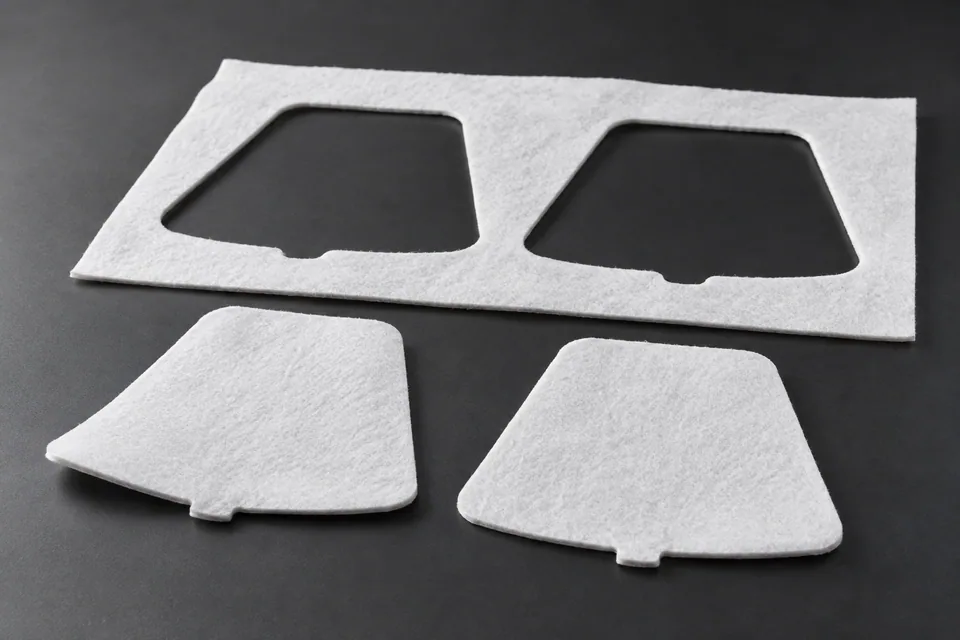
A ceramic battery insulation pad cut to a cell or module outline must survive internal slots, corners and part release without losing fibers or its required recovered thickness. The supplied grade may be a compressible ceramic-fiber mat with a facing; the grade and measurement load determine the trial. Evaluate the whole contour after ejection, especially narrow bridges and cutouts, and use the buyer’s separate methods for any thermal or electrical requirement.
Updated
Where This Cutting Application Appears
Start with the installed geometry
Identify pad edges that locate the part in the assembly and any slots that clear hardware. Put those datums on the finished drawing and flag thin ligaments where a compressible mat may tear or lose fibers during cutting.
Control hold-down and stroke
Compare cut order, backing and hold-down on the actual pad. Excess pressure can flatten a ceramic-fiber zone while too little support can leave an incomplete cut; record the applied restraint and recovery time.
Inspect after part release
Remove each internal slug before grading the part. Inspect the slot wall, outer corners and facing for fiber bridges, loose fibers or peeling, then measure the recovered outline and thickness under the buyer’s condition.
Account for matrix removal
Keep the cutout slugs and surrounding skeleton for diagnosis. Fibers bridging a slug or a ragged skeleton edge can reveal partial penetration even if the accepted part seems visually complete.
Material-specific acceptance
Check loose fibers at the cut and on the pad faces using the buyer's method. Record the thickness measurement load and recovery interval if the pad is compressible. Inspect any scrim or facing for lift. Test the smallest radius and internal slot on actual pad stock. Fiber bridging or a pulled facing may remain when the outer pad outline appears complete.
Define the Required Cut Result
- Meet the profile drawing at holes, corners and datums.
- Release parts without tears, trapped cutouts or ejection damage.
- Keep all layers continuous to the specified finished edge.
- Meet the buyer particulate and surface criteria.
- Check the supplied grade for fiber shedding, local compression or facing damage after normal handling.
Problems to Diagnose Before Changing the Knife
A corner tears or rounds beyond the drawing
- Inspect corner support and the blade tip.
- Review the sequence of outside and internal cuts.
- Compare actual part dimensions after release.
A small slug remains attached
- Check die engagement and slug-clearance path.
- Inspect the local support and waste exit.
- Verify that the accepted part is free of trapped fragments.
Parts shift relative to the drawing
- Check sheet registration and hold-down before blade contact.
- Compare first and last parts in the sheet.
- Look for slip or compression during ejection.
Ejector marks appear on an otherwise clean cut
- Separate cutting defects from release damage.
- Review contact area, pressure and matrix takeoff.
- Trial a lower-stress release method approved by the machine owner.
A cut pad sheds fibers or loses its facing
- Identify whether particles originate at the blade, support or handling path.
- Inspect blade condition and local compression at the cut.
- Ask whether the approved process requires edge sealing; do not assume every grade does.
Knife Forms That May Be Considered
| Possible knife form | When it may be considered | What must be confirmed |
|---|---|---|
| Profile die or shaped knife | For repeat profiles on a compatible die-cutting press. | Confirm outline, die mounting, clearance, hold-down and ejection from drawings and sample parts. |
| Programmable contour blade | For a compatible controlled-path cutter or changing part profiles. | Confirm blade path, tip geometry, support and corner performance on the actual sheet. |
Information to Send for Technical Review
You do not need to know the exact blade name. Send the available workpiece, machine, current-knife and cut-result information so the application can be reviewed against a drawing or sample.
- Ceramic fiber, filler and facing construction
- Pad thickness at the specified compression load
- Finished dimensions under the buyer measurement condition
- Loose-fiber and particle limits
- Approved pad sample and any edge-sealing requirement
- Dimensioned part drawing with holes and radii
- Stock orientation, support and hold-down details
- Machine or die mounting drawing
- Part and matrix removal method
- Accepted and rejected profile samples
Questions About This Cutting Application
Which pad features need the most attention?
Inspect the smallest slots and narrow bridges as well as the outer profile; these are common places to find fiber bridging or tearing.
How is a pad cutout accepted?
Confirm complete slug removal, inspect loose fibers and facing integrity, then measure the opening after the pad recovers.
Why measure after release?
Stripping and ejection can compress or distort a soft pad after the blade has made the contour.
Could a programmable cutter replace a die?
Possibly, if it supports the actual ceramic-fiber grade and produces the specified edge; compare methods with a sample trial.
Can uncompressed thickness alone qualify the part?
No. State the measurement load and recovery condition relevant to the intended assembly.
What should accompany the contour drawing?
Send the exact pad stock, facing orientation, slot and corner details, cutting support, and accepted fiber-shedding examples.
Public references and scope
These public sources provide material, cutting-method or safety context for this guide. Supplier pages describe their own materials or equipment; they do not establish a MEIRENTE blade specification or performance claim. Confirm the actual grade, machine setup and required cut with a drawing or sample.
Related product and service information
- Mica Battery Barrier Sheet Contour-Cutting Blades - mica battery barrier sheet · contour cutting
- Battery-Pack Flame Barrier Laminate Contour-Cutting Blades - battery-pack flame barrier laminate · contour cutting
- Cell-to-cell Aerogel Pad Contour-cutting Blades - cell-to-cell aerogel pad · contour cutting
Request a Custom Cutting-Knife Review
Send the workpiece details, machine or holder information, current knife photos or sample, required quantity and examples of the present cut problem. Final dimensions, material, edge geometry and tolerances are confirmed from the approved requirements.