
Blade Application Guides / Application Guide / Electric vehicle battery manufacturing
Cell-to-cell Aerogel Pad Sheet Slitting Blades
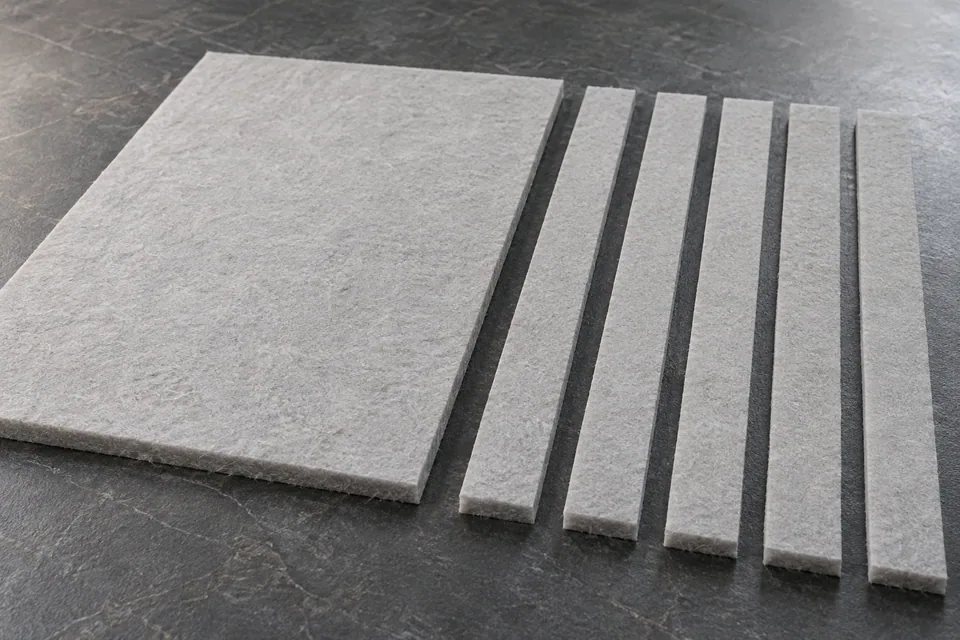
Sheet slitting converts a wider, flexible aerogel barrier sheet into narrower continuous lanes that may later become cell-to-cell pads. It is a longitudinal operation, so it should be specified only when the incoming stock has enough continuous width and the downstream layout needs lanes. Aspen describes cell barriers as engineered assemblies whose thickness, compression response and functional layers vary by design; its filings also describe cutting and lamination of aerogel products. The first trial must use the actual barrier construction, not a generic insulation blanket. Confirm whether skins, films or adhesive layers are present and whether a later profile cut remains to be done.
Updated
Where This Cutting Application Appears
Set lane width from cell layout
Calculate useful lane widths from the pad drawing and nesting plan, allowing separately for outside trim and any later contour cut. Measure lane width at the beginning, middle and end of a trial, and identify which face and machine direction each lane preserves.
Protect barrier layers
Support the sheet without crushing the aerogel region. If the stock has encapsulation or film facings, inspect for lifted edges after slitting. A dimensional pass does not excuse exposed core, loose particles or a peeled functional layer.
Separate narrow lanes
Review lane routing, tension and winding or stacking before selecting a knife arrangement. Unequal pull can curl or stretch one lane and change its later pad yield. Trial the smallest planned lane, because it may be hardest to transport cleanly.
Inspect after handling
Check the slit edge again after the lane is wound, stacked or transferred. Compare thickness and compression condition with an uncut control using the buyer’s method; avoid pressing a loose edge flat solely to make it appear acceptable.
Define the Required Cut Result
- Produce specified continuous lane widths for later pad conversion.
- Keep aerogel core and any facing layers bonded at the new edges.
- Limit visible shedding and prevent transfer of debris to cell-assembly surfaces.
- Preserve the specified thickness and compression response after handling.
Problems to Diagnose Before Changing the Knife
Edge sheds visible particles
- Compare incoming and slit edges.
- Review tool condition and support at the cutting line.
- Check whether waste handling or winding creates the debris.
Facing peels from the core
- Inspect layer stack and cut direction.
- Check clamp pressure and tension before and after the knives.
- Use a buyer-defined peel or visual criterion on trial lanes.
Lane width drifts
- Check sheet tracking and knife spacing.
- Compare measured width before and after winding.
- Record thickness and stiffness variation across the master sheet.
Knife Forms That May Be Considered
| Possible knife form | When it may be considered | What must be confirmed |
|---|---|---|
| Paired longitudinal slitting edges | When a supported continuous sheet must become two or more useful lanes. | Confirm blade form, support and downstream lane handling on the actual layered stock. |
| Single longitudinal knife with outside trim | When one useful lane and one sacrificial edge are required. | Confirm scrap routing and that the remaining lane is suitable for later contour cutting. |
Information to Send for Technical Review
You do not need to know the exact blade name. Send the available workpiece, machine, current-knife and cut-result information so the application can be reviewed against a drawing or sample.
- Actual aerogel barrier construction and layer stack
- Master sheet dimensions, thickness and feed orientation
- Lane widths and later pad drawing
- Buyer limits for edge shedding, layer lift and compression marks
- Contact-surface and winding or stacking arrangement
- Machine drawing, blade mounts and safe dust-control instructions
- Representative lot and accepted trial sample
Questions About This Cutting Application
Is a finished cell pad normally slit?
A finished individual pad is not continuous web stock. This guide applies to a wider sheet before final pad separation.
Can an industrial aerogel blanket be substituted for a cell barrier trial?
No. The EV barrier may have different facings, adhesive, thickness and compression behavior.
Does slitting establish final pad shape?
No. It creates longitudinal lanes; a later contour or cross cut may form the finished pad.
What is the main acceptance risk?
An edge can meet width while shedding material or opening the layer stack. Both dimensions and material integrity need review.
Public references and scope
These public sources provide material, cutting-method or safety context for this guide. Supplier pages describe their own materials or equipment; they do not establish a MEIRENTE blade specification or performance claim. Confirm the actual grade, machine setup and required cut with a drawing or sample.
Related product and service information
- Ceramic Battery Insulation Pad Edge-Trimming Blades - ceramic battery insulation pad · edge trimming
- Mica Battery Barrier Sheet Slitting Blades - mica battery barrier sheet · sheet slitting
- Battery-Pack Flame Barrier Laminate Sheet Slitting Blades - battery-pack flame barrier laminate · sheet slitting
Request a Custom Cutting-Knife Review
Send the workpiece details, machine or holder information, current knife photos or sample, required quantity and examples of the present cut problem. Final dimensions, material, edge geometry and tolerances are confirmed from the approved requirements.