
Blade Application Guides / Application Guide / Electric vehicle battery manufacturing
Mica Battery Barrier Sheet Slitting Blades
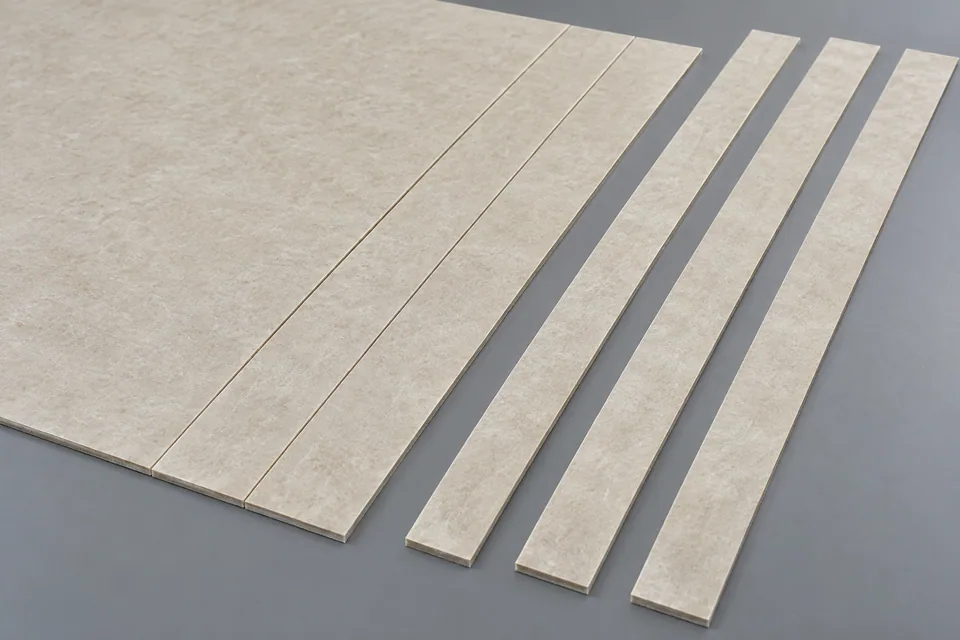
Battery mica barriers include rigid plates, flexible sheets and reinforced laminates. Lengthwise sheet slitting is a candidate for the supplied flexible, feedable grade, not a default route for a rigid plate. Lay out the useful strip widths before choosing a blade arrangement. During a trial, compare cracks, flaking and layer lift at each new edge and after strip collection. The buyer must separately validate electrical or thermal function of the converted part.
Updated
Where This Cutting Application Appears
Specify each strip position
Lay out each useful mica strip and the sacrificial outer margins on the parent sheet. If the stock is a laminated mica and glass-fleece construction, note the layer orientation and which face runs against the support; a center lane may fail differently from an outside lane.
Support both sides of the slit
Support the flexible or reinforced sheet close to each lengthwise cut and document which face contacts the backing. Compare blade exit on both faces; a fiber or mica layer can deflect while another separates. If the supplied grade is a rigid plate, require a separate straight-cut feasibility study rather than assuming continuous rotary slitting.
Measure the new edges
Measure the strip width and straightness at several points, then examine the newly exposed thickness edge for mica flakes, binder pullout or a lifted facing. Record which slit lane produced each sample so a local blade or support problem can be traced.
Keep finished strips identifiable
Collect strips without dragging the brittle edges across guides or one another. Reinspect after the buyer’s normal stack or reel handling and keep loose mica particles separate from accepted material; an apparently clean knife exit does not prove clean delivery.
Material-specific acceptance
Inspect both faces and the thickness edge for flakes, binder pullout and layer separation. If the part is used as an electrical barrier, the buyer must define any post-cut dielectric test and edge setback. Check whether rigid mica cracks across a strip and whether flexible or reinforced mica sheds flakes at each new longitudinal edge. Keep strip positions separate because edge quality may differ across the parent sheet.
Define the Required Cut Result
- Produce parallel strips within the buyer width and straightness limits.
- Meet the agreed edge-debris and layer-integrity criteria.
- Avoid marks, crushing and distortion through collection.
- Keep strip positions traceable during the trial.
- Check the supplied grade for flake release or a lifted mica layer after normal handling.
Problems to Diagnose Before Changing the Knife
Strip width drifts along the sheet
- Check sheet registration and lateral movement.
- Measure blade or spacer position and holder play.
- Compare the initial and final portions of the trial.
The cut edge differs between outer and center strips
- Check support and pressure at each knife position.
- Inspect individual blade condition and engagement.
- Compare thickness or construction variation across the parent sheet.
Strips curl or wrinkle after separation
- Locate the first point where distortion appears.
- Review tension, guides and winding or stacking method.
- Compare with an uncut sample from the same lot.
Narrow waste mixes with the accepted strips
- Review strip layout and waste-takeoff direction.
- Check whether the waste breaks during handling.
- Label and collect each fraction in the trial.
Mica flakes or a facing lifts at the cut
- Inspect the actual sheet construction and identify the layer that separates.
- Compare blade condition, support and cutting direction on matched samples.
- Check whether handling after cutting rather than the blade creates the visible defect.
Knife Forms That May Be Considered
| Possible knife form | When it may be considered | What must be confirmed |
|---|---|---|
| Paired circular slitter knives | For a continuous, flexible mica sheet or laminate that the buyer has qualified for rotary feed and longitudinal slitting. | Verify arbor, blade dimensions, side clearance and overlap from machine drawings and a sample cut. |
| Supported straight shear blades | For intermittent straight separation of a compatible supported sheet; confirm the grade tolerates a shear stroke. | Verify holder, support and cutting engagement on the installed machine. |
Information to Send for Technical Review
You do not need to know the exact blade name. Send the available workpiece, machine, current-knife and cut-result information so the application can be reviewed against a drawing or sample.
- Mica grade and rigid, flexible or composite construction
- Binder, facing and reinforcement description
- Material thickness and allowable variation
- Permitted loose flakes, edge cracks and delamination
- Approved material sample and finished-part drawing
- Parent-sheet size, feed direction and strip layout
- Slitter pair, arbor or shear-holder drawings
- Support, feed tension and collection method
- Accepted edge samples and inspection method
Questions About This Cutting Application
What does mica sheet slitting deliver?
It produces straight, continuous barrier strips. Supply the desired widths and parent-sheet layout so every slit lane and outer margin can be checked.
Why does the mica construction matter?
Rigid plates, flexible mica sheets and reinforced laminates respond differently to bending and blade pressure. Continuous slitting should be evaluated only on a feedable grade supplied with its layer orientation.
Where are trial samples taken?
Take samples from outer and center lanes at the start and later in the run, then compare them again after the normal collection path.
What edge defects deserve attention?
Look for cracks, loose mica flakes, pulled binder and facing lift along both sides of each longitudinal slit.
Does slitting verify dielectric or thermal protection?
No. Those properties belong to the specified material and assembled design; the buyer must define any functional test after conversion.
What information should accompany the RFQ?
Send the mica grade and sample, strip layout, support and blade-holder drawings, and examples of accepted and rejected slit edges.
Public references and scope
These public sources provide material, cutting-method or safety context for this guide. Supplier pages describe their own materials or equipment; they do not establish a MEIRENTE blade specification or performance claim. Confirm the actual grade, machine setup and required cut with a drawing or sample.
Related product and service information
- Automotive Radar-Absorber Sheet Precision-Trimming Blades - automotive radar-absorber sheet · precision trimming
- Ceramic Battery Insulation Pad Sheet Slitting Blades - ceramic battery insulation pad · sheet slitting
- Battery-Pack Flame Barrier Laminate Sheet Slitting Blades - battery-pack flame barrier laminate · sheet slitting
Request a Custom Cutting-Knife Review
Send the workpiece details, machine or holder information, current knife photos or sample, required quantity and examples of the present cut problem. Final dimensions, material, edge geometry and tolerances are confirmed from the approved requirements.