
Blade Application Guides / Application Guide / Electric vehicle battery manufacturing
Battery-Pack Flame Barrier Laminate Sheet Slitting Blades
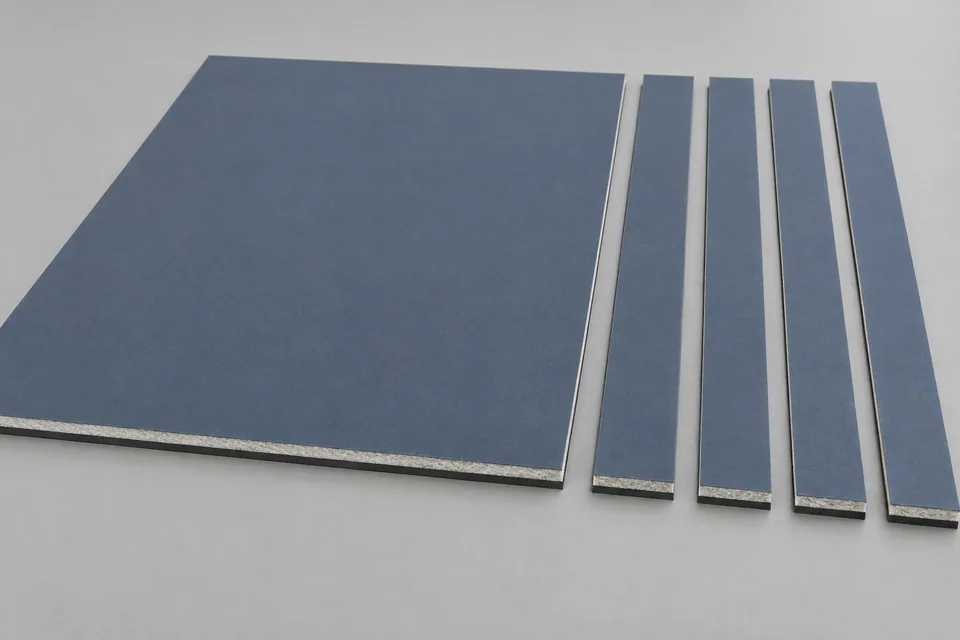
Sheet slitting creates parallel useful strips from a battery-pack flame-barrier laminate. LG Chem describes a battery barrier with laminated inorganic material, while Saint-Gobain documents a separate mica-and-foam battery pad; these are examples of different stacks, not interchangeable grades. The buyer’s actual layers control the cut. During a trial, measure each strip and check each exposed layer for recession, stretching, adhesive transfer where present, or loose material. Flame-barrier performance belongs to the specified material and tested assembly.
Updated
Where This Cutting Application Appears
Specify each strip position
Map the buyer’s laminate stack, layer orientation and strip schedule before setting knives. Mark the face that contacts the support and any removable liner; measure outer and center strips because layered edges may differ by lane.
Support both sides of the slit
Trial support and blade engagement that fully separate the supplied layers together. Compare both faces and a cross-section at knife exit. A soft foam or film facing may deform while a mica or other inorganic layer parts differently, leaving an offset edge; whether adhesive or a liner exists must come from the buyer’s stack drawing.
Measure the new edges
Measure strip width on both faces if layer recession is possible. Check for uncut backing, layer lift, debris, and adhesive strings only where the supplied laminate has adhesive. A straight visible edge can still hide a shifted interface.
Keep finished strips identifiable
Keep strip and waste paths separate through guides and collection. Recheck whether a liner peels, adhesive transfers or layers shift when a strip bends around a reel; record the handling condition for acceptance.
Material-specific acceptance
Inspect each layer at the new edge and compare the front and back faces for offset, incomplete separation or lift. Check loose fibers only if the actual grade contains a fibrous layer; check adhesive strings only if it has adhesive. Record layer orientation and any liner state during cutting and collection.
Define the Required Cut Result
- Produce parallel strips within the buyer width and straightness limits.
- Meet the agreed edge-debris and layer-integrity criteria.
- Avoid marks, crushing and distortion through collection.
- Keep strip positions traceable during the trial.
- Check the supplied grade for layer offset, uncut backing or delamination after normal handling.
Problems to Diagnose Before Changing the Knife
Strip width drifts along the sheet
- Check sheet registration and lateral movement.
- Measure blade or spacer position and holder play.
- Compare the initial and final portions of the trial.
The cut edge differs between outer and center strips
- Check support and pressure at each knife position.
- Inspect individual blade condition and engagement.
- Compare thickness or construction variation across the parent sheet.
Strips curl or wrinkle after separation
- Locate the first point where distortion appears.
- Review tension, guides and winding or stacking method.
- Compare with an uncut sample from the same lot.
Narrow waste mixes with the accepted strips
- Review strip layout and waste-takeoff direction.
- Check whether the waste breaks during handling.
- Label and collect each fraction in the trial.
One laminate layer extends past another at the edge
- Identify the lagging or stretched layer in a cross-section.
- Inspect blade engagement, support, web tension and layer orientation.
- Compare immediate and post-handling edges for delayed lift.
Knife Forms That May Be Considered
| Possible knife form | When it may be considered | What must be confirmed |
|---|---|---|
| Paired circular slitter knives | For a compatible continuous rotary sheet-slitting line. | Verify arbor, blade dimensions, side clearance and overlap from machine drawings and a sample cut. |
| Supported straight shear blades | For a compatible sheet line that makes straight parallel cuts with a shear. | Verify holder, support and cutting engagement on the installed machine. |
Information to Send for Technical Review
You do not need to know the exact blade name. Send the available workpiece, machine, current-knife and cut-result information so the application can be reviewed against a drawing or sample.
- Layer-by-layer construction, including adhesive and liner
- Total thickness and each layer thickness range
- Which face and orientation must meet the part drawing
- Allowed layer offset, edge lift and particle limits
- Approved material sample and assembly-specific acceptance criteria
- Parent-sheet size, feed direction and strip layout
- Slitter pair, arbor or shear-holder drawings
- Support, feed tension and collection method
- Accepted edge samples and inspection method
Questions About This Cutting Application
Why identify the layer stack before slitting?
A mica or other inorganic layer, a foam or film facing, and any liner can respond differently at a cut. The exact customer stack determines the blade trial and edge checks.
What is an offset laminate edge?
One constituent layer ends farther inboard or outboard than another after slitting; compare cross-sections on both faces.
Where should a laminate strip be sampled?
Sample each lane at knife exit and after guides or winding, preserving orientation and any liner state.
Can a good width reading hide a defect?
Yes. An uncut backing, adhesive string or recessed layer may remain even when the overall strip width is correct.
Does a neat slit establish a flame rating?
No. The buyer must evaluate the specified material and assembly by its applicable methods.
What must be supplied for a slitter review?
Provide the full stack-up, face and liner orientation, strip schedule, machine drawings and layer-specific edge acceptance.
Public references and scope
These public sources provide material, cutting-method or safety context for this guide. Supplier pages describe their own materials or equipment; they do not establish a MEIRENTE blade specification or performance claim. Confirm the actual grade, machine setup and required cut with a drawing or sample.
Related product and service information
- Busbar Insulation Laminate Sheet Slitting Blades - busbar insulation laminate · sheet slitting
- Mica Battery Barrier Sheet Slitting Blades - mica battery barrier sheet · sheet slitting
- Ceramic Battery Insulation Pad Sheet Slitting Blades - ceramic battery insulation pad · sheet slitting
Request a Custom Cutting-Knife Review
Send the workpiece details, machine or holder information, current knife photos or sample, required quantity and examples of the present cut problem. Final dimensions, material, edge geometry and tolerances are confirmed from the approved requirements.