
Blade Application Guides / Application Guide / Aerospace and structural composite preforming
Carbon Fiber Non-Crimp Fabric Ply Cutting Blades
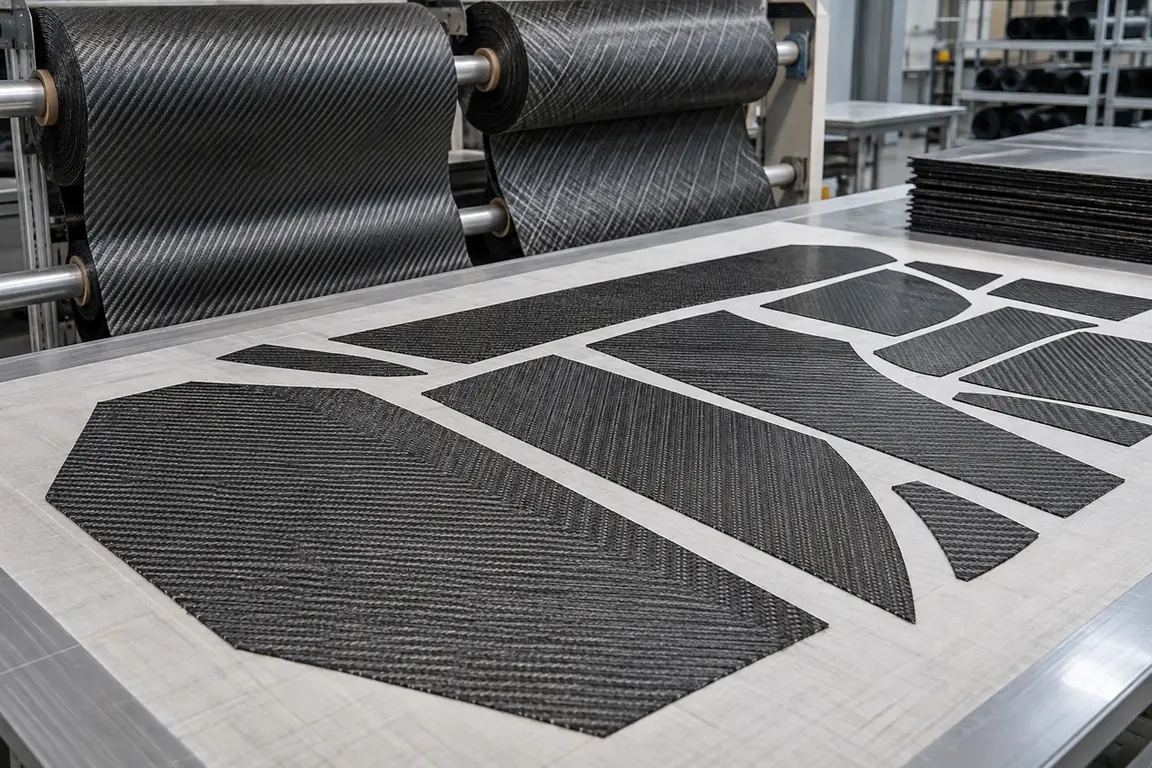
Carbon fiber non-crimp fabric ply cutting blades prepare dry multiaxial reinforcement for infusion, RTM and other composite preforming operations. Unlike tacky prepreg tape slitting, this application must control straight fiber bundles, stitching threads, multiple fiber orientations, ply registration and dry-fabric handling. Review should use the actual roll construction, approved ply geometry, orientation marks, support method and accepted edge condition.
Updated
Where This Cutting Application Appears
Preform ply profile preparation
Dry multiaxial fabric is cut to controlled ply shapes for later stacking, forming or infusion.
Roll-to-sheet reinforcement conversion
Master rolls are cross-cut into identified sheets while preserving orientation and layer alignment.
Development kit preparation
Representative ply sets are prepared to compare edge quality, handling and repeatability before production release.
Cross-Cutting And Profile Ply Cutting process boundary
Cross-cutting and profile ply cutting for Dry multiaxial carbon fiber non-crimp fabric is a linked sequence: the output condition and datum from each operation become the controlled input for the next. It should not be evaluated as one generic cut or accepted only by the final dimension.
Cross-Cutting And Profile Ply Cutting setup checkpoint
For Dry multiaxial carbon fiber non-crimp fabric, define the operation order, intermediate dimensions, registration transfer, material support, web or part handling and waste route for every stage of Cross-cutting and profile ply cutting.
Cross-Cutting And Profile Ply Cutting acceptance checkpoint
Verify both intermediate and final results from Cross-cutting and profile ply cutting, including dimensions, registration, edge or feature quality, material damage, waste separation and stable transfer between stages.
Define the Required Cut Result
- Controlled ply outlines without excessive tow pullout, spreading or local fiber displacement.
- Stitched layers remain aligned through straight edges, curves and profile transitions.
- Material orientation and ply identity remain traceable after cutting and collection.
- Clean handling without avoidable folds, contamination or distortion before layup.
Problems to Diagnose Before Changing the Knife
Carbon tows pull away from the profile edge
- Identify fiber directions intersected by each section of the approved profile.
- Review material support where tow movement first becomes visible.
- Compare edge behavior across the different layers in the supplied NCF construction.
Stitching remains connected across the cut
- Record the stitching direction and its position relative to the cut line.
- Inspect straight sections, corners and narrow transitions separately.
- Observe whether connection occurs during cutting or appears during ply lifting.
Ply shape distorts during unloading
- Confirm how the flexible ply is supported during measurement and transfer.
- Review pickup points, stacking sequence and orientation marking.
- Distinguish cutting inaccuracy from movement after the ply is released.
Loose carbon fibers contaminate the ply set
- Identify whether loose fibers originate at the edge or from general handling.
- Review cleaning, collection and interleaving before stacking.
- Apply the customer's accepted inspection method to representative ply sets.
Knife Forms That May Be Considered
| Possible knife form | When it may be considered | What must be confirmed |
|---|---|---|
| Supported profile cutting arrangement | For cutting defined dry NCF ply outlines on a flat supported cutting station. | Controlled drawing, fiber orientation, fabric construction, support, holding and pickup method. |
| Cross-cutting arrangement for roll-fed NCF | For preparing rectangular sheets or staged blanks from dry multiaxial fabric rolls. | Roll format, sheet layout, orientation reference, feed support and collection sequence. |
| Custom coordinated profile arrangement | When repeated profiles include curves, notches or transitions that cross several fiber directions. | Profile geometry, layer directions, stitching pattern, machine interface and accepted ply sample. |
Information to Send for Technical Review
You do not need to know the exact blade name. Send the available workpiece, machine, current-knife and cut-result information so the application can be reviewed against a drawing or sample.
- NCF product description, supplied roll construction and representative samples.
- Fiber orientations, layer order, stitching direction and marked material face.
- Controlled ply drawing, nesting layout and current revision.
- Roll direction, feed reference and required orientation marking method.
- Machine station, support surface, holding method and unloading sequence.
- Accepted and rejected ply edges showing tow movement or connected stitching.
- Cleanliness, stacking, interleaving and packaging requirements.
- Trial quantity, production repeat and current tooling information if available.
Questions About This Cutting Application
Is dry carbon NCF cutting the same as prepreg tape slitting?
No. Dry NCF contains aligned fiber layers and stitching without the same tacky resin handling behavior as prepreg tape.
Why must every fiber orientation be identified?
The cut intersects different tow directions around a profile, which can change edge movement and handling behavior.
How should a flexible ply be measured?
Use the customer's approved support and datum method so post-cut movement is not mistaken for cutting error.
What photographs are useful for review?
Show the full ply orientation and close views of straight edges, curves, notches, stitching and any displaced tows.
Can an unknown fabric construction be inferred from appearance?
No. Confirm layer directions and stitching from customer or supplier documentation and representative material.
Related product and service information
- Aramid Staple Fiber Bundle Cutting Blades - aramid staple fiber · bundle cutting
- Chopping Synthetic Staple Fiber Tow - synthetic staple fiber tow · high-frequency chopping
- Post-Industrial Textile Waste Cutting - post-industrial textile waste · fiber opening and cutting
Request a Custom Cutting-Knife Review
Send the workpiece details, machine or holder information, current knife photos or sample, required quantity and examples of the present cut problem. Final dimensions, material, edge geometry and tolerances are confirmed from the approved requirements.