
Blade Application Guides / Application Guide / Electric vehicle battery manufacturing
Busbar Insulation Laminate Sheet Slitting Blades
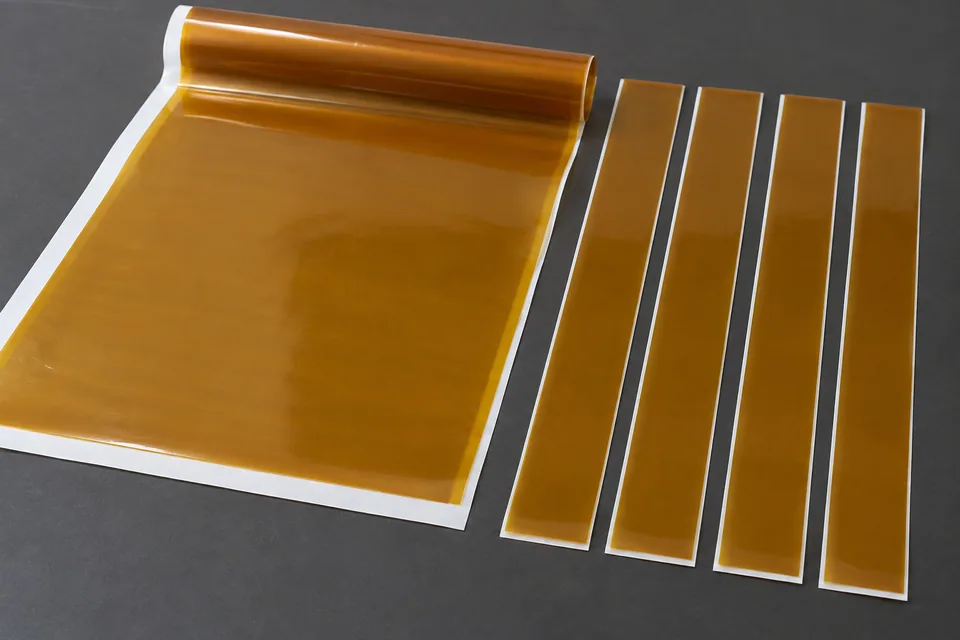
The subject here is a flexible insulation film laminate before it is bonded around a busbar, not a finished copper busbar assembly. Rogers explains that PET or polyimide films with adhesive can be applied to conductors during lamination, and that sealing around conductor edges matters to the final assembly. Sheet slitting divides a wide, continuous insulation laminate into narrower lanes along the feed direction. First identify the film, adhesive, release liner and winding orientation. The slit width should be derived from the conductor and overlap drawing, while electrical performance remains a separate qualification by the busbar owner.
Updated
Where This Cutting Application Appears
Calculate width from coverage
Define which surfaces of the conductor the film must cover and where the laminate must extend or seal. Set lane width from that construction, not merely from conductor width. Keep a documented allowance for bend or formed geometry where required by the buyer drawing.
Keep adhesive protected
Confirm whether the film has a release liner and whether it remains during slitting. Exposed adhesive can collect particles or transfer to guides. Inspect both the liner and adhesive edge after a trial, including any edge ooze or liner lift.
Separate and collect lanes
Set lane routing so adjacent strips do not touch adhesive edges. Inspect edge condition after winding or stacking, because blocking, telescoping or curl may start downstream of the knives rather than at the cut.
Check later lamination fit
Trial representative lanes on the intended conductor geometry. A strip can measure correctly while leaving inadequate overlap at a bend or leaving an exposed metal edge after heat and pressure. The busbar owner must confirm the final electrical test plan.
Define the Required Cut Result
- Produce continuous insulation lanes at drawing-controlled widths.
- Avoid adhesive contamination, edge ooze and liner damage.
- Maintain clean film edges without stretched or torn regions.
- Support later conductor coverage and sealing without claiming electrical certification.
Problems to Diagnose Before Changing the Knife
Slit edge curls or distorts
- Compare film and liner tension.
- Inspect blade contact and web support.
- Measure after the prescribed conditioning period.
Adhesive contaminates guides
- Confirm which face is exposed.
- Review liner integrity and roll path.
- Inspect for adhesive buildup at the cut and rewinder.
Strip fits a flat conductor but not a formed part
- Compare drawing revision and bend geometry.
- Review required wrap or overlap.
- Trial after the actual lamination step.
Knife Forms That May Be Considered
| Possible knife form | When it may be considered | What must be confirmed |
|---|---|---|
| Paired longitudinal slitter knives | When a wide supported laminate must become multiple continuous lanes. | Confirm layer stack, knife interface and adhesive/liner edge on actual stock. |
| Single longitudinal knife with edge trim | When one useful lane is cut beside a sacrificial outside margin. | Confirm waste collection and that the retained edge suits later lamination. |
Information to Send for Technical Review
You do not need to know the exact blade name. Send the available workpiece, machine, current-knife and cut-result information so the application can be reviewed against a drawing or sample.
- Film polymer, adhesive and release-liner construction
- Master width, thickness, roll orientation and splices
- Conductor and laminate drawings with coverage and overlap
- Required lane widths and permitted variation
- Accepted adhesive edge, liner and surface samples
- Slitter geometry, guides and rewinding path
- Downstream lamination and inspection plan
Questions About This Cutting Application
Is a laminated copper busbar itself sheet-slitted here?
No. This guide concerns flexible insulation stock before application to the conductor.
Does a clean slit prove electrical insulation?
No. Electrical qualification applies to the final busbar construction and its specified tests.
Why retain the liner during conversion?
A liner may protect adhesive and support handling, but the actual material supplier’s instructions determine whether it stays on.
What sample should be used?
Use the approved film, adhesive and liner construction from the intended supplier, plus the current conductor drawing.
Public references and scope
These public sources provide material, cutting-method or safety context for this guide. Supplier pages describe their own materials or equipment; they do not establish a MEIRENTE blade specification or performance claim. Confirm the actual grade, machine setup and required cut with a drawing or sample.
Related product and service information
- Cell-to-cell Aerogel Pad Sheet Slitting Blades - cell-to-cell aerogel pad · sheet slitting
- Mica Battery Barrier Sheet Slitting Blades - mica battery barrier sheet · sheet slitting
- Ceramic Battery Insulation Pad Sheet Slitting Blades - ceramic battery insulation pad · sheet slitting
Request a Custom Cutting-Knife Review
Send the workpiece details, machine or holder information, current knife photos or sample, required quantity and examples of the present cut problem. Final dimensions, material, edge geometry and tolerances are confirmed from the approved requirements.