
Blade Application Guides / Application Guide / Electric vehicle battery manufacturing
Ceramic Battery Insulation Pad Sheet Slitting Blades
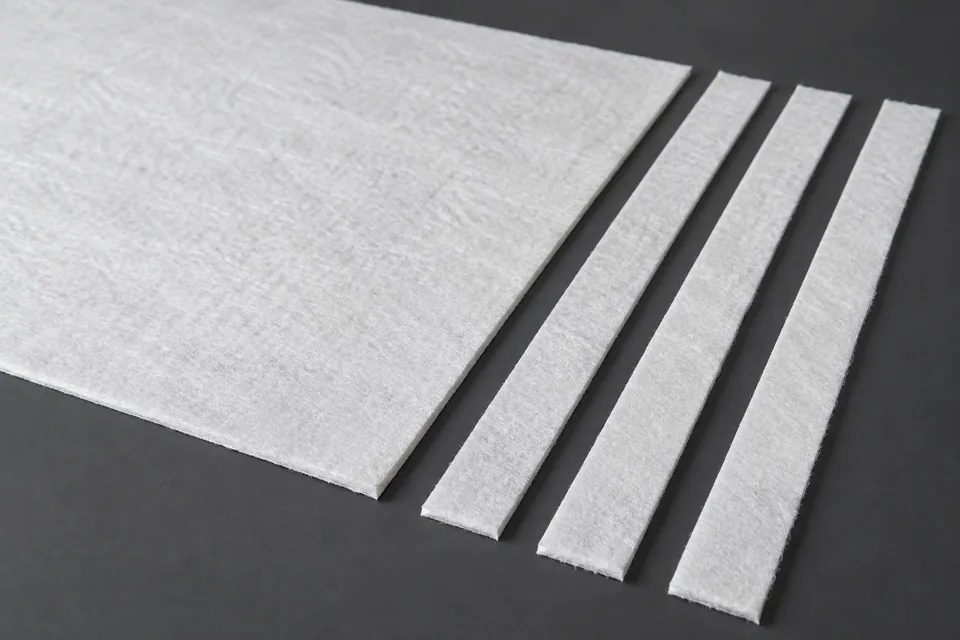
Slitting a ceramic fiber battery insulation pad into straight strips raises two linked questions: how the mat separates and how its compressible thickness is measured afterward. Supplier examples include ceramic-fiber matrix mats, but the exact buyer grade may have a facing or encapsulation. Trial the supplied pad under recorded support and compression conditions; compare strip width, exposed fibers and surface disturbance after handling. A cut edge alone does not establish thermal or electrical behavior in a battery.
Updated
Where This Cutting Application Appears
Specify each strip position
Plan all pad strips against the parent-sheet width and the buyer’s cell-gap layout. Mark any scrim or encapsulated face on the supplied sample, and retain outer and center lanes separately to detect a local edge-shedding pattern.
Support both sides of the slit
Record the hold-down load and backing under the blade. A compressible ceramic-fiber mat can rebound after the cut, so compare dimensions while restrained and after the buyer-defined recovery interval instead of assuming they match.
Measure the new edges
Inspect the exposed fiber edge and both pad faces for loose fibers, pulled facing or local thickness collapse. Measure width with a defined contact method and measure thickness under the buyer’s specified load.
Keep finished strips identifiable
Transfer slit pads through the normal tray, stack or packaging route before final inspection. Check whether friction dislodges fibers or crushes a strip edge, and keep lane identity for any failed sample.
Material-specific acceptance
Check loose fibers at the cut and on the pad faces using the buyer's method. Record the thickness measurement load and recovery interval if the pad is compressible. Inspect any scrim or facing for lift. A fibrous pad may compress under a slitter hold-down and expand after separation. Compare strip dimensions and edge fibers under the buyer-defined recovery and measurement condition.
Define the Required Cut Result
- Produce parallel strips within the buyer width and straightness limits.
- Meet the agreed edge-debris and layer-integrity criteria.
- Avoid marks, crushing and distortion through collection.
- Keep strip positions traceable during the trial.
- Check the supplied grade for fiber shedding, local compression or facing damage after normal handling.
Problems to Diagnose Before Changing the Knife
Strip width drifts along the sheet
- Check sheet registration and lateral movement.
- Measure blade or spacer position and holder play.
- Compare the initial and final portions of the trial.
The cut edge differs between outer and center strips
- Check support and pressure at each knife position.
- Inspect individual blade condition and engagement.
- Compare thickness or construction variation across the parent sheet.
Strips curl or wrinkle after separation
- Locate the first point where distortion appears.
- Review tension, guides and winding or stacking method.
- Compare with an uncut sample from the same lot.
Narrow waste mixes with the accepted strips
- Review strip layout and waste-takeoff direction.
- Check whether the waste breaks during handling.
- Label and collect each fraction in the trial.
A cut pad sheds fibers or loses its facing
- Identify whether particles originate at the blade, support or handling path.
- Inspect blade condition and local compression at the cut.
- Ask whether the approved process requires edge sealing; do not assume every grade does.
Knife Forms That May Be Considered
| Possible knife form | When it may be considered | What must be confirmed |
|---|---|---|
| Paired circular slitter knives | For a continuous ceramic-fiber pad grade that can be fed and supported without unacceptable compression or shedding. | Verify arbor, blade dimensions, side clearance and overlap from machine drawings and a sample cut. |
| Supported straight shear blades | For a compatible sheet line that makes straight parallel cuts with a shear. | Verify holder, support and cutting engagement on the installed machine. |
Information to Send for Technical Review
You do not need to know the exact blade name. Send the available workpiece, machine, current-knife and cut-result information so the application can be reviewed against a drawing or sample.
- Ceramic fiber, filler and facing construction
- Pad thickness at the specified compression load
- Finished dimensions under the buyer measurement condition
- Loose-fiber and particle limits
- Approved pad sample and any edge-sealing requirement
- Parent-sheet size, feed direction and strip layout
- Slitter pair, arbor or shear-holder drawings
- Support, feed tension and collection method
- Accepted edge samples and inspection method
Questions About This Cutting Application
How is the pad strip width defined?
Use the buyer’s finished width after a stated handling and recovery condition, with the parent-sheet layout identifying each lane.
Why record hold-down force?
A compressible ceramic-fiber mat can change thickness and apparent width when pressed; the trial needs repeatable restraint and measurement.
What should the edge inspection include?
Count or assess loose fibers by the buyer’s method and inspect any scrim or facing for pullback after normal handling.
Can a clean strip establish insulation performance?
No. Thermal and electrical claims require the specified material and assembly test, separate from dimensional cutting acceptance.
When should thickness be measured?
Use the buyer-defined measurement load and recovery interval after the pad has passed through normal collection.
What is needed to review a slitting tool?
Provide the exact pad grade, any facing or encapsulation, strip schedule, holder and backing details, and edge-shedding limits.
Public references and scope
These public sources provide material, cutting-method or safety context for this guide. Supplier pages describe their own materials or equipment; they do not establish a MEIRENTE blade specification or performance claim. Confirm the actual grade, machine setup and required cut with a drawing or sample.
Related product and service information
- Mica Battery Barrier Sheet Edge-Trimming Blades - mica battery barrier sheet · edge trimming
- Battery-Pack Flame Barrier Laminate Sheet Slitting Blades - battery-pack flame barrier laminate · sheet slitting
- Cell-to-cell Aerogel Pad Sheet Slitting Blades - cell-to-cell aerogel pad · sheet slitting
Request a Custom Cutting-Knife Review
Send the workpiece details, machine or holder information, current knife photos or sample, required quantity and examples of the present cut problem. Final dimensions, material, edge geometry and tolerances are confirmed from the approved requirements.