
Blade Application Guides / Application Guide / Flexible food packaging
BOPP Snack Packaging Film Razor Slitting Blades
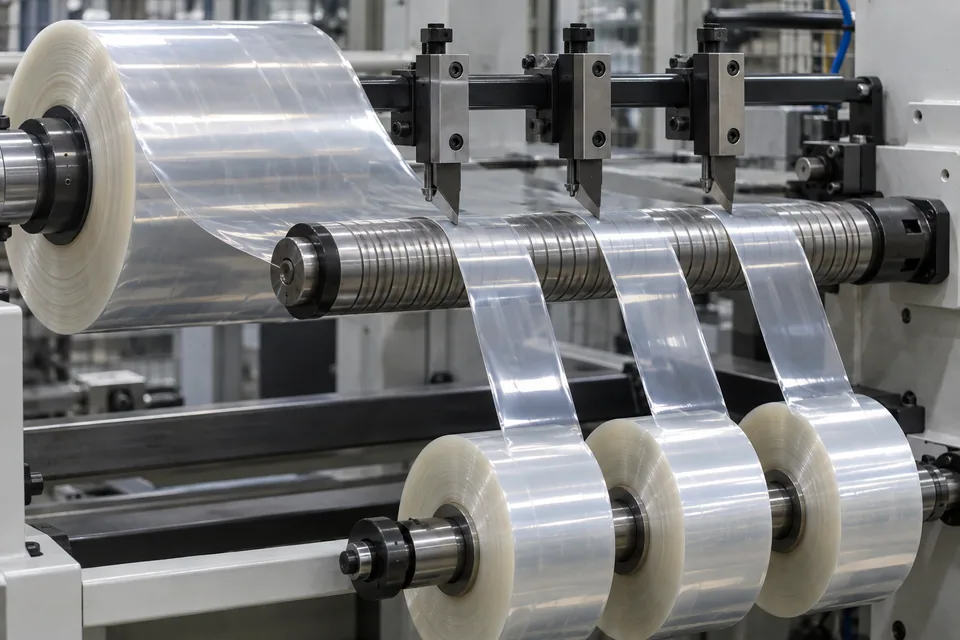
Biaxially oriented polypropylene (BOPP) is supplied as film for flexible packs, including snack applications. Jindal Films describes coated and uncoated BOPP packaging grades, and Kampf lists BOPP among film materials that its slitters can cut with razor or shear systems. A razor slit places a sharp stationary edge into a moving web to divide a parent roll into lanes; it is a candidate for a qualified grade, not a universal recipe. Clear, white, metallized and coated versions can present different face-contact and edge-inspection needs. The buyer should specify the actual construction and downstream form-fill-seal lane before tooling is selected.
Updated
Where This Cutting Application Appears
Build the slit map from the pack repeat
Set lane widths from the printed or unprinted web layout, machine direction and customer winding specification. If the web has register marks or an asymmetric coating, document which face must remain exposed on each finished roll. Keep sealing and print areas out of any sacrificial trim allowance.
Check razor contact on the actual grade
Use an approved short roll to compare cut quality with the incoming edge. Inspect for nicks, raised lips and whitening under consistent light. Film slip package and coating affect drag, so confirm blade angle and support by trial without assigning a generic fixed setting.
Observe lanes through rewinding
A slit can look straight at the knife yet show wander or telescoping in the finished roll. Record web tension, lane separation and edge-trim collection. Inspect whether static holds small film fragments on the pack surface or causes adjacent lanes to cling.
Hand off to packing-line qualification
Measure useful widths and inspect printed registration after winding and storage. The buyer then checks seal strength, barrier and machinability on its actual pack equipment; cutting alone does not establish those package properties.
Define the Required Cut Result
- Hold each BOPP lane to the buyer’s winding and print layout.
- Avoid edge nicks and coating scuffs at the razor.
- Remove narrow trim without redepositing slivers.
- Keep pack-performance tests with the buyer.
Problems to Diagnose Before Changing the Knife
Edge develops a repeated notch
- Inspect razor wear and local support.
- Compare notch spacing to roll or guide features.
- Check blade vibration at the web.
Metallized or coated face shows contact marks
- Identify the actual coating face.
- Inspect guide and knife-holder contact.
- Compare before-and-after samples under identical light.
Narrow lane telescopes on rewind
- Review tension taper and core grip.
- Check lane separation after the cut.
- Inspect parent-roll edge wander.
Knife Forms That May Be Considered
| Possible knife form | When it may be considered | What must be confirmed |
|---|---|---|
| Supported razor blade | For a BOPP grade that cuts cleanly under an approved web path. | Confirm edge, coating appearance and roll build on production-representative stock. |
| Paired rotary shear alternative | If razor drag or nicks do not meet buyer criteria. | Compare the same BOPP grade and winding conditions before changing the process. |
Information to Send for Technical Review
You do not need to know the exact blade name. Send the available workpiece, machine, current-knife and cut-result information so the application can be reviewed against a drawing or sample.
- Exact BOPP grade and supplier data
- Clear, coated, white or metallized construction
- Parent width and target lane map
- Print repeat and seal-zone layout
- Winding face and core details
- Approved edge-nick and surface criteria
- Razor holder and guide drawing
- Buyer pack sealing and barrier test plan
Questions About This Cutting Application
Can every BOPP snack film use the same razor?
No. Coating, gauge and winding behavior vary by grade; trial the supplied film.
Why inspect the printed or coated face?
A good edge can still accompany a scuff that interferes with graphics or later sealing.
What does the slitting inspection cover?
Width, visible edge defects, surface contact and wound-roll quality.
Does a clean slit prove shelf-life performance?
No. Barrier and package seals need buyer testing on completed packs.
What should the RFQ include?
Provide the actual roll, web layout, winding specification and accepted edge samples.
Public references and scope
These public sources provide material, cutting-method or safety context for this guide. Supplier pages describe their own materials or equipment; they do not establish a MEIRENTE blade specification or performance claim. Confirm the actual grade, machine setup and required cut with a drawing or sample.
Related product and service information
- BOPP Snack Packaging Film Shear Slitting Blades - BOPP snack packaging film · shear slitting
- CPP Heat-Seal Film Razor Slitting Blades - CPP heat-seal film · razor slitting
- Effervescent Tablet Sachet Laminate Razor Slitting Blades - effervescent tablet sachet laminate · razor slitting
Request a Custom Cutting-Knife Review
Send the workpiece details, machine or holder information, current knife photos or sample, required quantity and examples of the present cut problem. Final dimensions, material, edge geometry and tolerances are confirmed from the approved requirements.