
Blade Application Guides / Application Guide / Pharmaceutical packaging
Effervescent Tablet Sachet Laminate Shear Slitting Blades
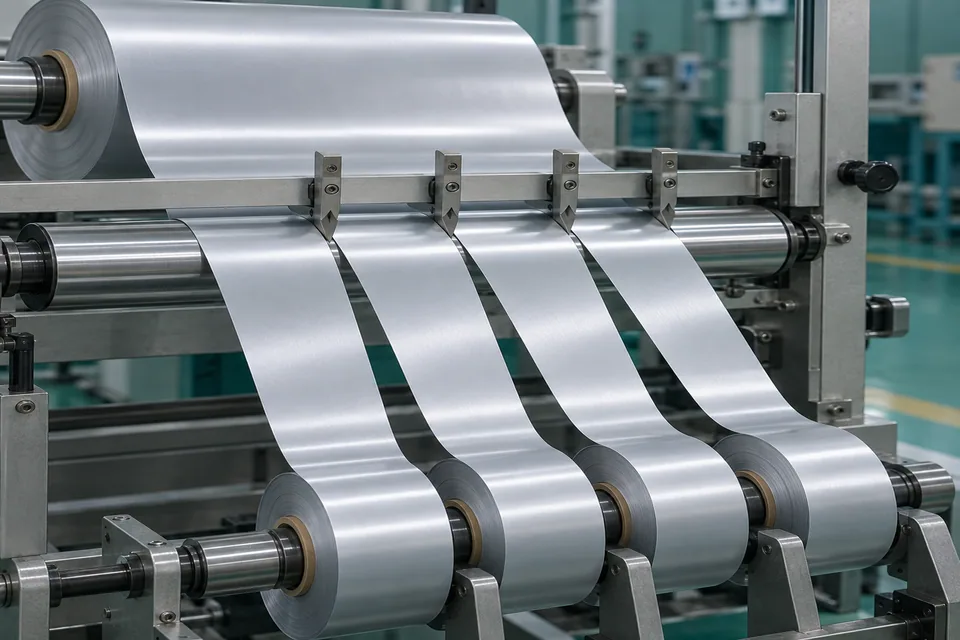
A sachet laminate for effervescent tablets can be a printed multilayer web with foil and a heat-sealable inner layer; its exact structure must come from the packaging owner. HERMES PHARMA and Tower Laboratories document foil formats used for this moisture-sensitive dosage form. Shear slitting divides an unfilled master web longitudinally by passing it between paired rotating edges, as DIENES describes. It is a different mechanics problem from pushing a stationary razor through the web: overlap, side clearance and drive slip can mark a sensitive foil edge. Select settings from machine and sample trials, not from generic pouch-film assumptions. The buyer then validates formed sachets for sealing and protection.
Updated
Where This Cutting Application Appears
Use the longitudinal seal as the datum
Set each slit from the printed sachet repeat, heat-seal band and tear-opening position. Record whether lane centerlines or outside edges drive registration on the filling machine. Measure after rewinding as well as directly at knife exit because a wound foil laminate can curl.
Match both rotary cutting members
Document top and bottom knife condition, diameter, overlap, side clearance, drive method and spacer sequence. Run short trial sections across the master width. Inspect whether the lower knife rubs a coated or printed face or a friction-driven top knife slips on the foil.
Grade both sides of every shear
Check aluminum burr or cracks, exposed paper fibers, delaminated adhesive and stretched sealant. The two edges produced by a shear pair can differ. Label samples by knife station and face so a later pinhole or leaky seal can be traced.
Check conversion through bag forming
Compare useful seal width and printed alignment after the slit lanes run through the intended forming shoulder and sealing jaws. Keep material conversion acceptance separate from pack leak or product stability testing. Reject lanes that satisfy width yet enter the longitudinal seal with particulate or foil damage.
Define the Required Cut Result
- Meet the lane schedule and print-to-seal clearance.
- Minimize foil burrs, cracking and paper dust on both shear sides.
- Keep the heat-seal layer continuous to the intended bag seam.
- Record knife-pair conditions for a reproducible buyer trial.
Problems to Diagnose Before Changing the Knife
One side carries more aluminum burr
- Compare upper/lower knife overlap and side clearance.
- Inspect wear or slip on that station.
- Review coil face orientation.
Seal-band width drifts along the run
- Check web guide and print-to-knife registration.
- Compare spacer stack with drawing.
- Measure lanes after rewind relaxation.
Paper dust appears despite a clean foil edge
- Inspect outer printed layer and knife friction.
- Check dust collection at the first guide.
- Compare the same material before slitting.
Knife Forms That May Be Considered
| Possible knife form | When it may be considered | What must be confirmed |
|---|---|---|
| Matched upper and lower circular shear knives | For continuous web conversion where the installed machine supports paired rotary edges. | Confirm arbor layout, drive, overlap and acceptable multilayer edge on actual stock. |
| Outside-edge rotary trim pair | Where one sacrificial margin is removed before useful lanes are wound. | Confirm trim-strip takeoff and retained seal margin separately. |
Information to Send for Technical Review
You do not need to know the exact blade name. Send the available workpiece, machine, current-knife and cut-result information so the application can be reviewed against a drawing or sample.
- Actual sachet laminate construction and layer thicknesses
- Master and finished lane widths
- Artwork, eye marks, seal lands and tear-feature drawing
- Upper and lower knife/arbor/spacer drawings
- Drive and side-clearance arrangement
- Accepted foil burr, paper dust and sealant-edge samples
- Winding tension and lane collection plan
- Buyer bag seal and barrier test criteria
Questions About This Cutting Application
How does shear differ from razor slitting?
A shear uses overlapping paired rotating edges; a razor presents one stationary edge to the web.
Which side of a shear slit should be inspected?
Both adjacent lane edges, because their burr and coating damage can differ.
Can a setting from plain PET be transferred?
No. Printed foil laminate needs its own trial for layer integrity and sealant behavior.
Does a specified width establish sachet quality?
No. Check print and seal clearances, then validate formed and sealed packages separately.
Why record the knife drive?
Slip or inconsistent rotation can rub a sensitive foil or printed face despite correct geometry.
Public references and scope
These public sources provide material, cutting-method or safety context for this guide. Supplier pages describe their own materials or equipment; they do not establish a MEIRENTE blade specification or performance claim. Confirm the actual grade, machine setup and required cut with a drawing or sample.
Related product and service information
- Pharmaceutical Desiccant Lidding Film Cross-Cutting Blades - pharmaceutical desiccant lidding film · cross cutting
- Unit-Dose Powder Stick-Pack Film Shear Slitting Blades - unit-dose powder stick-pack film · shear slitting
- Effervescent Tablet Sachet Laminate Razor Slitting Blades - effervescent tablet sachet laminate · razor slitting
Request a Custom Cutting-Knife Review
Send the workpiece details, machine or holder information, current knife photos or sample, required quantity and examples of the present cut problem. Final dimensions, material, edge geometry and tolerances are confirmed from the approved requirements.