
Blade Application Guides / Application Guide / bamboo panels and interior materials
Bamboo Veneer Sheet Trimming
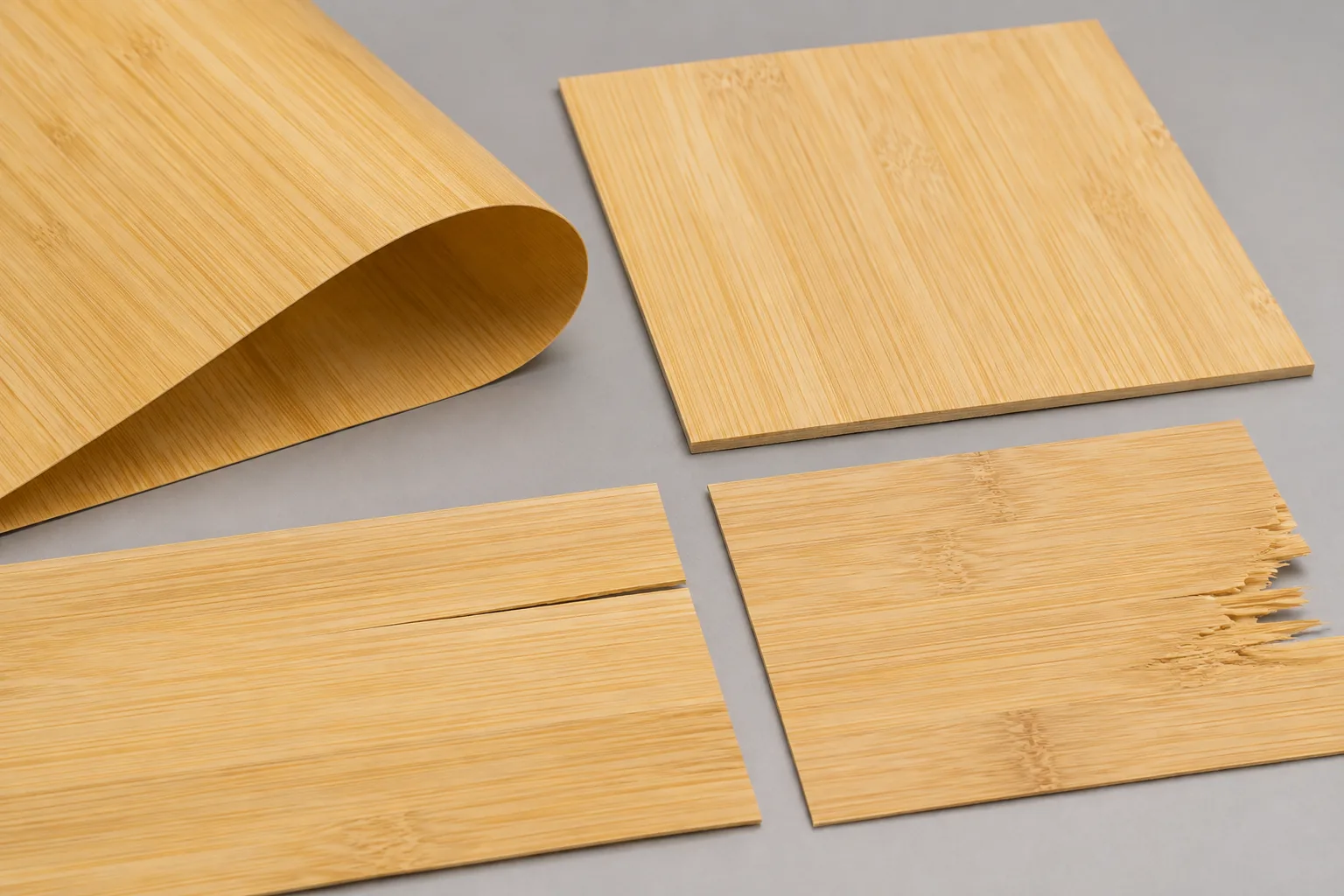
Bamboo veneer has strongly aligned fibers that can continue splitting beyond a poorly supported cut, while thin sheets may curl after slicing, drying or lamination. Knife selection therefore begins with the veneer construction, fiber direction and acceptable appearance on both faces, followed by the guillotine holder and bed geometry.
Updated
Where This Cutting Application Appears
Squaring sliced bamboo veneer
Trim irregular sheet ends after slicing and conditioning before grading, matching or panel lay-up.
Sizing backed bamboo surface sheets
Cut veneer bonded to paper, fleece or another stabilizing layer to the dimensions required for pressing or wrapping.
Preparing repair and inlay pieces
Produce smaller rectangular blanks where straight edges and controlled fiber ends aid alignment in decorative assemblies.
Guillotine Trimming And Sheet Sizing process boundary
guillotine trimming and sheet sizing for bamboo veneer sheets is a linked sequence: the output condition and datum from each operation become the controlled input for the next. It should not be evaluated as one generic cut or accepted only by the final dimension.
Guillotine Trimming And Sheet Sizing setup checkpoint
For bamboo veneer sheets, define the operation order, intermediate dimensions, registration transfer, material support, web or part handling and waste route for every stage of guillotine trimming and sheet sizing.
Guillotine Trimming And Sheet Sizing acceptance checkpoint
Verify both intermediate and final results from guillotine trimming and sheet sizing, including dimensions, registration, edge or feature quality, material damage, waste separation and stable transfer between stages.
Define the Required Cut Result
- A straight cut that stops at the intended line instead of following a fiber bundle
- Low breakout on the supported and exit faces
- Repeatable sheet dimensions without buckling or shifting
- Stable cut quality across natural and reconstructed bamboo veneer constructions
Problems to Diagnose Before Changing the Knife
Long splits continue beyond the trimmed edge
Mark fiber direction and split origin, then review hold-down distance, bevel orientation, penetration and existing edge checks.
Fibers pull out on the exit face
Inspect bed condition, local support, knife sharpness, sheet moisture and whether backing layers are fully bonded.
Curled sheets move during sizing
Measure free-state curl and check how the machine flattens, locates and clamps the veneer before the cutting stroke.
Cut quality deteriorates unevenly across the width
Compare wear locations with denser fiber bands, laminated joints, adhesive residue, natural mineral content and holder alignment.
Knife Forms That May Be Considered
| Possible knife form | When it may be considered | What must be confirmed |
|---|---|---|
| straight guillotine knife | A full-width straight knife can suit cross-trimming when the sheet is clamped close to a firm cutting bed. | Confirm knife length, section, mounting holes, bevel face, stroke direction and mating bed from the machine drawing and used sample. |
| straight shear knife | A shear arrangement may suit equipment that separates backed or slightly thicker bamboo veneer against a defined counter-edge. | Confirm rake, working clearance, moving and fixed components, datum faces and adjustment method before defining the pair. |
Information to Send for Technical Review
You do not need to know the exact blade name. Send the available workpiece, machine, current-knife and cut-result information so the application can be reviewed against a drawing or sample.
- Bamboo veneer type: natural, reconstructed, laminated or backed
- Nominal thickness and measured thickness variation
- Fiber direction relative to each required cut
- Moisture or conditioning state at the trimming station
- Sheet width, target dimensions and allowed edge defects
- Free-state curl, stacking method and maximum sheets per cut
- Machine, holder and cutting-bed drawings plus a used knife where available
- Accepted and rejected samples showing both faces and the direction in which splitting began
Questions About This Cutting Application
Why can a bamboo veneer split past the cutting line?
Strong longitudinal fibers can redirect a wedging cut, especially when support or hold-down is distant. Mark the fiber direction and compare bevel orientation and exit support.
Does reconstructed bamboo veneer cut like natural bamboo veneer?
Not necessarily. Fiber arrangement, resin, joints and backing may change cutting resistance and wear. Identify the actual construction rather than using bamboo thickness alone.
Which face should be placed against the cutting bed?
The choice depends on bevel direction, visible-face requirements and machine motion. Trial both orientations when the equipment permits and retain labelled cut samples.
Can sheet curl be corrected by changing the knife?
A knife change cannot reliably correct poor registration. First review conditioning, flattening, guides and hold-down; then assess whether cutting force is adding movement.
What is needed to reproduce an existing bamboo veneer knife?
Provide the used knife, complete holder dimensions, bevel and installation orientation, cutting-bed details, veneer samples and an approved drawing before production.
Related product and service information
- Cutting Laminate Flooring Planks - laminate flooring planks · cross-cutting and end sizing
- Clipping Natural Wood Veneer Sheets - natural wood veneer sheets · clipping and edge joint preparation
- Trimming Plywood Panel Edges - plywood panels · panel edge trimming
Request a Custom Cutting-Knife Review
Send the workpiece details, machine or holder information, current knife photos or sample, required quantity and examples of the present cut problem. Final dimensions, material, edge geometry and tolerances are confirmed from the approved requirements.