
Blade Application Guides / Application Guide / Technical films
Anti-Static Protective Film Cross Cutting
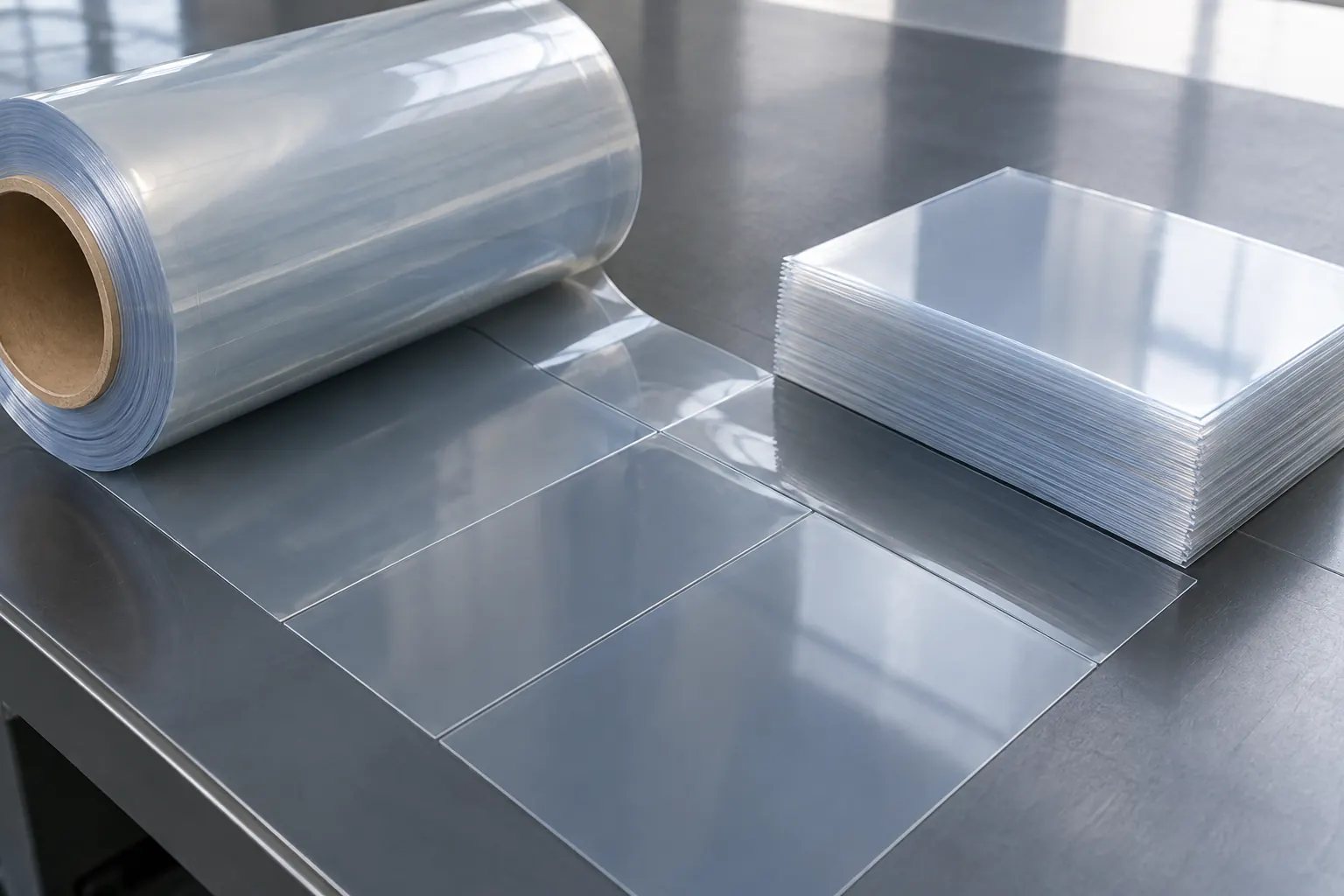
Cross-cut anti-static protective film is supplied as masking sheets, interleaves or process blanks for charge-sensitive surfaces. Thin films can cling or scatter at discharge, while adhesive constructions may curl or expose sticky edges. The finished sheet must be evaluated for dimensions, cleanliness and electrical surface behavior after cutting.
Where This Cutting Application Appears
Display and panel masking sheets
Prepare clean protective blanks sized for charge-sensitive surfaces.
Electronic component interleaves
Cut nonadhesive antistatic sheets for separation and handling.
Cleanroom process blanks
Produce controlled-size film pieces with low particle burden and stable handling.
Common Ways to Describe This Cutting Problem
- anti-static protective film cross-cutting blades
- ESD protection film transverse cutoff knife
- cleanroom antistatic film roll to sheet cutting
- cross cut electronics masking film blanks
- static safe protective film sheet conversion
- prevent particle attraction in ESD film sheets
- adhesive antistatic film length cutting
- dimensionally stable anti-static interleaf cutting
Define the Required Cut Result
- Hold sheet length and squareness after relaxation.
- Control electrostatic charge during discharge and stacking.
- Keep adhesive, liner and treatment edges clean and aligned.
- Avoid curl, creases, burrs and attracted particles.
Problems to Diagnose Before Changing the Knife
Sheets cling or fly during discharge
- Measure charge polarity and level.
- Check grounding, ionization and humidity.
- Review sheet velocity and collection geometry.
Particles accumulate along cutoff edge
- Identify cut debris versus ambient dust.
- Inspect static field and extraction.
- Compare treated-face orientation.
Adhesive sheet curls after separation
- Review carrier, adhesive and liner stress balance.
- Mark winding direction.
- Condition before measurement.
Surface resistance test becomes inconsistent
- Standardize conditioning and test method.
- Check contact contamination.
- Map results away from and near the cut edge.
Knife Forms That May Be Considered
| Possible knife form | When it may be considered | What must be confirmed |
|---|---|---|
| Straight cross-cut arrangement | For roll-to-sheet conversion against a controlled support or counter-edge. | Confirm motion, support, holder, rake, grounding, cleanability and sheet dimensions. |
| Rotary cutoff arrangement | For repeated high-speed antistatic-film lengths with synchronized discharge. | Confirm repeat, cylinder interface, speed, ionization, collection and dimensional tolerance. |
Information to Send for Technical Review
You do not need to know the exact blade name. Send the available workpiece, machine, current-knife and cut-result information so the application can be reviewed against a drawing or sample.
- Carrier, gauge, anti-static treatment and specified property range
- Adhesive and liner construction where applicable
- Treatment face, winding direction and allowed contact surfaces
- Sheet width, length, squareness and conditioned tolerance
- Speed, feed, tension, grounding, ionization and humidity
- Cutting motion, support, holder drawing and used sample
- Particle, curl, adhesive exposure and electrical test limits
- Sheet collection, clean packing, end-use environment and volume
Questions About This Cutting Application
Why do antistatic sheets still cling?
Antistatic performance has limits, and charge can still arise from separation speed, contact materials, humidity and grounding.
How should electrical performance be checked?
Use the customer's specified method after controlled conditioning and protect samples from contamination.
Can ionization solve sheet curl?
No. Ionization addresses charge; curl usually relates to layer stress, roll memory and handling.
Why inspect near-edge resistance?
Treatment coverage or cutting contact may differ near the perimeter from the center of the web.
What makes a useful cutoff trial?
Measure dimensions, charge, particle level, stack separation, curl and performance on the protected surface.
Request a Custom Cutting-Knife Review
Send the workpiece details, machine or holder information, current knife photos or sample, required quantity and examples of the present cut problem. Final dimensions, material, edge geometry and tolerances are confirmed from the approved requirements.